Immune cells that normally protect the body from infection can also drive the progression of some early breast cancers, McGill University researchers have found.
The discovery points to a potential way of distinguishing relatively harmless cases of ductal carcinoma in situ (DCIS) from those most likely to become invasive, one of the biggest challenges in breast cancer care.
DCIS is an early form of breast cancer that accounts for roughly one-fifth to one-third of cancers detected through screening.
“Many patients diagnosed with DCIS face difficult treatment decisions because we can’t reliably predict which lesions will progress,” said lead author Tarek Taifour, an M.D.-Ph.D. student in McGill’s Department of Medicine. “We’ve identified a mechanism that brings us a step closer to identifying those at highest risk.”
How cancer hijacks the immune system
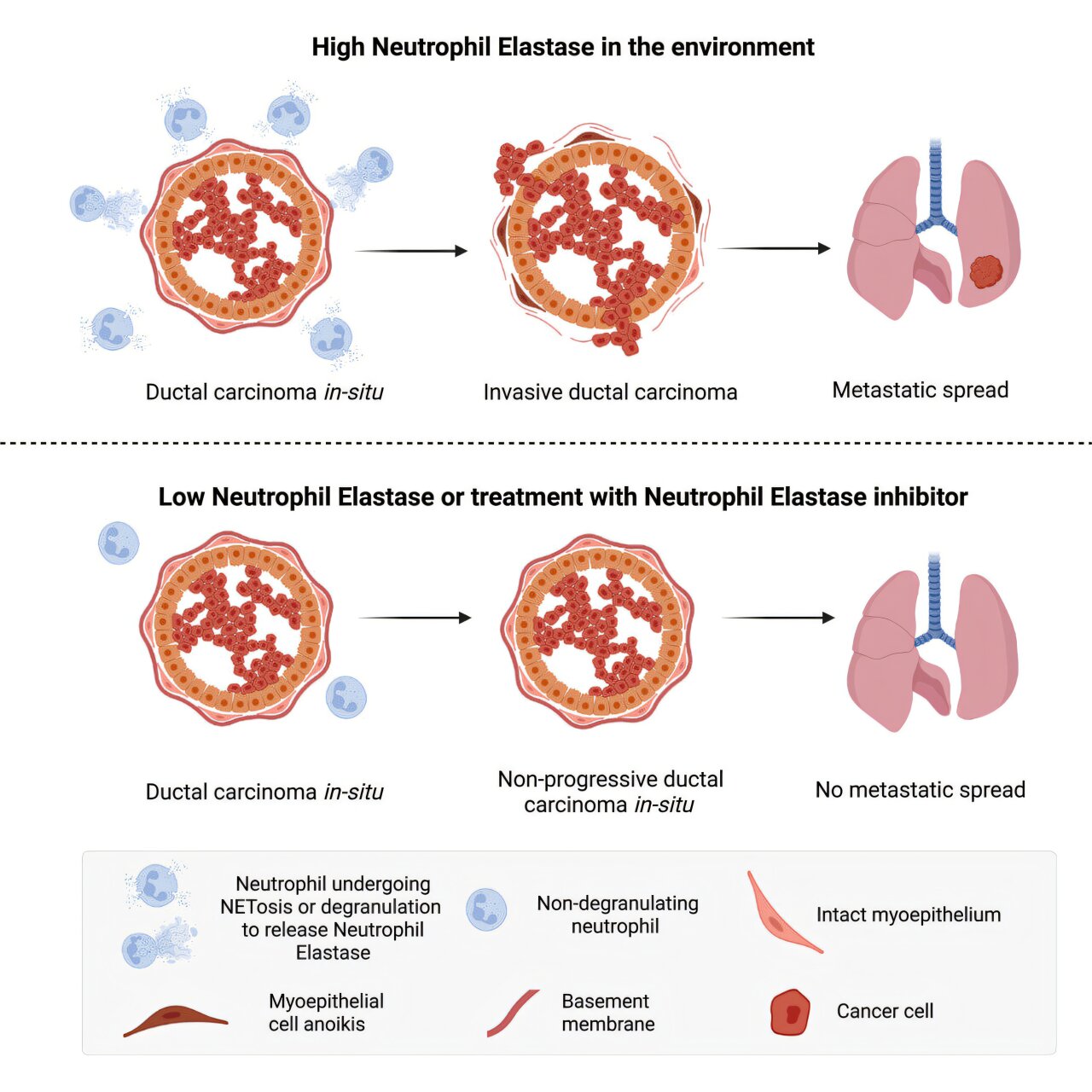
DCIS is normally held in check by a thin layer of cells that acts like a protective barrier, preventing cancer cells from spreading into nearby tissue.
Researchers studied the disease in mice, human breast tissue samples and 3D tumor models grown in the lab to understand how some cancers break through the barrier.
Results published in Cell Reports Medicine point to an unexpected role of the immune system.
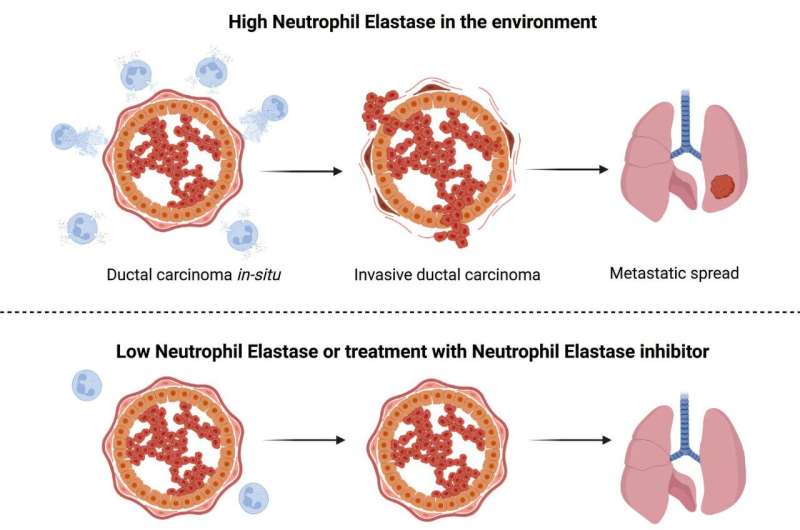
Neutrophils—immune cells best known for fighting infection—release an enzyme called neutrophil elastase that weakens this barrier, the study found. When researchers blocked either the cells or the enzyme, the protective barrier remained intact.
“Cancer can sometimes hijack normal immune processes and turn them into processes that help disease progress. This appears to be an example of that,” said senior author William Muller, professor in McGill’s Department of Biochemistry.
Step toward personalized medicine
Many patients diagnosed with DCIS undergo surgery, radiation or other treatments without knowing whether their lesions would have ever become dangerous.
The findings suggest neutrophil elastase could one day serve as a biomarker, helping doctors tailor treatment to a patient’s risk and avoid unnecessary treatment for those whose cancer is unlikely to progress.
The study was the product of collaboration among researchers across McGill, including the labs of Morag Park, Luke McCaffrey and Peter Siegel, as well as partners at the University of Texas.
Publication details
Tarek Taifour et al., Neutrophil elastase-mediated myoepithelial loss is a therapeutic vulnerability in ductal carcinoma in situ progression, Cell Reports Medicine (2026). DOI: 10.1016/j.xcrm.2026.103050
Journal information:
Cell Reports Medicine
Key medical concepts
Clinical categories


Citation:
Immune mechanism discovery could help predict which early breast cancers will spread (2026, October 20)
retrieved 20 October 2026
from https://medicalxpress.com/news/2026-10-immune-mechanism-discovery-early-breast.html
This document is subject to copyright. Apart from any fair dealing for the purpose of private study or research, no
part may be reproduced without the written permission. The content is provided for information purposes only.