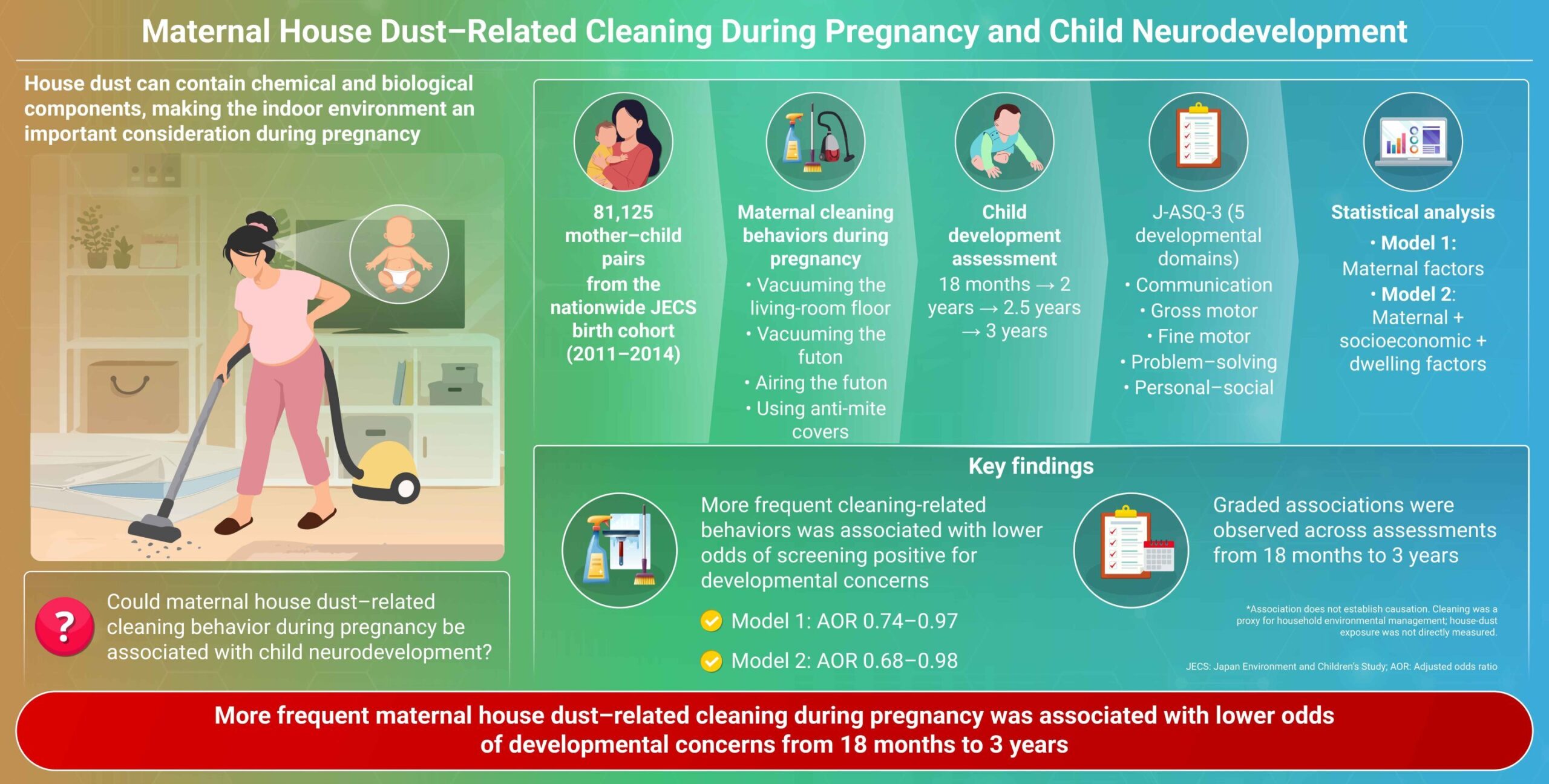

Residence dust can have chemical and biological components, including phthalates, fire resistants, allergens, endotoxins and microorganisms. Since pregnant ladies spend time indoors, home environmental problems while pregnant might relate to youngster development.
Earlier study connected mother’s cleaning habits with infant advancement as much as 12 months, however proof past the first year was limited. The researchers as a result analyzed whether these behaviors were related to developing testing outcomes from 18 months to 3 years old.
To address this gap, a study team led by specially assigned aide teacher Kanako Shimada of the Toyama Regional Center for JECS at the College of Toyama, Japan, conducted the research study in collaboration with scientists from the university’s Department of Public Health And Wellness.
They evaluated information from 81, 125 mom– youngster pairs participating in the Japan Environment and Children’s Study, an across the country birth friend.
Mommies reported exactly how typically they vacuumed living space floorings and futons and broadcast futons while pregnant, as well as whether they used anti-mite covers for their futons or bed linen. Child growth was evaluated at 1 5, 2.0, 2 5 and 3.0 years making use of the Japanese Ages and Stages Questionnaires, Third Version (J-ASQ- 3, covering 5 developing domain names: interaction, gross electric motor, great motor, analytic and individual– social.
Generalized straight models were used to approximate modified odds proportions (AORs); Model 1 accounted for mother’s variables, and Design 2 additionally represented socioeconomic and home atmosphere aspects.
Their searchings for were published online in the journal BMC Pediatrics on Sept. 3, 2026 [
***************]
Across all four analysis ages, higher frequencies of residence dirt– relevant cleansing behaviors were associated with lower probabilities of screening positive for developing worries. In Version 1, changed chances proportions ranged from 0. 74 to 0. 97, while Design 2 produced a variety of 0. 68 to 0. 98
A graded association was observed, with higher frequencies of cleaning-related habits associated with gradually lower probabilities of screening favorable for developmental worries.
“Our previous research found an association between maternal cleaning actions during pregnancy and child development approximately 1 year old. Nevertheless, it remained uncertain whether these organizations expanded beyond infancy,” claims Shimada. “We therefore analyzed the organizations in between these behaviors and developmental screening end results from 18 months to 3 years old.”
The findings might be relevant to household ecological administration during pregnancy, especially actions such as routine vacuuming, broadcasting futons and making use of anti-mite covers. Nonetheless, the study did not directly determine house dirt or environmental pollutants.
The cleaning behaviors were utilized as proxy signs of family environmental management, so the researchers can not figure out whether the organizations reflected reduced direct exposure to chemical impurities, allergens, particle matter, microbial components or various other facets of the indoor environment. The observed organizations were likewise small, with changed chances ratios close to unity.
“More research is required to better recognize the elements underlying these associations. Research studies using unbiased measures of the home setting will be especially vital in establishing what may explain the observed organizations,” states Shimada.
Importantly, the searchings for show an association, not a causal partnership, between maternal cleaning actions and developing testing outcomes.
On the whole, the research study prolongs previous searchings for by showing that mother’s house dust– relevant cleansing actions during pregnancy were associated with developing testing results throughout multiple time factors from 18 months to 3 years. The results need to not be interpreted as evidence that cleaning itself directly lowers developmental risk.
Differences in caregiving, health-related habits, socioeconomic scenarios, postnatal atmospheres and various other unmeasured factors might contribute to the associations. The researchers highlight the demand for research studies integrating objective ecological measurements, such as dirt sampling or biomonitoring, in addition to replication in varied social and environmental setups, to clear up the underlying systems and generalizability.
Publication details
Kanako Shimada et alia, Mother’s house dust– relevant cleaning habits while pregnant and neurodevelopment from 18 months to 3 years of age in the Japan Setting and Kid’s Research study, BMC Pediatrics (2026 DOI: 10 1186/ s 12887 – 026 – 07588 – 7
Journal info: BMC Pediatric medicines
Trick clinical ideas


Citation :
Maternal house cleaning actions during pregnancy associated with kid developmental screening outcomes (2026, October 9
gotten 9 October 2026 from https://medicalxpress.com/news/ 2026 – 10 -maternal-house-behaviors-pregnancy-child. html.
This paper is subject to copyright. Apart from any kind of fair dealing for the purpose of personal research study or research study, no.
part may be replicated without the composed consent. The material is provided for information purposes only.