Adapting to changing situations requires people to continuously revise their expectations about what might happen next when new information becomes available. These expectations are believed to be represented by mental models that help the brain predict outcomes and plan future behavior.
The contribution of different brain regions to the updating of expectations in changing circumstances has not yet been clearly delineated. One brain region that could play a role and yet remains poorly understood is the claustrum, a thin sheet of nerve cells deep inside the brain.
Researchers at Yale University and other institutions recently carried out a study investigating the possible contribution of the claustrum to aversive learning, the process through which humans and other animals learn about unpleasant outcomes in specific situations. Their findings, published in Nature Neuroscience, suggest that neurons in this brain region track uncertainty about outcomes and prediction error (i.e., the difference between an expected outcome and what ultimately happens) during aversive learning.
“The claustrum, which is reciprocally connected to nearly the entire neocortex, is uniquely positioned to influence cortical processing,” wrote Mingyue Hu, Rodrigo Dalvit and their colleagues in their paper. “We report single-neuron recordings from the human claustrum during aversive learning, with anterior cingulate cortex and amygdala recordings for comparison.”
Recording neurons in the claustrum during aversive learning
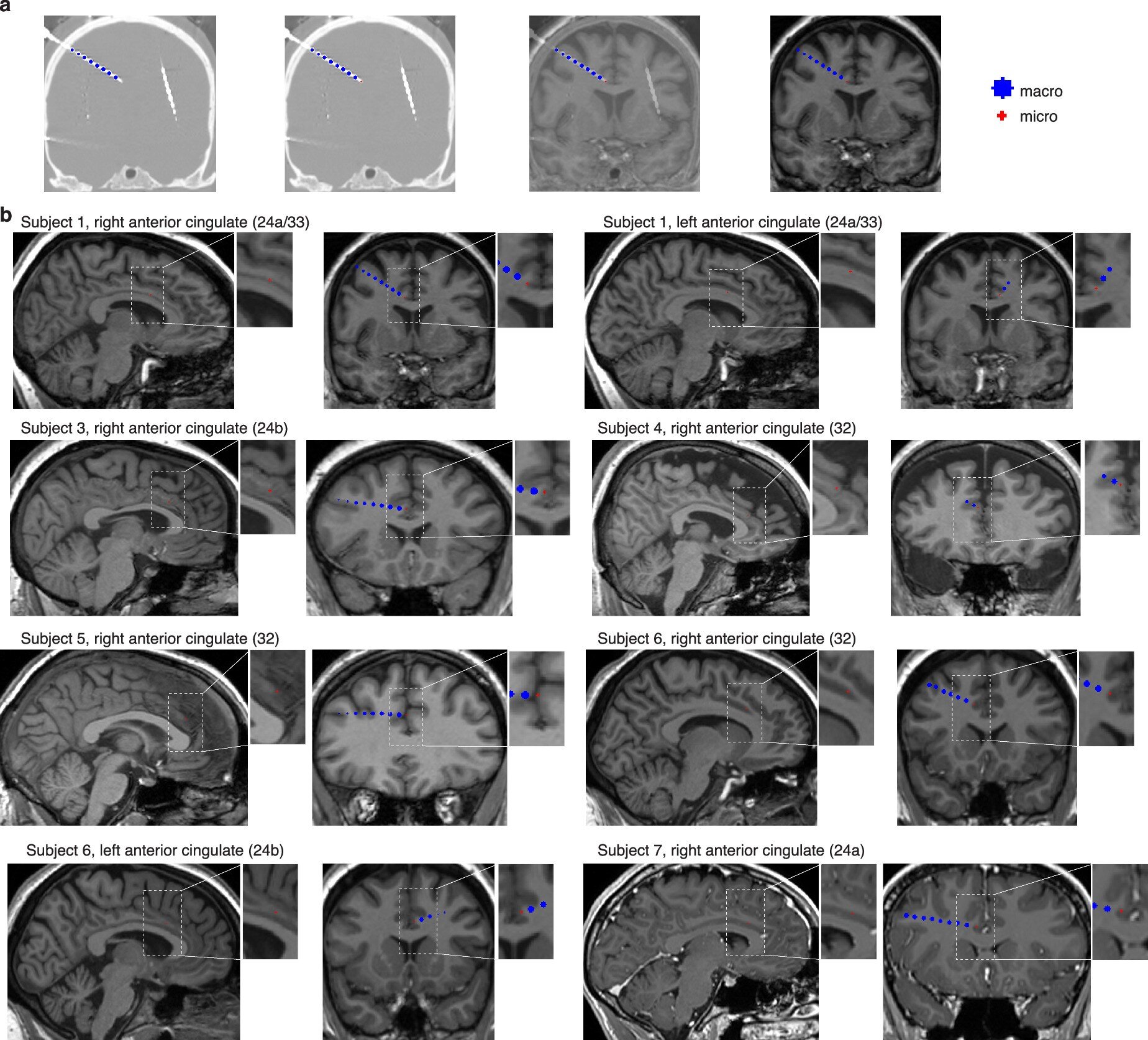
Hu, Dalvit and their colleagues recorded the activity of individual neurons using electrodes that had been implanted in the brains of seven patients with epilepsy as part of clinical monitoring to identify where their seizures began. They specifically monitored neurons in the claustrum, the anterior cingulate cortex, which helps to monitor outcomes and guide behavior, and the amygdala, which contributes to processing emotions and learning about threats. Not every participant had recordings from all three regions.
While they were collecting their recordings, the participants were asked to play a game on the computer. This game required them to steer a virtual spaceship through gaps in approaching asteroid belts.
The researchers changed which locations were more likely to contain safe passages. This required the participants to revise their expectations to prevent collisions with asteroids.
The team then analyzed the activity of neurons in the claustrum, anterior cingulate cortex and the amygdala in conjunction with the changing conditions in the game and the participants’ ability to avoid asteroids. Using a mathematical model of how expectations are updated with new evidence, they estimated participants’ uncertainty and prediction error at specific moments.
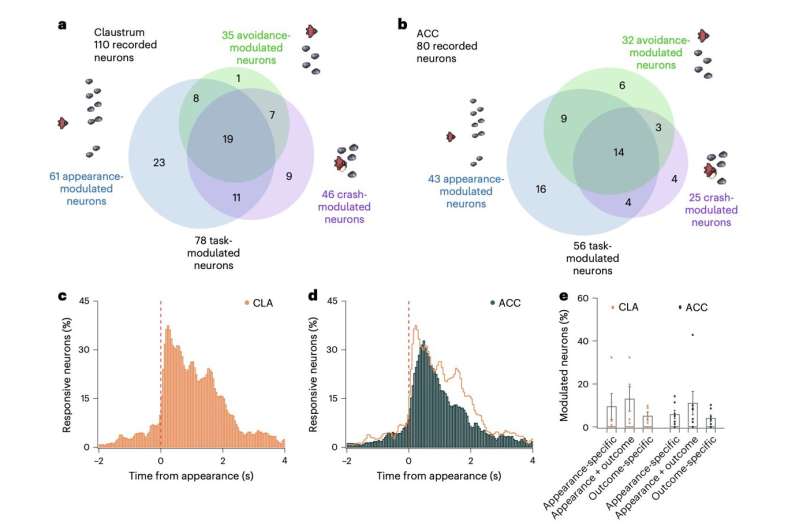
“Claustrum and anterior cingulate neurons displayed structured, task-related responses,” wrote the authors. “Distinct subpopulations encoded stimulus onset and action-contingent outcomes, with outcome representations diverging between regions.”
Essentially, the researchers found that different neurons responded to distinct events. Some changed their activity when a stimulus (i.e., an asteroid belt) appeared on the screen, while others appeared to respond to outcomes associated with a participant’s actions in the game.
An improved understanding of the claustrum
The team’s findings suggest that neurons in both the claustrum and the anterior cingulate cortex track hidden quantities, or more specifically, estimated uncertainty and prediction error. However, during the experiment, signals in the two regions appeared at different stages of the task.
“Critically, both regions encoded model-derived latent variables, including uncertainty and prediction error, but with different temporal profiles; only the anterior cingulate carried uncertainty signals during the intertrial period, whereas both regions encoded uncertainty and prediction error during the active-avoidance period,” wrote the authors. “By contrast, the amygdala showed minimal latent-variable modulation.”
The researchers observed that neurons in the anterior cingulate cortex carried uncertainty-related signals between trials as well as during the active-avoidance phase. In the claustrum, however, signals linked to uncertainty and prediction error were evident primarily during the active-avoidance phase, the part of the game when asteroids appeared and were approaching the players’ spaceship.
“These findings provide evidence that human claustrum neurons track higher-order cognitive variables not directly observable from sensory input and reveal dissociable roles for the claustrum and anterior cingulate cortex in tracking latent task states,” wrote the authors.
The results of this study do not establish that the claustrum causes expectations to change under uncertainty. Instead, they suggest that it could play a role in tracking the gap between expectations and reality during aversive learning.
Future studies could further explore the role of the claustrum using other tasks that involve learning and the updating of mental representations. This could help to shed more light on the functions of this poorly understood brain region.
Written for you by our author Ingrid Fadelli, edited by Gaby Clark, and fact-checked and reviewed by Robert Egan—this article is the result of careful human work. We rely on readers like you to keep independent science journalism alive.
If this reporting matters to you, please consider a donation (especially monthly). You’ll get an ad-free account as a thank-you.
Publication details
Mingyue Hu et al., Human claustrum neurons encode uncertainty and prediction errors during aversive learning, Nature Neuroscience (2026). DOI: 10.1038/s41593-026-02475-x.
Journal information:
Nature Neuroscience
Key medical concepts
Clinical categories



© 2026 Science X Network
Citation:
A poorly understood brain region tracks the gap between expectations and reality (2026, October 18)
retrieved 19 October 2026
from https://medicalxpress.com/news/2026-10-poorly-understood-brain-region-tracks.html
This document is subject to copyright. Apart from any fair dealing for the purpose of private study or research, no
part may be reproduced without the written permission. The content is provided for information purposes only.