

Sleep apnea often gets passed off as mere snoring, but it’s a much bigger deal. Throughout the night, breathing keeps pausing, and each pause chips away at sleep quality. Left untreated, repeated breathing disruptions and drops in blood oxygen during sleep can do far more than leave you groggy in the morning—they can take a serious toll on long-term health.
Excess body weight is a major contributor to this condition. In a recent clinical trial, researchers investigated whether a weight-loss drug called retatrutide could help improve the condition.
To find out how well retatrutide works against sleep apnea, researchers launched two large phase 3 clinical trials, TRIUMPH-1-OSA in patients without type 2 diabetes and TRIUMPH-2-OSA in those with type 2 diabetes. The trials compared the once-weekly injections of three different doses with a placebo in adults who were overweight or living with obesity and had moderate-to-severe sleep apnea.
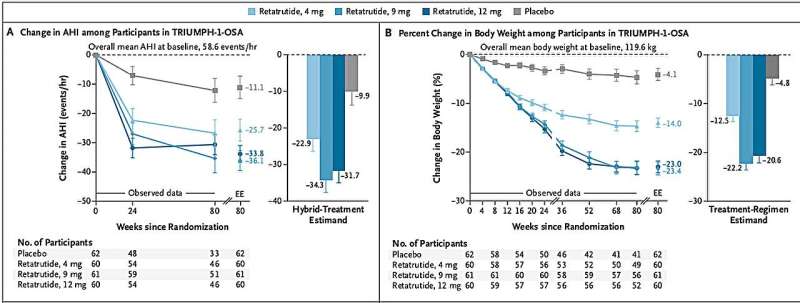
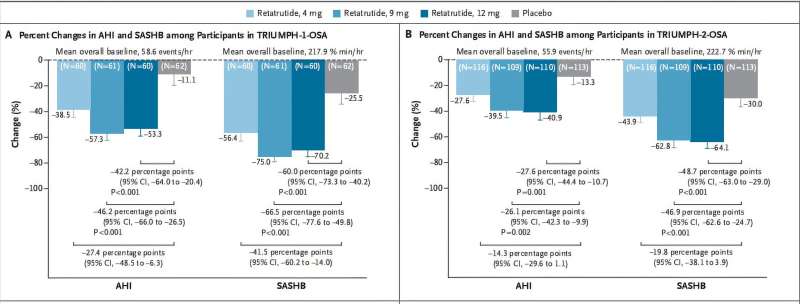
After 80 weeks, all three doses of retatrutide reduced breathing interruptions more than placebo, including in participants with diabetes. Among participants receiving higher doses of retatrutide, 39%–52% saw their sleep apnea improve to either no disease or mild disease without excessive daytime sleepiness, compared to only about 13% of those receiving a placebo. At the two higher doses, the drug also cut breathing disruptions during sleep by an average of 25 pauses per hour, roughly a 40% reduction, compared to 10 fewer pauses in the placebo group.
The findings are published in the New England Journal of Medicine.
Same target, different route
Standard treatment for sleep apnea involves using continuous positive airway pressure (CPAP) breathing masks, but many people find them uncomfortable and struggle to wear them every night. One way to overcome this discomfort while still addressing the concern was to change the treatment approach. What if we treated modifiable factors of sleep apnea, such as excess body weight, rather than just the symptoms?
To explore that, researchers went for retatrutide, which is an experimental once-weekly injection being developed to treat obesity and type 2 diabetes. What sets it apart is its ability to activate three hormone receptors simultaneously, making it a triple receptor agonist. Its predecessors, semaglutide (Wegovy) and tirzepatide (Zepbound), target one and two hormones, respectively.
By mimicking GLP-1 and GIP, retatrutide helps lower blood sugar, promote fullness and improve the body’s insulin response; GIP also helps reduce body weight alongside GLP-1. By acting on glucagon receptors, it increases energy expenditure and metabolic activity, helping the body burn more energy.
To assess how well retatrutide works against sleep apnea, researchers tested the drug in two major phase 3 clinical trials using a double-blind, randomized, placebo-controlled design. To qualify, participants needed a body mass index (BMI) of at least 27 and had to experience at least 15 breathing pauses per hour during sleep. In both the trials involving participants with diabetes and those involving participants without diabetes, participants were randomly assigned to four equal groups, each receiving weekly injections of retatrutide at 4 mg, 9 mg or 12 mg, or placebo.
The treatment period lasted about 1.5 years, and at baseline, week 24 and week 80, participants stayed overnight in a sleep clinic for full sleep assessments via polysomnography.
Easing up of apnea
At the 4 mg dose, retatrutide reduced breathing pauses by an average of 23 per hour, and the participants also lost an average of 12.5% of their body weight. For 52%–66% of participants without diabetes taking the 9 mg or 12 mg doses, retatrutide cut breathing interruptions during sleep by at least half.
Up to 52% of those without diabetes and 40% of those with diabetes reached normal breathing levels or had only mild sleep apnea, levels at which they might no longer need a CPAP machine to keep their airways open during sleep. In TRIUMPH-2-OSA, participants with diabetes showed an average weight loss of 18% to 19%, compared to about 6% on placebo.
More people on retatrutide saw their obstructive sleep apnea (OSA) ease to a mild form without excessive daytime sleepiness. If approved, the drug could become another treatment option for sleep apnea in people living with obesity, including those who also have type 2 diabetes.
Written for you by our author Sanjukta Mondal, edited by Gaby Clark, and fact-checked and reviewed by Robert Egan—this article is the result of careful human work. We rely on readers like you to keep independent science journalism alive.
If this reporting matters to you, please consider a donation (especially monthly). You’ll get an ad-free account as a thank-you.
Publication details
Ronald R. Grunstein et al., Retatrutide Once Weekly for Treatment of Obstructive Sleep Apnea, New England Journal of Medicine (2026). DOI: 10.1056/nejmoa2611477
Journal information:
New England Journal of Medicine



© 2026 Science X Network
Citation:
Triple-action weekly weight-loss drug reduces sleep apnea in two late-stage trials (2026, October 24)
retrieved 24 October 2026
from https://medicalxpress.com/news/2026-10-triple-action-weekly-weight-loss.html
This document is subject to copyright. Apart from any fair dealing for the purpose of private study or research, no
part may be reproduced without the written permission. The content is provided for information purposes only.