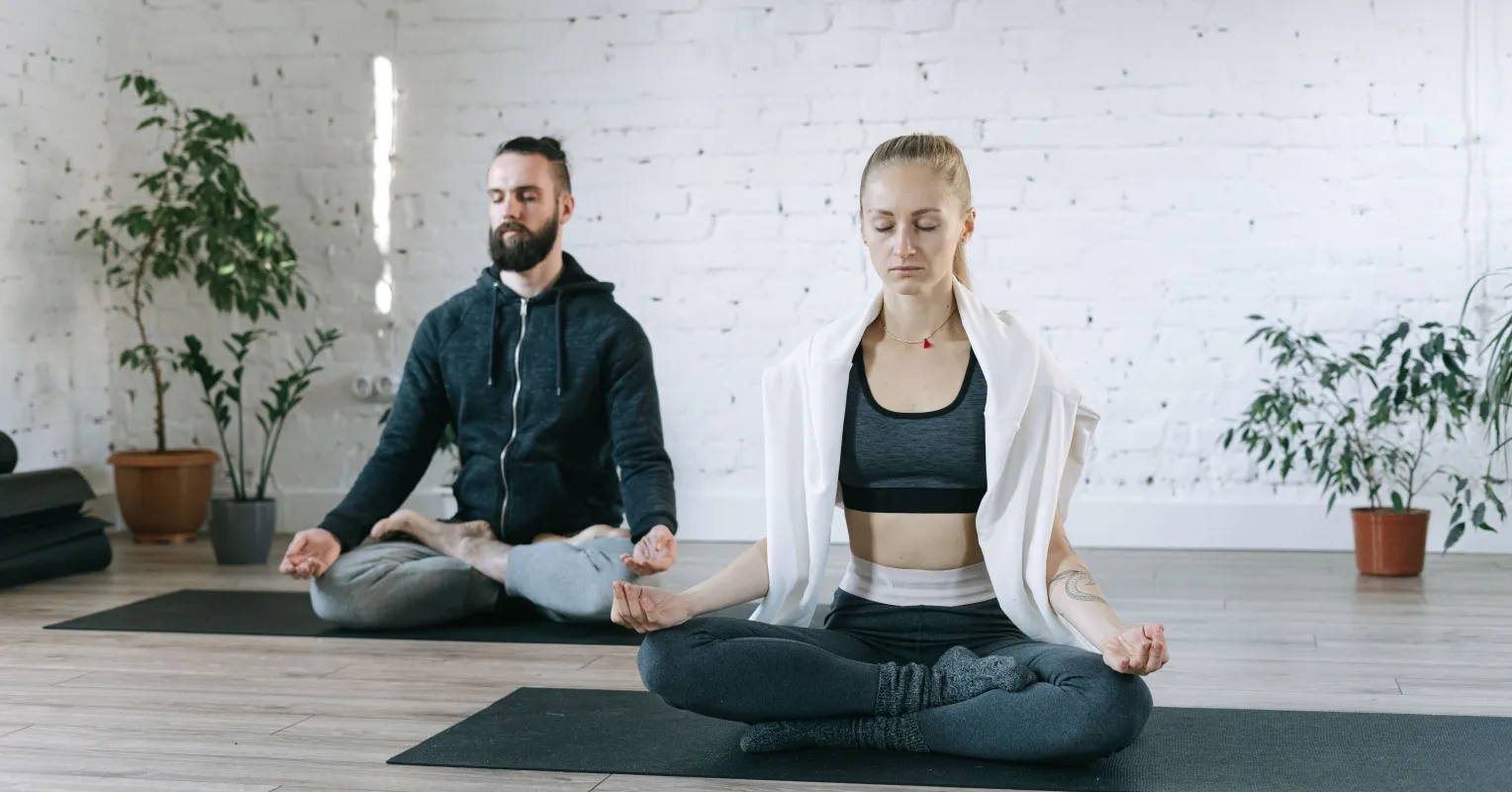
Meditation is a tool for creating distance between yourself and the onslaught of default thoughts, emotions, and sensations that make up our moment-to-moment experiences. This distance enables choice and provides the most profound type of personal freedom on offer: the freedom to decide how you feel about things, your sexuality being chief among them.
Here is the most basic meditation I’m aware of. Try it if you dare:
- Sit down somewhere comfortable. It can be in a chair (like the Germans do), on your couch (like Americans), or cross-legged on the ground (like the Buddha).
- Start breathing in through your nose and out through your mouth. Don’t worry about pacing—just breathe to stay alive, per usual.
- Notice your breath—like really notice it. Notice the slight coolness inside your nose when you breathe in, the mild but still somehow sharp pressure in your lungs as they fill with air, the subtle tingle on the inside of your lips as air exits through your mouth.
- Keep noticing the sensations that arise with your breath. There are a lot of them; they never stop, and they’re always different.
- Your mind will wander. Thoughts will pop into your head—thoughts as quotidian as “Jeez, I still need to pack lunch for tomorrow” and as profound as “Man, do I hate Jim.” When that happens, simply notice that you are focusing on something other than your breath and bring your attention back to the explosion of stimulation that is your breathing.
- Be warned: You will have amazingly urgent thoughts when you’re meditating. Yesterday the cure for cancer popped into my head, and then I realized the perfect thing to say to save my marriage. Each time, I gently noticed that my attention was on something other than my breath, and I brought it back.
You don’t need to spend a ton of time practicing to reap significant benefits. I recommend starting with ten to fifteen minutes a day, three days a week. But even as little as a couple of minutes a week can make a difference.
The benefits of meditation have become so sensationalized by the self-help industry that it’s important to be clear about what its actual purpose is. Meditation will not produce startling insights into the mysteries of the universe. Your IQ and personality will remain unchanged. If you suck at pickleball before meditating, you will suck afterward. But do it enough—starting with a few minutes a few times a week—and you will notice that your mind has become a little less frantic, a little less hooked by doom loops, and a little more spacious.
Meditation is a way to create space between us and our unproductive thoughts, and it can therefore offer relief from shame. Try doing a meditation practice when you feel yourself getting into a negative mindset. When you experience that stench of shame associated with your fetish, notice it as a thought arising out of nowhere. You did not ask for that feeling of shame, and it in no way helps you. Let it go and bring your attention to your breath. It will probably arise again—notice that, and again gently but firmly return your attention to your breath. There is no need for you to react to or add commentary to your shame—don’t pile new thoughts onto the shame thought and don’t recoil from it—just notice it and bring your attention back to the breath.
This is not about avoiding unpleasant thoughts; it is simply about recognizing and not elaborating on them. Shame is just a thought arising in your mind like any other thought, and it is in its nature to pass away (thanks, Buddha). Simply processing your shame thoughts in this way will eventually strip them of their emotional power. So much of our suffering is the result of obsessive elaboration on the things that pop into our heads. Somatic exercises are meant to help us stop piling on.
Allow me to introduce an analogy based on my beloved New York City, whose sidewalks burst with every type of human imaginable, all of whom jump into your field of vision all the time. You can’t control who walks by or what might be on the sidewalk. They simply appear. You might notice the pretty girl, the cold-eyed businessman, the kindly older man helping his wife across the street, or the guy you think is waiting to pick your pocket. Your thoughts are the same. Simply notice them when they pop up next to you on the sidewalk.
Let’s walk through a common shame spiral I see in my work: Imagine you’re scrolling Instagram on the couch. Someone has posted a fashion photo of a person wearing latex. There’s a brief moment of excitement, followed immediately by, “This is so shallow. Why can’t I be turned on by something normal?” That thought brings in the others: “This is weird. I shouldn’t be turned on by this. How can I possibly live a normal life with this desire?” Now your attention is no longer on the image itself—it’s on the story you’re telling about your desire.
From there, the thoughts intensify. You start replaying past rejections—that time you brought a date to the sex toy store, and they judged you for wanting them to try on latex, etc. Within seconds, a neutral moment of arousal has turned into a full-on spiral.
Notice what’s happening here. The fetish didn’t create the suffering. The thought about the fetish did. This is where the sidewalk metaphor becomes useful. You didn’t choose who walked by, but you stopped, stared, followed, and built based on what you saw. A meditation-trained mind might instead note, “Arousal happened,” or “That person looks hot in latex,” just as it might note, “That smells bad,” and then keep moving. The practice isn’t to pretend the sidewalk is empty. It’s to stop writing poems about the pile of sh*t.
Excerpted from my book, Fetish: Smash Taboos and Celebrate What Turns You On.