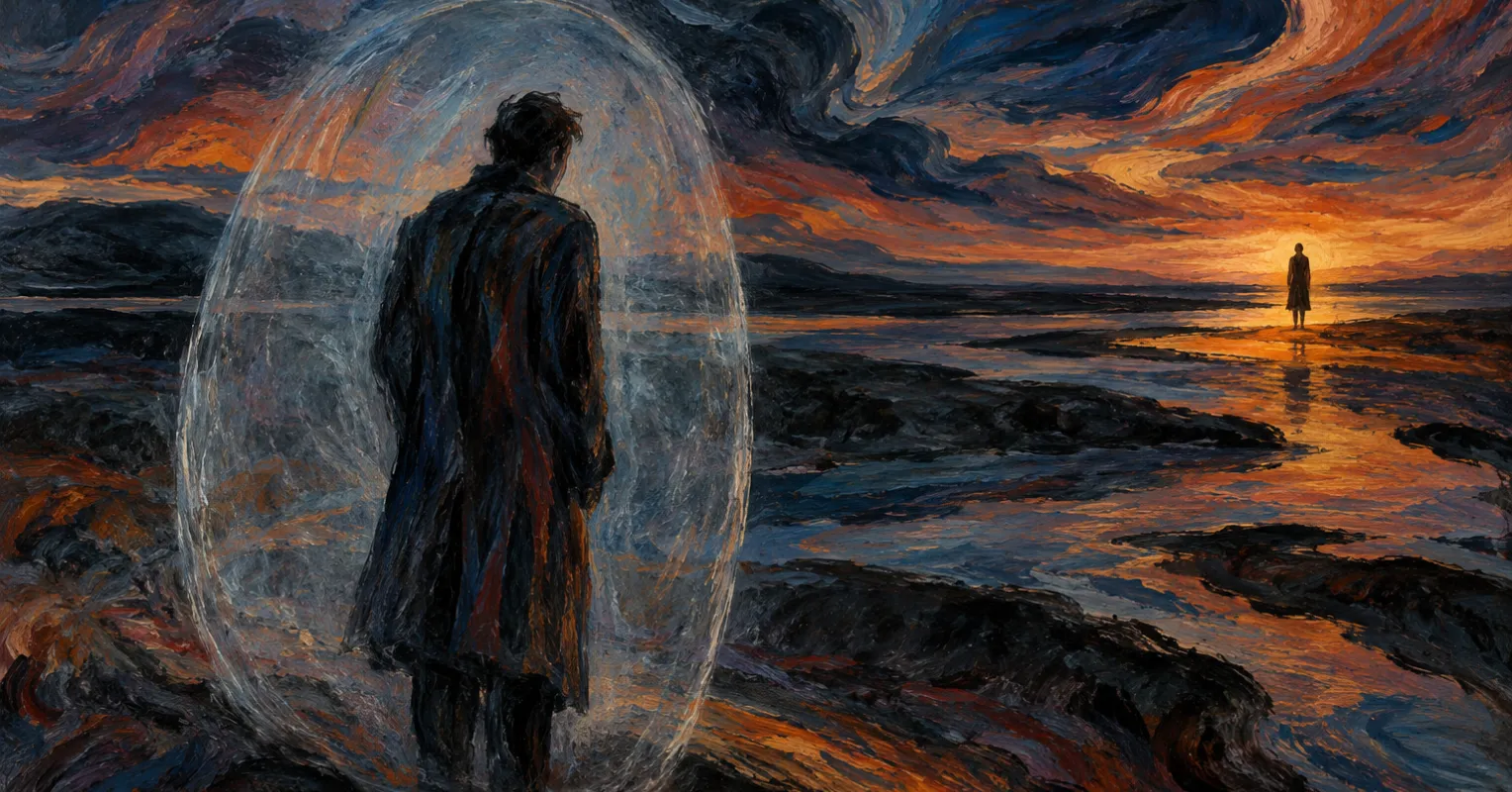
“My name’s Dave, I live in a one-by-one box of bone that no other party can penetrate or know,” David Foster Wallace once observed.
He went on to describe how certain experiences in his life seemed to help alleviate the deep-rooted sense that he and the world were essentially separate: ‘Fiction, poetry, music, really deep serious sex, and, in various ways, religion – these are the places (for me) where loneliness is countenanced, stared down, transfigured, treated.’
His description closely resembles what psychologists call existential loneliness: a feeling of aloneness arising from an awareness of the limits of how completely one person can know another.
The psychiatrist Irvin Yalom described the concept as an awareness of the distinction between oneself and the rest of the world, the realization that no one else can truly know our subjective experiences first-hand. There is something fundamentally lonely about that.
What Is Loneliness?
Loneliness has been defined, discussed, studied, and politicized so often in recent decades that we can begin to lose sight of what we mean by it. People can also speak about different sorts of loneliness interchangeably, as though they are the same.
Existential loneliness tends to be aligned with the description above: a sense that part of being human means living with the sometimes-painful reality of our fundamental separateness. Social loneliness is a different experience. It is more explicitly connected to the feeling that we lack a social network or community, while emotional loneliness concerns the absence of close emotional bonds.
These experiences are distinguishable, but perhaps not entirely separate. Social and emotional connection cannot abolish our existential separateness, but they can soften its harsher edges, making the loneliness of being human less brutal to bear.
How Does Existential Loneliness Show Up?
In my conversations with people at different points in the lifespan, I have found that existential loneliness is so often the heart of the loneliness experience. For example, one of the loneliest parts of grief and heartbreak is the sense that, ultimately, what we have lost was completely unique.
Others can try to console us by telling us that they know what it’s like. But the truth is that there are no exact points of reference in the external world. Every individual loss or heartbreak is unique and nobody else can ever completely know what it’s like to lose the particular connection we have lost. This can amplify existential loneliness because it harshly emphasizes our separateness.
In later life, I’ve spoken to many older people whose existential loneliness tends to surface more acutely as the various losses associated with aging accumulate. For some older people, bereavements and other losses begin to appear with increasing regularity, and there is a sense that the emotional connections that have somehow buffered our existential loneliness for most of our lives are eroding. Again, a sense of separateness can be more acute.
‘There’s No Cure for Existence’
The dominant public-health narrative around loneliness has moved closer to the idea that loneliness can and should be cured. The emphasis can shift from understanding what form of loneliness has appeared in a person’s life, and searching for its meaning, towards assuming that meaning in advance and looking for a cure.
But is there really a cure for existential loneliness?
In a review of 121 scientific papers on existential loneliness, an international group of researchers identified that there is enormous variation in how psychologists understand and attempt to study it. Although the review revealed striking variation, one recurring theme was that it is inseparable from the conditions of human existence.
This is where we need to think more carefully about how we understand and respond to experiences like existential loneliness. Clinical psychologist, Professor Dolores Albarracín has warned that ‘there is no cure for existence’.
In my own work, I have found that attempting to eliminate existential loneliness can be futile and may also stigmatise an experience that, although undoubtedly painful, is likely to form part of many people’s lives. Existential loneliness may not always be something that more company or social contact can remove.
Loneliness Essential Reads
This does not mean, however, that relationships are unimportant when it comes to existential loneliness. Another person may be unable to cross fully into our inner world, but they can certainly listen from its threshold. They can help us feel witnessed rather than abandoned within our separateness.
Perhaps this is what it means for existential loneliness to be transfigured rather than cured: not eliminated but encountered in the presence of another.
At The Inner Room, I write free essays about loneliness, connection, and the quieter dimensions of inner life. If this kind of exploration speaks to you, you’re warmly invited to subscribe.