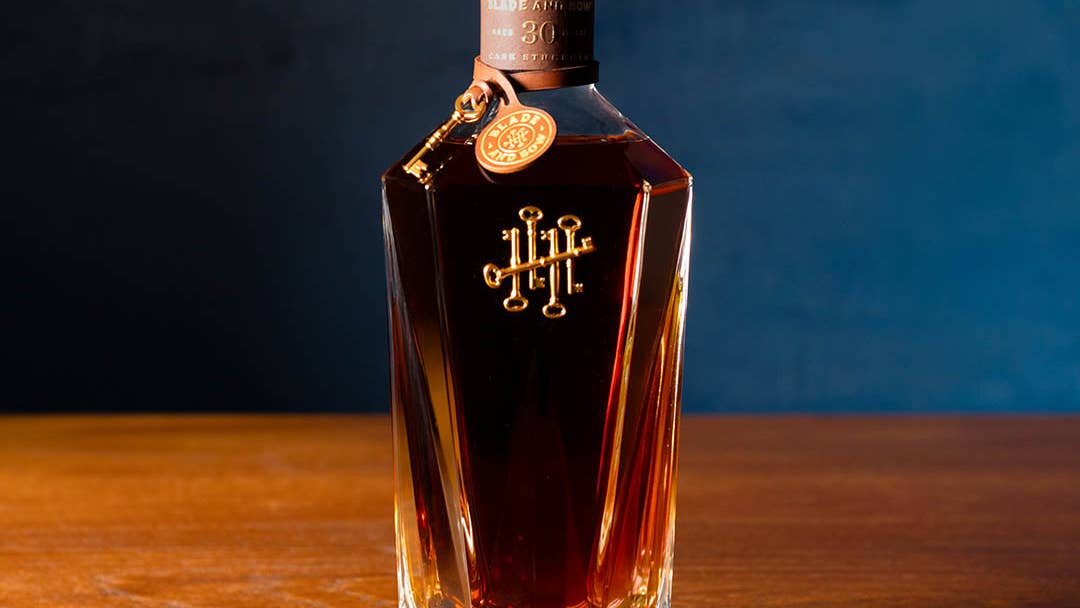
It hasn’t even been a full year since we gave you an exclusive first look at Blade and Bow’s oldest bourbon ever. That 30-year-old offering was stripped from shelves rather swiftly despite its hefty $1200 price tag. Now the Louisville-based brand is preparing something even heftier, and we’ve got yet another sneak peek. This time, it’s a preview of what will be one of the priciest and proof-iest American whiskeys of the year: Blade and Bow 30-Year-Old Cask Strength.
As the name implies—and as is legally required of anything bearing the title—this release was bottled straight from the barrel, without any significant dilution. This explains its supernatural strength of 82.1 percent ABV, which is well in the “hazmat” whiskey territory. But that extreme metric belies a liquid that’s incredibly rich and utterly evocative. It bites but never burns. Immediately upon uncorking, it struts with force towards your nostrils, surrendering notes of bergamot, dark berry fruit, and singed cedar. The palate is piquant, with ginger, cranberry, and molasses as top notes, all backstopped by a profound minty tug.
Related: A 30-Year-Old Bourbon That Actually Tastes Good? Blade and Bow Pulls It Off
You could actually sip on this one as is—a remarkable truth given the fact that it’s literally twice as strong as most well whiskies. Nevertheless, if you add more than several drops of room temperature water you’ll be incrementally rewarded with floral aromas as well as bittersweet swirls of currant and cassia. And that’s partially the point. Sipping this bourbon is actually intended to be something of an interactive experience.
“One of the things I love about cask-strength whiskey is that it puts the experience in the hands of the person drinking it,” says Nicole Austin, who heads up whiskey development for Diageo, Blade and Bow’s parent company. “The aromas and flavors can reveal themselves differently as the strength changes, and there’s no single answer to where that balance should be. That’s what makes this whiskey such a special experience for serious enthusiasts.”
Courtesy Image
Those same enthusiasts will undoubtedly appreciate the liquid’s pedigree along with its precious allotment. The limited release comes from the same tranche that Austin used to assemble the initial Blade and Bow 30 from last year. That is: 96 total barrels that sat in the historic Stitzel-Weller rickhouses since the spring of 1993 (though they weren’t distilled at this hallowed site, but at another undisclosed Kentucky production site nearby).
At any rate, an immense degree of stewarding was necessary to ensure the juice wasn’t “over-oaked” along the way, as is so often the case with any American whiskey of this age. The careful curation involved moving them around the warehouse as needed—to keep them in cooler, less-reactive environments—and consolidating the stock, repeatedly, as those thirsty angels slowly sapped each vessel of volume.
Related: Jack Daniel’s Just Dropped Its First-Ever Coy Hill Rye—and It’s a Monster Proof
In the end, only 1,200 bottles’ worth of liquid remained. Such rarity comes at a cost, of course. $2500 per decanter, to be precise, with every one delivered in a custom-made leather box. The precious cargo rolls out across select US markets in mid-November. Additional bottles will also be available shortly thereafter by way of limited drops at the Stitzel-Weller Distillery throughout the holiday season (if you want to try something from Blade and Bow that’s more readily available and a bit less expensive, go here).
But bear in mind that if you flew in to buy it from the source, you’d better plan a road trip back. Any whiskey bottled above 70% ABV is considered hazardous material by the federal government and can’t be flown in commercial airplane holds. Thankfully for the jet set, the brand is also using the occasion to re-release what’s left of that original 30-Year-Old, bottled at a relatively tame 109-proof. It returns at its original suggested retail price of $1200. That could read as a bargain, considering some secondary sites list it at nearly 3x that cost. And you thought gas markups were bad. Try high-octane hooch.
More on Whiskey
- How a Kentucky Priest Brought Rare Bourbon to the Vatican—and Got Pope Francis to Sign Bottle No. 1
- At This Colorado Whiskey Hotel, You Can Sleep Steps From the Stillhouse
- Jack Daniel’s Just Dropped Its First-Ever Coy Hill Rye—and It’s a Monster Proof
- Old Forester Debuts a $300 Vintage-Inspired Bourbon for Collector Season

