David Fincher’s Fight Club opened in U.S. theaters on October 15, 1999, following its world premiere at the Venice International Film Festival on September 10. The 139-minute film was adapted from Chuck Palahniuk’s 1996 novel. It challenged late-1990s consumer culture through an insomniac office worker who forms an underground fighting society with an enigmatic soap salesman.
The film’s critique of materialism, masculine insecurity, and manufactured identity came wrapped in graphic violence, sardonic humor, and an audacious twist.
Edward Norton, Brad Pitt, and Helena Bonham Carter Changed the Equation
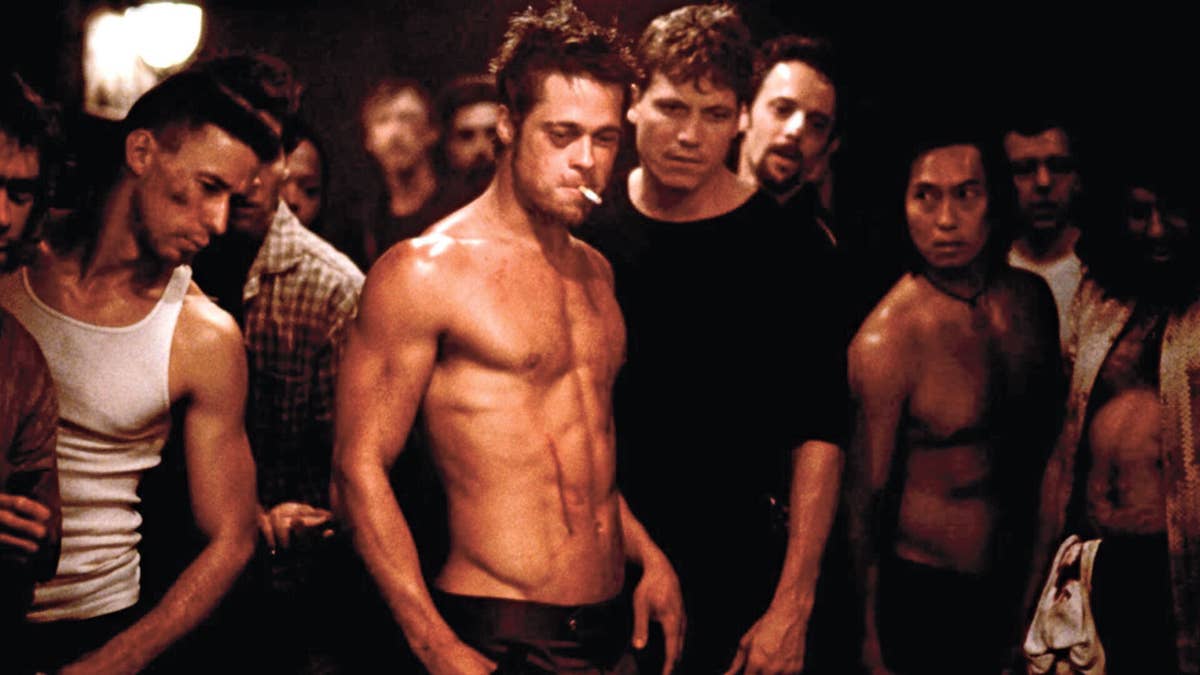
20th Century Fox
Edward Norton plays the unnamed Narrator, grounding the story in exhaustion, alienation, and an increasingly unreliable perception of reality. His restrained, anxious performance makes the character’s psychological collapse integral to the film’s critique of consumer-driven identity.
Brad Pitt supplies the combustible counterpoint as Tyler Durden, a charismatic rebel whose rejection of corporate conformity gradually exposes the authoritarian impulses lurking beneath his anti-establishment philosophy. Pitt’s physical confidence and magnetic screen presence make Tyler dangerously persuasive, effectively sharpening the distinction between the freedom he promises and the destruction he encourages.
Helena Bonham Carter brings abrasive vulnerability to Marla Singer, a fellow support-group visitor whose chaotic relationship with the Narrator complicates his fantasy of masculine self-reinvention.
Although the film devotes considerably more attention to its male characters, Marla’s independence and refusal to fit their ideological games expose the limitations of their self-created world. The cast give Fincher’s stylized satire its emotional and psychological force.
Box-Office Disappointment, Critical Division, and Lasting Influence
Despite opening in 1,963 theaters and ranking first at the U.S. weekend box office, Fight Club collected just $11.04 million domestically in its opening weekend against a reported $63 million production budget. Its second weekend fell 42.6% to $6.34 million. The film ultimately earned approximately $37 million domestically and more than $100 million worldwide, a commercial outcome that initially fell short of expectations.
Furthermore, critics were sharply divided over whether Fincher’s violence illuminated male alienation or glamorized it. The New York Times critic Janet Maslin praised its examination of contemporary manhood, warning that careless viewing could mistake its satire for an endorsement of nihilism. Roger Ebert, however, awarded two stars out of four, calling it “a thrill ride masquerading as philosophy” and arguing that its later violence undermined its sharper opening act.
Subsequent home-video viewing, online discussion and critical reassessment helped transform the film into a cult classic. Its nonlinear storytelling, consumerism critique, and deliberately ambiguous ending continue to fuel greatest-film debates. In any case, Fight Club’s legacy remains complicated: Tyler’s appeal has sometimes eclipsed the film’s critique of destructive masculinity, demonstrating how provocative cinema can be interpreted in ways that challenge its original intentions.