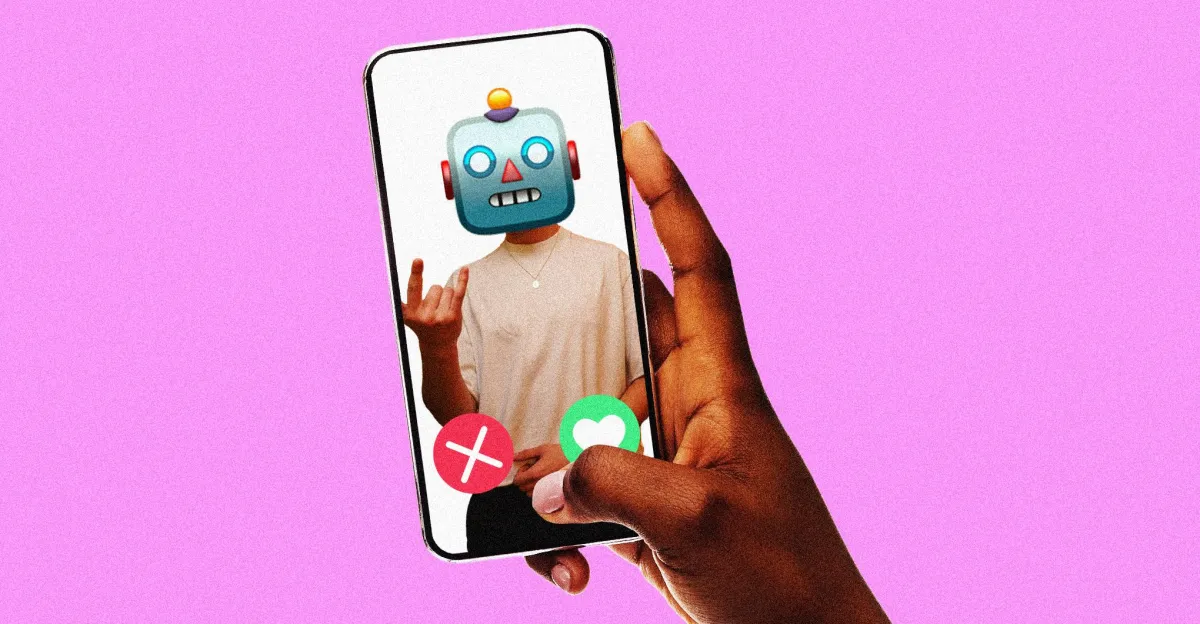
When Irene moved to San Francisco last year, she started using dating apps as a way to meet new people, get to know her new city, and connect with others who care about the things she does. After the 25-year-old analyst downloaded Hinge and started swiping, she noticed a trend.
“Hinge has a prompt where you can say, ‘We’ll get along if”,” she recalls. “Sometimes people will be like, ‘Fuck AI.’”
Usually, the people who include this kind of value statement on their profile work in the arts, nursing, maybe graphic design. Within the span of a few minutes of sitting down and swiping, Irene shows me a second profile where this happened once more: “You should *not* go out with me if… you use AI.”
In San Francisco, the epicenter of tech, the metaphorical AI bomb went off in 2022 with the release of OpenAI’s ChatGPT. Conversations surrounding artificial intelligence now permeate the dating scene in one shape or another. Over the past month, I bopped around the city —, chatting with people at parties and coworking spaces and reviewing dating directories and other online profiles —, trying to find out how AI affects the dating scene.
Responses varied wildly. For some, AI feelings take on a similar valence to traditionally political ones, showing up in dating profiles next to party affiliation or other signifiers, like the watermelon emoji symbolizing solidarity with Palestinians amid the war in Gaza. Others are wrestling with the ethics of dating someone who builds AI, considering the financial benefits a partner in the industry can bring, weighing whether to have children in a future this uncertain, or even handing their love lives over to it entirely.
On a street near Berkeley, I meet up with Kyle. (His name has been changed so that he can talk openly about his personal life.) Kyle is a researcher at an AI safety nonprofit initiative, and although he is just in his early 20s, he’s already thinking about death. In the AI safety community, some experts see a 10 percent chance of humans going extinct due to AI taking over. This apocalyptic possibility is always top of mind when he navigates conversations with a potential partner: The rapid development of AI shapes how he thinks about whether he wants to have kids or where he might live long term — if there is even a long term.
“It’s hard to have that planning conversation because I don’t really expect a long-term future”
“A lot of people are planning for what they want their life to look like five, 10, 15 years down the line,” Kyle says, raising his gaze and looking off into the distance. Life could change depending on whether the world manages to get AI alignment right, he tells me. “For me, it’s hard to have that planning conversation because I don’t really expect a long-term future,” he says. He tries to have these conversations in person rather than over text, so a date can ask follow-up questions about why he sees the future the way he does.
For now, he’s focusing on finding a partner with whom he enjoys spending time.
When I ask Kyle if he would date someone who works in artificial intelligence or tech, he says that he would have to think hard about it. He believes that a lot of people who work at frontier AI companies are doing things that he considers pretty heinous. “They don’t think very hard about the societal impacts of their actions because they’re mostly in it for the paycheck or because it’s interesting,” he says.
But Bryan, who works at a frontier AI company and also asked to go by a pseudonym, doesn’t believe that feelings about AI matter when it comes to romance.
“I just don’t think it’s a factor at all. Like, it’s the least [relevant] thing,” says Bryan, who recently started a relationship. To him, dating is more about weighing a series of factors: how someone talks and approaches problems, how they have fun. Despite his day job (and whatever someone like Kyle might think of him for it), he believes that working out more and looking better probably increases someone’s chances of getting a match way more than any AI or non-AI affiliation. But, he says, “The one way it interacts is that there are a bunch of people who are rich from AI, and, you know, being wealthy is always a plus.”
Bryan isn’t exactly wrong about the benefits of a high-paying job in AI. With the IPOs of Anthropic and OpenAI in the next year, matchmakers have found that clients are specifying “AI engineer” on their list of preferred dating profile qualifications. And stability is particularly attractive right now: According to a CBRE report released in August, more than 20,000 AI jobs were added to the San Francisco Bay Area’s technology workforce, even as overall tech talent contracted by 6 percent since 2022. “Member of technical staff” roles have become very lucrative jobs; the average salary of an AI researcher can be around $300,000. According to the New York Post, one matchmaker found that her client booked a six-month stay in San Francisco because of the possibility of meeting a significant other who might be connected to an AI company going through an IPO.
AI is reflected in the way the technology is seeping into San Franciscans’ everyday habits — including those that shape relationships, from how people process their feelings to whom they confide in.
Andromeda, who works as an EMT and a registered behavior technician as well as an AI security analyst, says she’s worried about the unintended consequences of talking to AI chatbots, especially for questions about (and possibly the replacement of) human connection. According to a study released by Elon University, 27 percent of Americans are turning to AI chatbots with personal, emotional, or social queries. Thirty-eight percent of the surveyed group said they occasionally tell AI things that they would not tell other people, including their romantic partners. Andromeda weighs the pros and cons of dating someone who would use bots for “emotional regulation.”
“Socially and psychologically, it’s a big deal, and we have to talk about it,” she says. She appreciates the role that a chatbot can play to help someone better express themselves. “I would certainly date a man who uses AI to talk through intense thoughts and feelings and to brainstorm clarity.”
At the same time, she is also reluctant to date someone who might abuse a chatbot, since it’s maladaptive behavior and does not represent good values for model welfare. “If they treat ChatGPT badly today, it will be me tomorrow!”
“There are a bunch of people who are rich from AI, and, you know, being wealthy is always a plus”
If Andromeda worries about what people tell chatbots, others have gone a step further and let AI do the talking for them.
At the Hugging Face Open Source Week party, Joseph, a 21-year-old software engineer, explains how he has automated his dating life. Working 14 hours a day to launch his startup, he has decided to outsource swiping on Hinge entirely to an AI agent. The agent is managed by his human virtual assistant from the Philippines and has been fine-tuned to mimic the way that he speaks and acts. Looking at each profile, the AI agent sends tailored outreach messages to spark a conversation. After some back and forth, the agent determines if the woman is compatible with Joseph and, if so, books open slots on his weekend calendars for dating in person.
“If you are a founder, you have to put a value on your time, so you can’t be doing low-leverage activities. Protect your dopamine, folks,” Joseph tells me at The Midway in San Francisco’s Dogpatch district, where hundreds don white bucket hats and dance next to Hugging Face’s round, foam emoji mascot. “It’s kind of a copy-and-paste sequence that happens with every girl to get to know about you, understand your backstory, and so on and so forth.”
He’s not alone. A 2025 survey by Match and the Kinsey Institute found that 26 percent of singles in the United States use AI tools to enhance their dating experiences. Hinge now has an AI tool to generate suggested responses, and Bumble will soon phase out swiping in favor of AI assistant-facilitated matchmaking. Joseph says he won’t share the secret sauce of his AI agent on GitHub, but he tells me it’s pretty easy to make one on Claude Code.
“It has been extremely successful. I’m averaging two closed conversions a week,” he says, meaning that he goes on two dates with two different people. The women on the other side don’t know. The point is to meet in real life. The overall process has lowered what he calls “CPN,” or “cost per nut.”
At 29 years old, JJ has stopped using dating apps. Instead, she turns to the Date-Me Directory — a collection of longform, resume-like documents where people write personal dating profiles — to find a partner. Two years ago, she worked in product design in New York, but she transitioned into the AI safety field because she felt that it aligned more with her effective altruist morals.
Upon reviewing troves of Date-Me Docs for the San Francisco / Berkeley area, I noticed that quite a few people mention “the singularity” as a factor of whether to have kids. The so-called “singularity” is the point of when technology overtakes human control; some have pointed to the development of true artificial general intelligence as the point of no return. According to JJ, many people in AI safety specifically use the Date-Me Docs as a way to meet people.
“Don’t want kids in the pre-singularity future, if there’s a post-singularity future then I might want kids then,” one document states.
On the other hand, similar to climate doom anxieties, other people are looking at whether having children is ethical amid massive structural changes in society caused by AI.
“Is the world good, getting to a good place, or is it bad? And if it’s good, baby. If not, no baby, because you’re gonna bring a baby into a world full of potential suffering,” JJ says, explaining the train of thought that these Date-Me Doc potential suitors might have. She does not consider herself a doomer, but she is still pressed for her own singularity timeline. (2029, she suspects.) If anything, she jokes that the approaching end times makes her more likely to want a baby around: “If the bomb gets me, I want to be holding a shiny child.”
These existential concerns have translated into a backlash against tech, San Francisco included. “Stop the AI” rallies have spread to events like Salesforce’s Dreamforce convention and OpenAI’s DevDay, with protestors calling out tech companies and their roles in data center development and ICE raids.
“If there’s a post-singularity future then I might want kids then”
That skepticism has spilled into how people size up a potential match, even at local events designed to bring the Bay Area together. At a pop-up “Date My Friend” pitch event at the Kilowatt Bar in the Mission District on a Saturday evening, a dozen people pitched their friends and exes to a crowd of more than a hundred.
“He works in tech, but he’s unhappy about it,” one person announced to a chorus of cheers. Other people cracked jokes that their PowerPoints were clearly made by humans, not AI.
Annalise Wulf, 26, one of the three cofounders of the “Date My Friend” series, says that although people in San Francisco try to “tech maxx” their lives, more tech workers with crazy schedules are interested in analog, in-person events to go back to the roots of meeting and creating community. “It’s like, ‘I’m here because I’m not using an AI dating app right now. Like I’m trying to do something different,’” Wulf says.
“I do think it’s maybe popular now to be more anti-tech,” says Lucy Segraves, 28, one of the other cofounders. If someone is working for a company that people see as perpetuating war crimes through their technology, she might be more hesitant to date them.
But ultimately, she says, there are more immediate concerns. “As a person with a non-tech job, I never judge someone if they do work in tech,” Lucy says. “Because that’s unfortunately where the money is, and we’re all just trying to make it in life.”