Do you like your job? Or wonder what it would be like if you’d gone against your parents’ advice and pursued your dream career? Her World’s Career Confessions column spotlights the professional journeys of its subjects and reveals how each individual’s career path and the choices they have made can have an impact on their personal finances, psychological health, and interpersonal relationships.
What if you didn’t have to know where your career was going?
In 2026, how many of us can confidently say we are on the right track and sticking to the exemplary timeline of the Singaporean Dream? While a handful might be on what society perceives as a stable, linear path to success, with BTO keys and a stable job in hand, the rest of us are navigating Singapore’s busy-bee culture. At the end of the day, we just want the comfort of knowing we’re moving toward our own idea of success.
For 34-year-old Kassandra Lim, that question has taken her from architecture to filmmaking, to the runways of London Fashion Week.
Kassandra Lim spent six years building her career in architecture, working with firms such as the Urban Redevelopment Authority, before setting her sights on the fashion industry in 2021. She then dedicated two years to technical training and self-learning in hopes of entering fashion school.
Her creative ambitions had already begun taking shape in film. In 2020, her first experimental short film, Season of Aeon, won Best Picture at the La Jolla Fashion Film Festival, with Kassandra taking on multiple roles as director, screenwriter, art director and set designer.
But film alone wasn’t enough. She wanted to bring her ideas to life through fashion itself. Eventually, she took the leap, leaving architecture behind to pursue a master’s in fashion design at London’s Royal College of Art, where she gained direct entry into the programme in 2023.
On paper, it looks like a series of career pivots. To her, however, these disciplines have always been connected: different passions that came at different points in her life, but all driven by the same desire and curiosity to bring ideas to life.
Credit: El Khemie
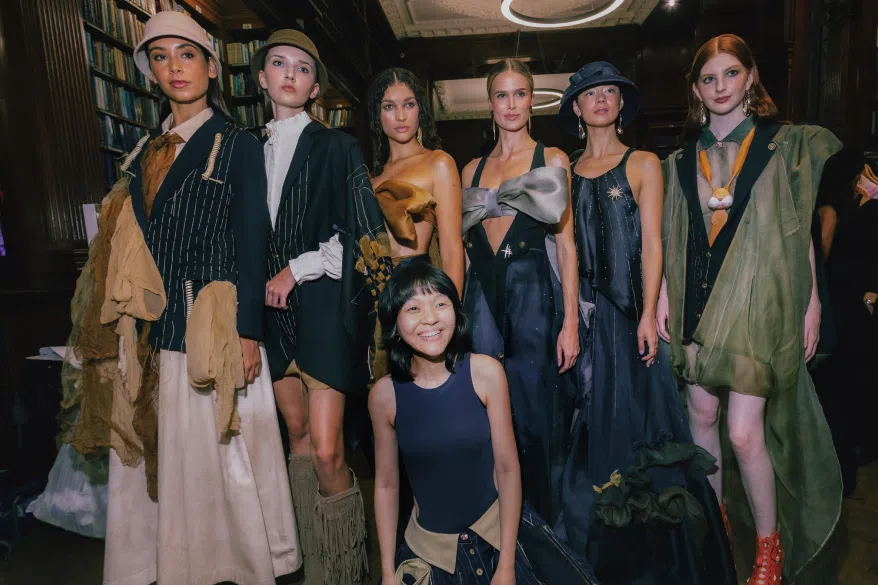
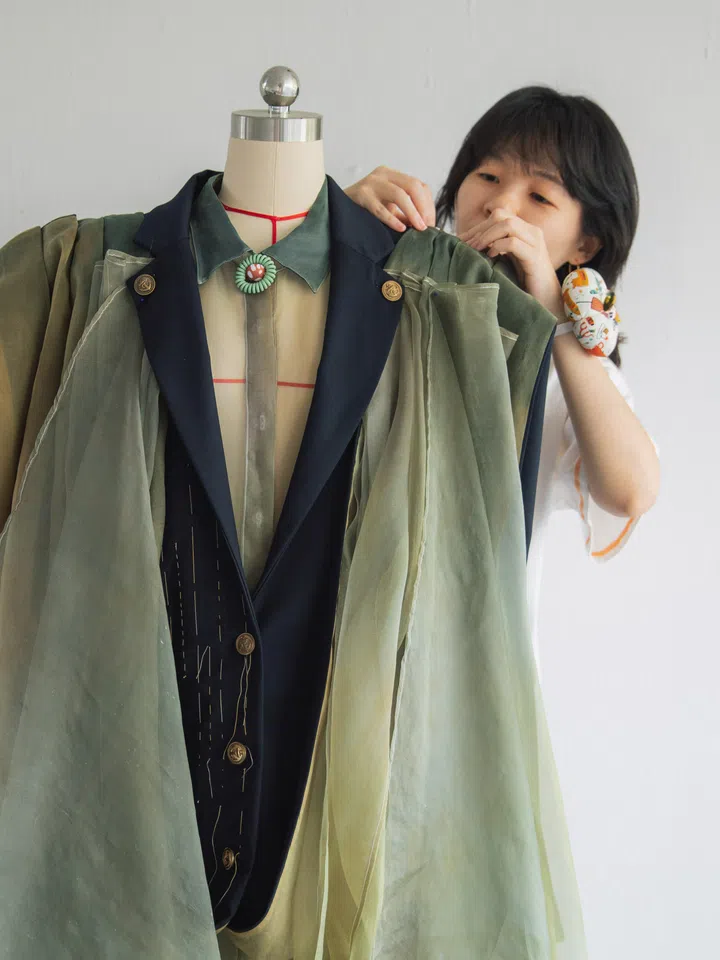
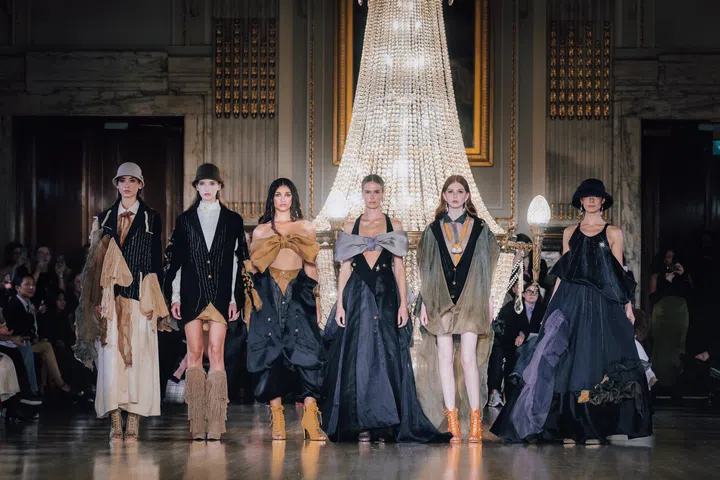
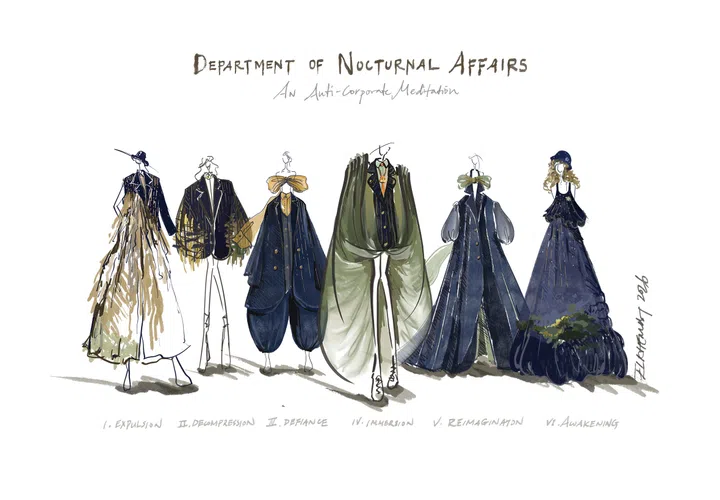
That same curiosity now sits at the heart of El Khemie, her independent fashion label she established in 2025, and Department of Nocturnal Affairs, the collection she brought to London Fashion Week. Built around Singapore’s workaholic culture, the collection explores the after hours that many Singaporeans are all too familiar with: leaving the office late, counting the lit windows of buildings on the way home, and trying to make space for the dreams that exist outside of work.
Colour was key to translating the collection’s concept. Kassandra worked with formal navy suiting, infusing it with hand-dyed silk organza coloured by the everyday fuels of working life: coffee for sustenance, black tea for respite, chamomile tea for calm, and butterfly pea tea for fascination.
The silhouettes followed suit, beginning with a classic navy pinstripe suit before gradually unravelling its structure until the final look almost loses the suit entirely. For Kassandra, the real test lay in deconstructing and reconstructing the suit through pattern-making, sewing and detailing, a challenge she gladly took on.
Here, Kassandra shares more about why that risk has been worth taking.
Credit: El Khemie
I couldn’t really imagine it happening. It wasn’t until I bought the plane ticket that I realised, “Okay, this is really happening. This is actually becoming a reality.”
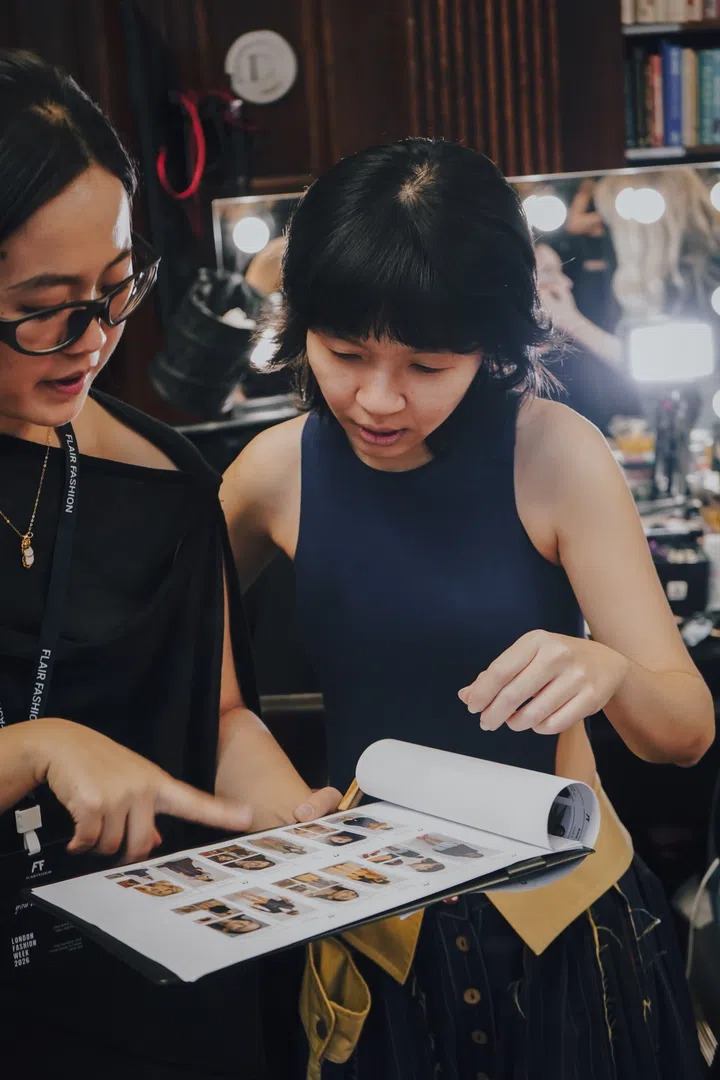
But in any case, things worked out quite naturally. The organisers first reached out to me about 10 weeks before the event because they had seen my graduate collection and were really interested in it. They wanted to showcase the collection, but at the time, I had a chat with them and told them that I didn’t think it was the right time.
Credit: El Khemie
Part of it was because I knew I was at a point where I was building a brand, and doing a one-off showcase didn’t necessarily have much of a legacy. When you’re building a brand and committed to developing its story, you start thinking more carefully about what the right platform is to present that story. I wanted to create something that could exist on a stage and communicate the vision of my idea.
That’s when I felt like it was the right time to accept the invitation. Everything else just fell into place from there.
What do you hope people in London will see or understand about Singaporean creativity through your work?
Credit: El Khemie
I hope there’s a sense that Singaporean creativity is multidimensional. We’re not always creating by being objective-driven or planning a singular outcome in mind — it’s simply a way of expressing ourselves.
With the idea of talking about Singapore’s workaholic culture on an international stage, I’ll be honest — I paused and thought about it for a while. I wondered, “Is this really the thing that we want to tell the world about Singapore?”
But it doesn’t change the fact that people are already looking at Singapore in terms of our work culture. I’m not embarrassed to talk about it because there are so many layers that need to be understood about this culture and it’s not necessarily negative.
I think it’s only when we talk about it and present it in different ways that some of those harder conversations can be presented in a way that allows people to engage with them.
You’ve moved from architecture to filmmaking and now fashion. Looking back, does this feel like a series of career pivots to you, or have you always seen these disciplines as connected?
For me, they’re definitely connected. When I left architecture and moved into filmmaking and fashion, a lot of people asked me, “Why the career switch?” But I’ve never really seen them as separate things.
In very broad terms, I would say it’s looking at design on a different scale. In architecture, you’re looking at things on a much larger scale — spaces, structures, places and how people experience them. When you move to a much closer scale, you start looking at the human body, materials and the things that sit directly against the skin. To me, that scale was the connection. It was still design, but it was something much closer to the human experience.
I also think disciplines are defined for a purpose, whether in professions or education, because we need a specific name to define a position. But at the end of the day, I believe that a designer is a designer. The spirit of wanting to design — to be able to make the world a better place or simply just problem-solve — is universal and can exist across many disciplines.
I’m also fortunate to have developed a lot of different skill sets. My starting point is always the idea or the story I want to tell. Once I have that, I think about what medium would best allow me to develop and communicate that idea. It doesn’t really matter to me whether it ends up being film, fashion, architecture or something else. Those are simply different ways of expression.
In 2023, you took a career break to pursue a Master of Arts in Fashion at the Royal College of Art. What was happening in your career and in your life that made you feel, “I need to stop and do this”?
It was actually more of a pull factor than a push factor. I wasn’t at a point where I felt I needed to leave my career. In fact, my career was at a high point — and I don’t mean that in terms of status, but because I was working on projects that I was passionate about and wanted to see through.
At the same time, I had started learning how to sew and design on the side, and my interest in fashion just grew out of proportion to what I had expected. Eventually, I wanted to take that interest to a deeper level by going back to school where I could explore the topic.
At the time, my work was centred around urban planning and consultancy — projects dealing with big ideas over long-term horizons. Diving into fashion grounded me; picking up those skills gave me a new way to connect with people, even without the intention of becoming a fashion designer. That understanding alone taught me to truly value the craft as a designer. At some point you have to make a choice, so I left my job and went back to school.
Was there any fear or uncertainty around stepping away from the career you had already built to become a student again?
Definitely, yes. At several points in my life, I’ve either deliberately or subconsciously chosen the path I was most fearful of. It’s become a recurring pattern. I know myself well enough by now to recognise that fear usually comes with two traits.
The first is looking at something and not knowing how to do it. The second is that, despite not knowing, my heart starts beating fast. That’s when I know I’m genuinely curious about something — and that it’s a sign I should pursue it.
I felt that when [I chose] to go back to school, and again when committing to fashion. But I’ve learned to manage that fear. I try to look at it from the opposite perspective: the fear of taking the leap was nothing compared to the fear of missing out if I didn’t seize the opportunity to pursue fashion. In fact, my biggest fear back then was simply not getting into fashion school — I didn’t have a bachelor’s degree in design and was applying straight for a master’s. Just thinking I could pull that off was bold, and getting accepted felt like the hardest challenge.
Once I got in, I struggled at first. People there didn’t understand how an architect’s brain worked. When I brought structural elements into discussions or mentioned my architecture background, people questioned what I was doing there: “Are you actually ready to do fashion? Why is the first thing you design still architecture?” They didn’t realise that, for me, I need the context of the environment. I also had to battle the stereotype that everything I made was bound to be structural.
You described the decision to study fashion as a chance to “unlearn, relearn and explore”. What did you actually have to unlearn and relearn?
Both times I went to the UK to study — first for my studies in architecture, and then again for fashion — one of the biggest things I took away was learning to unlearn the way I was brought up in Singapore.
Growing up in Singapore, I was very used to the idea that whenever you start doing something, the objective has to be clear and you have to see the end goal. That was what I grew up with and was very used to — this value that Singaporeans have.
But in a foreign environment, I think my mind opened up a lot more. And that’s particularly relevant with design, because you don’t have to design with a particular objective or know exactly what angle you want. In fact, most of the time, you can’t really project what the outcome will be.
Instead, you have to learn to trust your intuition — to uncover and trust that feeling in your gut — and let the process take you somewhere. I think that’s something I still have to remind myself of: to trust the process and let it lead wherever it goes.
What did you tell yourself during that period when you weren’t sure where the path was going? Were there people around you who inspired you and kept you going with their words?
I had to keep reminding myself that it was okay to fail. I was perfectly fine with moving towards the fashion industry and not necessarily getting anything else out of it, because at the end of the day, I didn’t venture into fashion thinking that I wanted to become a famous fashion designer. That was never part of the equation.
For me, it was always a line of inquiry — an opportunity to understand space and scale. If that could be fulfilled, then I felt the experience would already be worthwhile.
Of course, it was difficult because it took a lot out of me, both financially and in terms of what I was willing to put into my ideas and this shift. The cost was extremely high, but I still felt that it was important. Sometimes we have this mentality that if we’re going to put everything into something, we must succeed at it. But I think my intention behind wanting to pursue fashion was a very pure, emotional feeling, and none of these hardships or eventual outcomes should take that away.
So I had to remind myself that it was okay if I didn’t end up becoming some famous fashion designer, and that just because I had put so much into making it happen didn’t mean I had to “succeed” in the conventional sense. That was something that helped me through it.
I’ve also had people tell me that I’m very fortunate to have found something I’m so passionate about. Not everyone gets to find something they genuinely want to pursue at all costs. Because I happened to encounter something like that, it made sense for me to pursue it.
Building a sustainable career in fashion can be challenging, especially as an independent designer. Has your relationship with money, success or financial stability changed as you’ve moved from architecture and film into fashion?
I don’t know if my mindset has changed, but it’s definitely a constant dialogue. It’s a difficult thing to manage when many of these passions are financially consuming and not exactly profitable.
You’ll always be balancing your passion and ideals against financial stability. That’s something I’ve had to navigate at many different points in my life, and I think I’ll probably continue to do so.
If there’s a way to manage your life so that you can link ambition, passion, and financial stability, then I think it can work — and in my case, it has worked. It means I can continue to grow my craft in my own way while keeping money out of the creative equation.
I don’t know whether those two things will come closer together at some point, but protecting my intuition as a designer is still my top priority right now. There’s just a certain way I can compartmentalise my life so that unnecessary distractions don’t derail me from that desire to create.
What do you wish someone had told you when you were younger about building a career in the creative industries?
I wish someone had told me to grow at my own pace.
I don’t think that’s very common in Singapore — knowing that it’s okay to fail and go at your own pace. There’s always a certain pressure to hit targets, goals, and objectives. But in the creative industries, there’s a necessary process of exploration, and I hope people understand that with exploration comes failure. When I do my experiments every day, they come with setbacks that push the timeline back, but that doesn’t mean you should discount the process. You should be allowed the time to fail. We should be in no hurry to succeed.
One thing I remind myself of is that when you look at local brands that succeed, you know them because they’ve probably spent 5 to 10 years building their brand. They’ve gone through their failures and slowly adjusted their direction along the way — that process is truly necessary. Just because you feel pressured to be successful on a certain timeline doesn’t mean you have to succumb to it. Just because institutions have deadlines for funding, proposals, or projects doesn’t mean you have to succeed on that exact same timeline.
I also want to share something valuable I heard early on in the industry. One of my mentors — a trainer at technical school, the Textile & Fashion Industry Training Centre which was renamed to Tembusu Institute in 2024, when I was learning to sew — told me: “If you see fashion as a form of art, my biggest worry is that the industry will fail you.” I’m very grateful someone told me that at the start. If you are determined to do fashion in your own way, you have to be prepared to calibrate your expectations.
Is there any advice you’d give to Singaporean women who want to pursue their passions like you, but are also afraid to take that first step?
I would say: take that leap of faith, but do it with your eyes open. Take that leap of faith when the feeling is strong enough. But when I say “do it with your eyes open,” I mean you have to be extremely honest with yourself and be clear about the consequences of the choices you’re making. I would never romanticise what I did — leaving a job and moving overseas to pursue an education. I think a lot of people look at me with eyes of envy.
But the price I had to pay to make that happen is something I don’t share as much about. So while I wouldn’t blindly encourage people to just do it, I also wouldn’t undermine the kind of commitment it takes if you do.