Designers don’t always have time to explain the ideas behind their collections before the show, but Carla Fernández—who opened the first day of Mexico Fashion Week—took a moment to share the inspiration behind hers. Her starting point was the Manila Galleon, a trade route that connected Acapulco with Asia across the Pacific for more than 250 years, thereby linking Mexico to a wider commercial network that extended as far as Europe.
Fernández used that starting point to highlight Mexico’s role as an important center of cultural exchange during this period, when textiles, silver, food, and crafts circulated freely between continents. That idea carried through to the evening’s performance, in which dancers wearing loose-fitting garments dyed with natural pigments moved around a formation of chairs arranged as if for a game of musical chairs, exploring how cultures come together and influence one another.
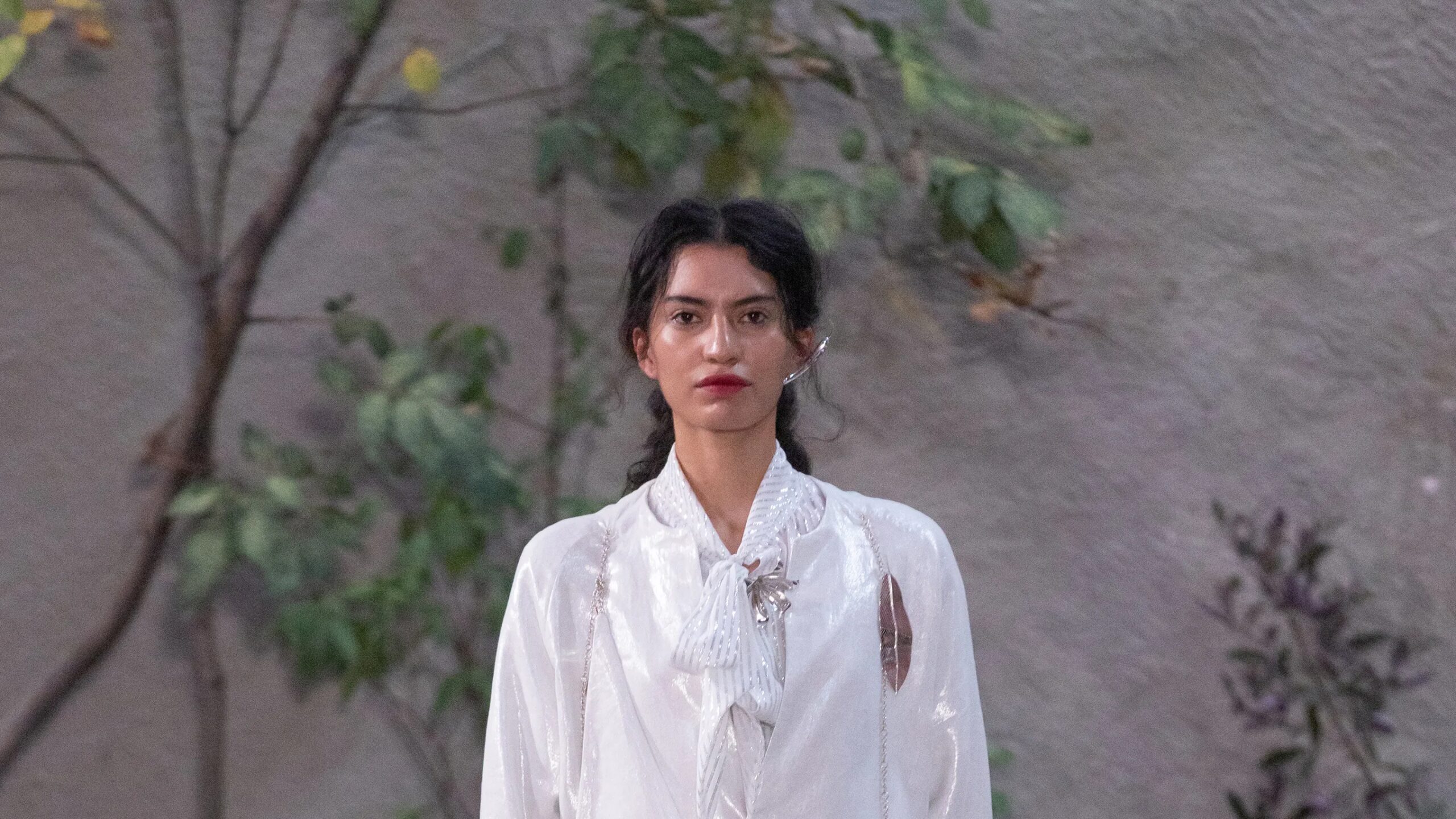
The dancers’ minimalist outfits stood in contrast to the first looks on the runway, which featured lustrous fabrics, embroidery inspired by “papel picado”, the traditional cut paper decorations found at Mexican celebrations, and knots tied at unexpected points on the garments, at the hip, say, or shoulder. “They are the ties, the interweaving of how we become one,” Fernández said backstage. She also explained that the bags were inspired by merchants, incorporating them into the looks as an integral part of the collection.
Geometric silhouettes are a signature of Fernández’s work and this season they appeared in wrap skirts, wide-leg trousers, and tailored pieces finished with floral embroidery. Silver jewelry included chili pepper-shaped earrings and pendants, engraved hoop earrings, and leaf-shaped ear cuffs that extended across much of the ear.
Fernández’s fascination with a chapter of Mexican history that may seem distant today has roots in her own childhood. Her father served as director of museums and exhibitions at Mexico’s National Institute of Anthropology and History, an experience that helped nurture her interest in the country’s craftsmanship and the cultural heritage it represents. In this way, the collection was not only a deft exploration of a country’s history, but also of her own.