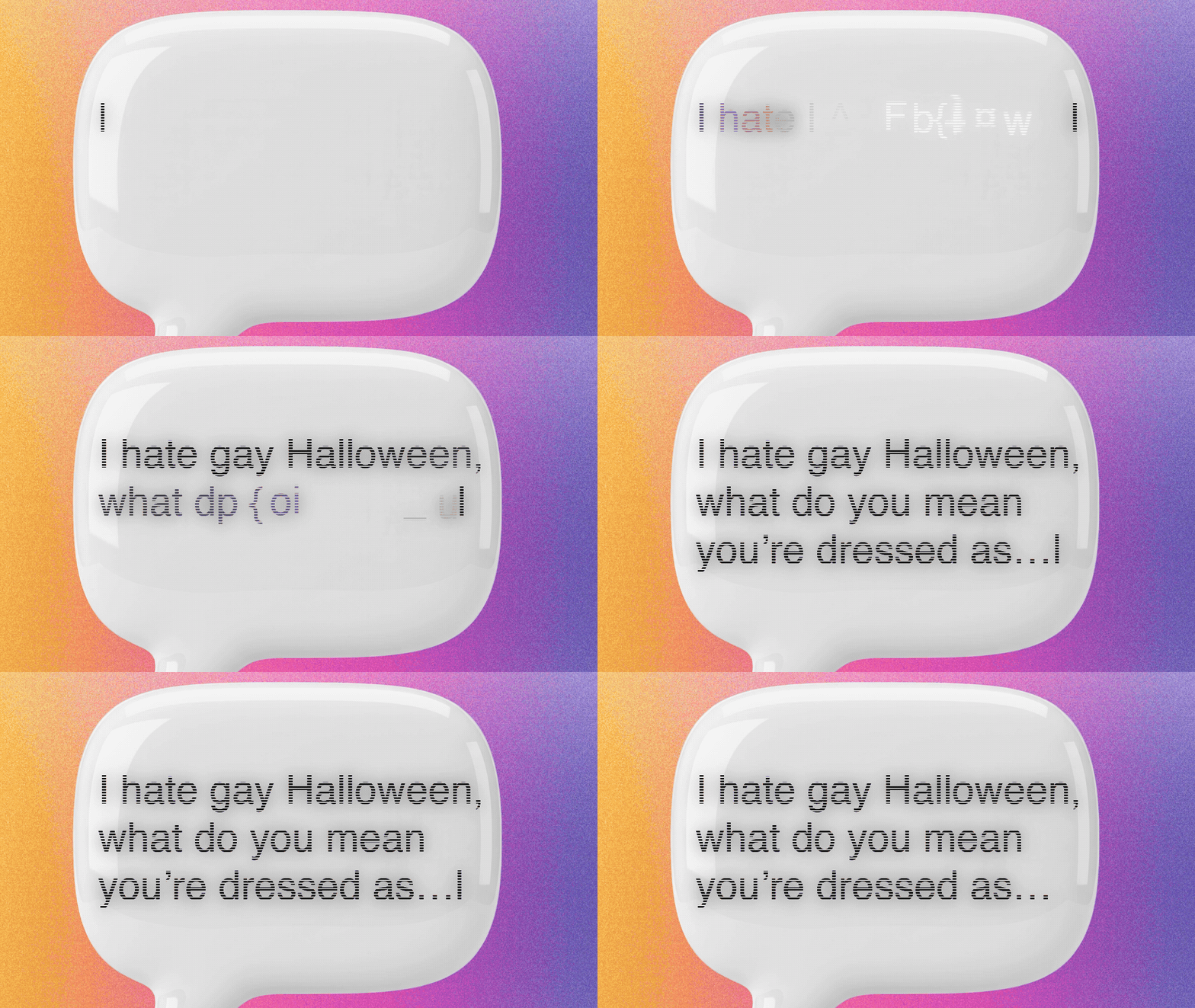
When you see a post that begins with “I hate gay Halloween, what do you mean you’re dressed as…” you know you’re in for a good laugh, or perhaps the feeling that you’re completely out of the loop. Trick-or-treating isn’t until this weekend, but in the age of social media the day itself has taken the back seat—it’s online where the battle for the best costumes takes place, and it’s happening earlier every year.
The trend began taking shape in the late 2010s and gained strength during the pandemic: celebrities—most notably the Kardashian-Jenner clan—began re-creating memorable moments from pop culture, mostly old film posters or iconic music album covers, and staging elaborate costume shoots for their Instagrams. The closer the re-creation would get to the original the better—and worthier of likes.
The idea of gay Halloween exists somewhere in this realm, though it’s inevitably more lo-fi, and the most successful looks aim for laughs rather than mere online clout. Plainly, it’s when people—mostly gay men—pick a niche pop culture moment or meme and re-create it in a costume. Forget witches and Scream masks. In 2004, Mean Girls declared, “In girl world, Halloween is the one night of the year when a girl can dress like a total slut and no other girls can say anything about it.” The 2026 equivalent is less about horny devils. Halloween is now the one night of the year when you can let out your inner freak or geek: Now you can be the breakup Post-it from a 2003 episode of Sex and the City, or Marc Jacobs when he wore a neck brace. Two years ago, a friend dressed as Antonio, a character played by Ariana Grande on Saturday Night Live. Another at the same party went as Rihanna as a nun for an Interview magazine cover.
Once upon a time, Halloween was about being as frightening as possible. Sure, there is something indeed terrifying about being broken up with via Post-it, and some less-online people are still attached to the classics—a zombie, a devil, et cetera—but Halloween has been co-opted by the internet, and by celebrity culture, in a way that has made it entirely self-indulgent.
Consider Heidi Klum’s famous annual Halloween bash, which she started in 2000. Early on, her costumes evolved from classic (a dominatrix the first year, a vampire in 2005) to more complex (a skinless person in 2011) to complete cosplay. In 2015, Klum appeared as Jessica Rabbit; in 2018, as the ogre version of Fiona from Shrek. Last year, she was a Medusa, and her husband, Tom Kaulitz, a hoplite turned into stone. There are Hollywood-level prosthetics, and, largely, it appears as if her costumes are made more for an image than for a party. Klum, in this space, is both the trendsetter and the shining example of the way our collective take on the holiday has evolved to adjust to our online-first lifestyles.
“Someone I just started working with recently said, ‘We live in a reference economy,’” says stylist Ron Hartleben, who works with Camila Cabello and Tyla, among others. “That really struck me,” he says. “Everything has been done. Everyone has access to all the same images now.” So much so that people in the queer community “have gone about seeking the most niche, obscure reference from a show or pop culture moment and making that their Halloween costume” so that a mere mortal, in this case a cis, heterosexual person, may not understand it. “Gay Halloween is exploiting that obscure moment in pop culture and running with it to create one of the most stupid and entertaining outfits imaginable,” Hartleben says. “As long as you think it’s funny and you get it, you’re doing gay Halloween right.”