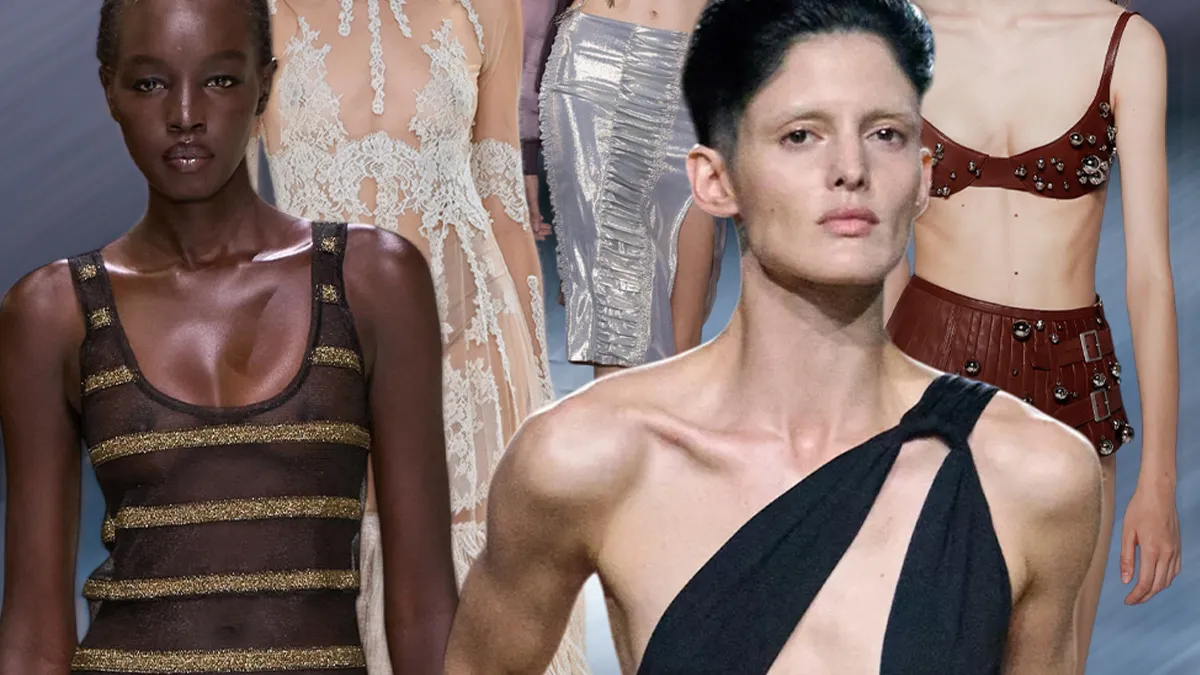
Bra tops were visible across the majority of runways, too. They were a fixture at Prada, cone-shaped at Jean Paul Gaultier, and fashioned from leather and silk scarves at Tod’s and Hermès, respectively. They were bandeau in style at Stella McCartney and Mugler, and styled over dresses and tops at Miu Miu and Marni.
It’s hard not to draw correlations between the bra’s ubiquity on the runway and the rise of GLP-1s. With bras replacing tops, the body is increasingly visible. It puts abdomens, waists and arms in focus, drawing attention to the wearer’s figure. One insinuation is that those taking weight loss medications may want to show off their newly trimmed frames, especially at a time when thinness is so present in the cultural conversation.
Still, the suggestion that the rise of lingerie details and sheer fabrics is in direct response to GLP-1s could be misguided. Belgium-based inclusive womenswear brand Ester Manas offers a case in point. Manas, known for radical size inclusivity, showed a SS27 collection made in partnership with Belgian underwear brand Primadonna, featuring sheer bodysuits and architectural bustiers.
The same can be said of Di Petsa’s latest collection shown at London Fashion Week. While there was plenty of skin on display — transparent dresses, breasts covered merely by jewelry or a model’s hand, and plunging necklines — the brand is deeply rooted in inclusivity. Season after season, diversity has remained central to its runway, and this season was no different.
“For me, it’s about showing the garments in the best way possible,” says Greek designer Dimitra Petsa. “Through size diversity, you can show different designs. I think body conscious silhouettes look amazing on fuller bodies.”
In addition to Ester Manas and Di Petsa, designers like Rick Owens in Paris, Marco Rambaldi in Milan, and Collina Strada in New York kept inclusivity as a fixture on the runway. They continue to prove that skin-baring designs and body-conscious silhouettes are not exclusive to any one body. “I don’t think there should be one body type that represents fashion,” says Collina Strada creative director Hillary Taymour. “The world is full of different people, and fashion is much more exciting when it reflects that.”