
This is a guest post. Viewpoints and suggestions are the writer’s own.
GruffyGoat is a web design and advancement agency in Greenville, South Carolina. Over the previous 14 years, we have actually constructed and now keep thousands of WordPress websites for local business, nonprofits, and firms that hand over their development work to us. We are not a launch-and-leave shop. The relationships we appreciate look less like a task and more like a fractional teammate, which suggests the day a site goes online is the day the actual job begins.
Speed belongs to that job, and it does not reach be optional. WP Rocket has actually gotten on every WordPress site we develop for over 5 years. A new client, a redesign, a white-label job for a partner company, it makes no difference. WP Rocket takes place before launch, the same way you would not hand over an auto without tires. Here is how it came to be common tools for us and why it has actually stayed this way.
Speed Quit Being Optional
When GruffyGoat started back in 2012, website speed was something you glanced at near completion of a construct and after that mainly failed to remember. That has not been true for a very long time.
Two points changed it. Google made Core Web Vitals a ranking signal , so a slow-moving site is currently a peaceful tax obligation on a customer’s search presence. And site visitors stopped being patient, particularly on phones, where the majority of our clients’ website traffic now comes from. A small business owner does not read a record concerning Biggest Contentful Paint They feel a website that drags, therefore do individuals they are trying to get to.
The harder issue for a firm of our size was none solitary sluggish site. It was consistency Every WordPress website put on weight in time. A plugin below, a tracking pixel a customer’s marketing professional includes there, a page building contractor doing greater than it should. A site that scored well at launch wanders. We were not maintaining one site quickly. We were maintaining numerous them quick, across different styles, home builders, hosts, and customer routines. Hand-tuning every one was not a strategy. It was a slow-moving leak.
What We Attempted First
Before WP Rocket, we did what a lot of companies do. We stacked totally free plugins One for caching, one more for minification, a third for lazy loading, each with its very own setups screen and its own point of views.
That can function. It is also vulnerable. A setup that helped one website would break an additional. A theme update would certainly undo a week of cautious adjusting. Every website needed its own babysitting, and when something broke after hours, there was no person to call. Free devices are not complimentary. They are spent for in our team’s time, which bill came due monthly.
We were not looking for magic. We were looking for something boring in the very best feeling of words. Predictable. The very same on every site. Something we can place on a list and depend on without examining it two times.
Why We Acquired It, and the Problem We Had First
We kept hearing the WP Rocket name. In WordPress community threads, from other developers, in the type of recommendation that shows up when people contrast notes on what actually holds up. Ultimately, we stopped reviewing it and examined it.
We did have one genuine doubt. WP Rocket is a paid plugin, and we use it on every website, so the price isn’t per permit. It expands ideal alongside us. On top of that, we hold most client websites on handled WordPress hosting that already runs server-level caching. Including an additional caching layer seemed like a great way to start a fight between 2 devices.
It did not. WP Rocket sat alongside the host’s caching without problem and looked after the parts server caching does not touch, the JavaScript, the CSS, and the means pictures tons. It was likewise quicker to set up than the complimentary stack we were replacing. The number one factor we got it was not a solitary attribute. It was that one tool did the entire job, the same way, on every site. For a firm, repeatable beats smart.
What We Actually Use
WP Rocket switches on a big share of its work the minute it is triggered, which is the point. A couple of features do the hefty lifting on the 90 -plus mobile scores and environment-friendly Core Internet Vitals our clients respect:
- Page caching On by default. It is the structure, and it is one less point for us to think of.
- Delay JavaScript Execution The solitary largest bar we have for mobile. The majority of what reduces a contemporary WordPress website is scripts, consisting of the third-party ones clients add without telling us. Holding them up until a site visitor communicates with the web page is what relocates a mobile score from middling to eco-friendly.
- Eliminate Unused CSS Web page home builders like Elementor and Divi ship a great deal of CSS that a provided web page never ever uses. Clearing up that render-blocking weight off the top of the web page is commonly the distinction in Largest Contentful Paint.
- LazyLoad Images pack as site visitors scroll to them, not at one time. Easy, and it matters most on the lengthy, image-heavy pages small businesses often tend to desire.
- Typeface preloading Cuts the little layout changes and hold-ups that originate from web font styles loading late.
None of this asks a developer to hand-write anything. That is what makes it functional across thousands of sites instead of a handful.
Another piece of how we use WP Rocket rests outside the score chasing. A lot of the web servers our clients run use Varnish, a server-level cache. WP Rocket’s Varnish add-on clears that web server cache from inside WordPress, so we handle it there rather than the host’s own assimilation. When a website’s cache requires cleaning, we do it in one place instead of logging right into a different hosting panel. It sounds minor. Throughout thousands of websites, the small points are what build up.
What It Looks Like in the Numbers
A page-builder site is the reasonable test, because that is where the weight is. The builder-heavy websites we reconstruct commonly start in the 40 s and 50 s on mobile PageSpeed Insights. That is typical for a content-rich website running a visual builder and a few advertising scripts.
With WP Rocket configured, those exact same sites land in the 90 s on mobile and go eco-friendly across Core Web Vitals.
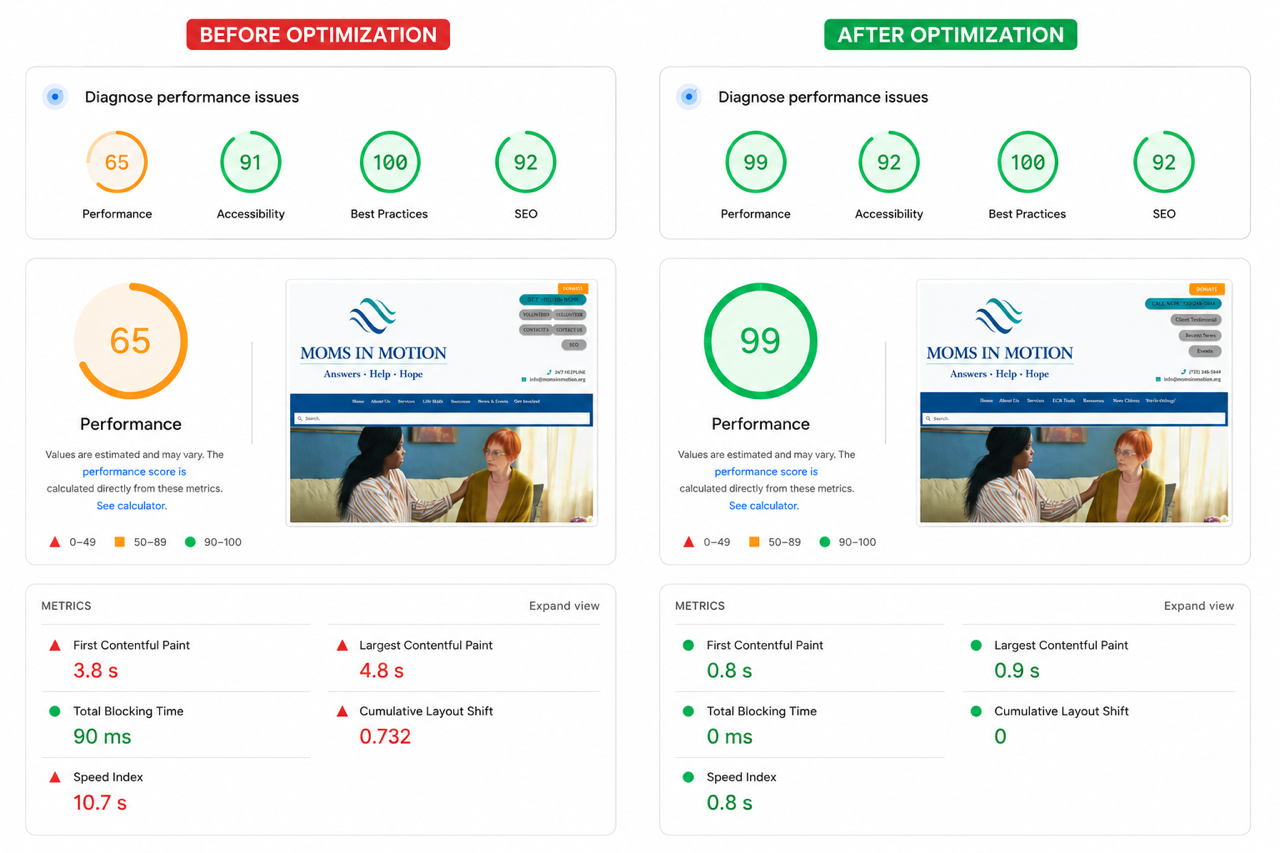
The number on the display is the easy component to show. The outcome we value a lot more is the quieter one. We obtain less rate problems, less after-hours fires, and much less sites that slip below where they need to be in between sees. Our clients do not think about their site’s efficiency, which implies we have done our job. And due to the fact that Core Web Vitals feed search position, the exact same work that makes a site feel faster likewise secures the presence a customer is paying us to grow.
WP Rocket is the unusual device we never ever need to market internally and never ever have to apologize for. It does what it states on every website, and afterwards it gets out of the way.
The Hardest Thing It Has Aided with
The toughest websites are page-builder builds, the Elementor and Divi websites that offer clients the design freedom they want and hand us a stack of JavaScript and CSS in return. Include the third-party scripts that appear later, a conversation widget, a booking embed, two analytics tags, and a site that launched fast can fall back without anyone touching the design.
That is where WP Rocket earns its place. Postpone JavaScript Execution and Eliminate Unused CSS do a lot of the work, and they do it without us needing to restore the site or informing a customer to give up the builder they such as. We get to maintain the guarantee we made about how the website would certainly really feel, also after the client has actually included things we did not prepare for. For a support-first agency , that matters greater than a perfect launch-day score.
What We Inform Other Agencies
A few things we would inform an additional company evaluating this.
- Rate is not a launch task It is an upkeep job. A website is fastest the week it goes real-time, and works against you from there. If efficiency is not part of your continuous organizing and upkeep work , it is not really handled.
- Make it typical, not a per-project choice The agencies that battle with rate are normally the ones determining, on a site-by-site basis, whether it deserves the effort. Decide as soon as. Place it on everything. Take it off the table.
- Examine the JavaScript and CSS setups Do not simply switch them on and walk away. They are the best attributes and the ones most able to damage a layout. Five minutes of inspecting per site is affordable insurance policy.
- And great holding and WP Rocket are not an either-or Handled holding handles the server. WP Rocket handles the front end. They are doing various tasks, and the sites we are proudest of use both.
Why It Is Still on Every Website
If WP Rocket went away tomorrow, the important things we would miss is not a feature. It is not needing to consider it Returning to a pile of complimentary plugins would certainly suggest handing our group back hours every month and handing our clients back a slower, less steady site. That is a trade we are not thinking about.
It has held up far better than we anticipated, and we did not anticipate little. A tool that remains this beneficial for this lengthy, with every modification WordPress and Google have actually thrown at it, is uncommon. It ended up being common equipment at GruffyGoat due to the fact that it does one difficult work well and asks for practically absolutely nothing in return.
If you run a firm and you are still adjusting sites one by one, that is the case for WP Rocket in a sentence. Pick the tool as soon as, placed it on everything, and get your group’s attention back for the job that in fact needs a human.