WordPress ecommerce websites have a different security profile from many other types of websites.
An attack can interrupt transactions, affect customer data, damage trust, and directly interfere with revenue. That makes ecommerce an interesting group from our 2026 WordPress security survey to dive deeper into.
Of the 319 respondents included in the main survey, 106 respondents said they worked on an ecommerce website. Their responses show a group that is more concerned about security than average and generally more likely to have security controls in place, but which also reports a very high level of previous security incidents.
This report looks specifically at those 106 respondents, providing unique data into what they worry about, which controls they use, how incidents are detected, what happens when an incident occurs, and who is ultimately responsible for security.
This report covers ecommerce security in depth, with insights not covered in our main security survey report. If you’d like to check out the main report, which covers 319 respondents across all website types, check out our WordPress security survey statistics post here.
Ecommerce security at a glance
- Security concern averaged 8.37 out of 10.
- 85.7% rated their concern between 7 and 10, compared with 72.5% of respondents outside the ecommerce group.
- 61.0% rated their concern at 9 or 10.
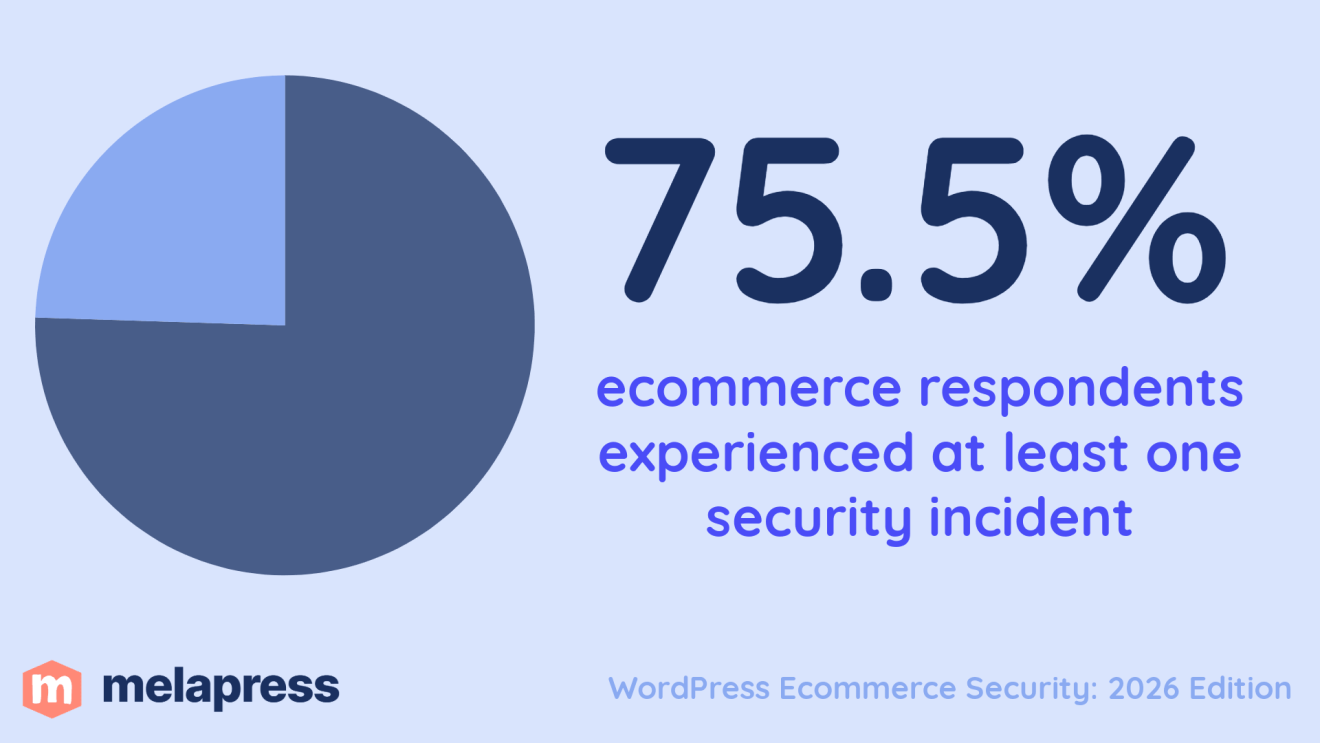
- 75.5% had experienced at least one security incident.
- 72.7% of those with a confirmed incident had experienced two or more.
- 65.3% of those with an incident selected at least two impacts from their most serious incident, compared with 40.9% outside the ecommerce group.
- 23.6% selected both website downtime and lost search rankings as impacts of that incident.
- Respondents reported an average of 4.68 of the eight security controls measured in the survey.
Three-quarters have experienced a known security incident
75.5% of ecommerce respondents had experienced at least one security incident. Among those with a confirmed incident, 72.7% had experienced two or more.
This shows that, similar to the other groups in the survey, many of those working on ecommerce stores have experienced incidents in the past.
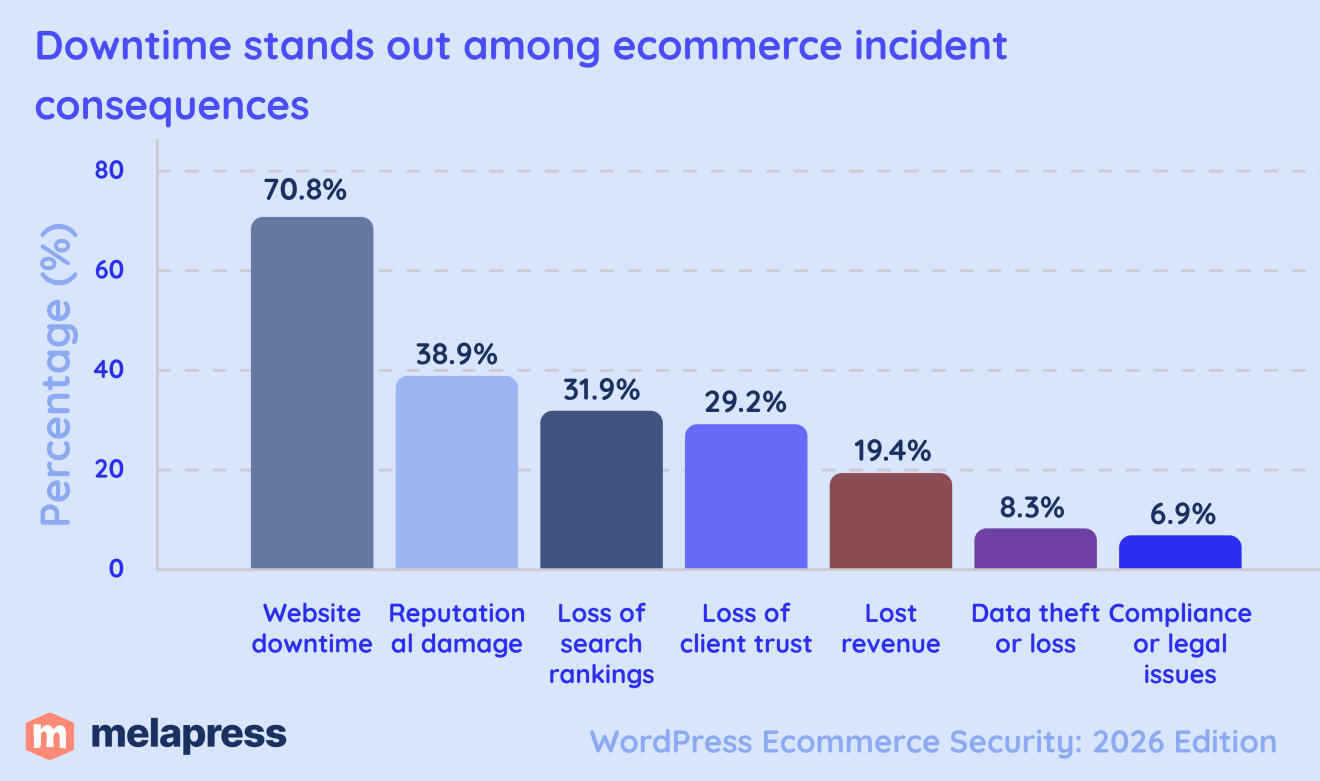
Downtime was the most common incident impact among ecommerce respondents
Among ecommerce respondents with a confirmed incident who answered the impact question, 70.8% reported website downtime from their most serious incident. Reputational damage was reported by 38.9%, loss of search rankings by 31.9% and loss of client trust by 29.2%. Revenue loss was reported by 19.4%, data theft or loss by 8.3% and compliance or legal issues by 6.9%.
Incidents often had several consequences at once
The individual impact numbers do not show how often multiple consequences were reported for the same incident. Out of the ecommerce respondents who answered the impact question, 65.3% selected at least two impacts from their most serious incident, compared with 40.9% of respondents outside the ecommerce group. 29.2% of ecommerce respondents selected three or more impacts, versus 13.9% outside the group.
One combination that stood out in particular was that 23.6% of ecommerce respondents selected both website downtime and lost search rankings, compared with 6.6% outside the group. The survey does not tell us which occurred first, but it shows that availability and search visibility were sometimes affected in the same incident.
The commercial impact extends beyond direct revenue loss
Only 19.4% explicitly selected revenue loss as an impact of their most serious incident.
Yet 51.4% of ecommerce respondents who answered the impact question selected either reputational damage, loss of client trust, or lost search rankings, or multiple of these, without selecting revenue loss. Even of those who reported downtime, 84.3% did not also select revenue loss.
The survey cannot tell us whether these other consequences eventually caused a financial loss. However, it does show that the revenue-loss response captures only part of the impact respondents reported.
Security concern is particularly high among ecommerce respondents
The average security-concern score was 8.37 out of 10 for those working on ecommerce sites. 85.7% rated their concern at 7 or higher, and 61.0% rated it at 9 or 10. Their answers about specific concerns show which risks stood out most.
Availability is the leading concern
61.3% of ecommerce respondents said that website availability was one of their biggest security concerns.
It was the most commonly selected concern in the group, followed closely by data theft or loss at 56.6% and website defacement or reputational damage at 53.8%.
Financial loss came in fourth at 35.8%, and compliance, selected by 30.2%, came in fifth.
Compared with the rest of the survey, ecommerce respondents were 8.2 percentage points more likely to be concerned about website availability.
For a transactional website, the possible reasons for this seem obvious. If a content website becomes unavailable, visitors cannot read its content for a while. When an ecommerce website becomes unavailable, transactions may be interrupted, and revenue can be directly affected.
Interestingly, the concern matches their reported experience, with downtime also being the most commonly selected impact of a previous incident.
Data theft and financial loss matter more to ecommerce respondents
The differences become larger when looking at data and revenue.
56.6% of ecommerce respondents were concerned about data theft or loss, compared with 41.3% of the rest of the sample, a difference of 15.3 percentage points.
Financial loss was selected by 35.8%, compared with 24.4% among other respondents.
Again, ecommerce websites often have more direct exposure to both risks. They may process customer information, maintain user accounts, connect to payment and fulfilment systems, and depend on the website itself for generating revenue.
The results suggest that ecommerce respondents recognize this additional exposure.
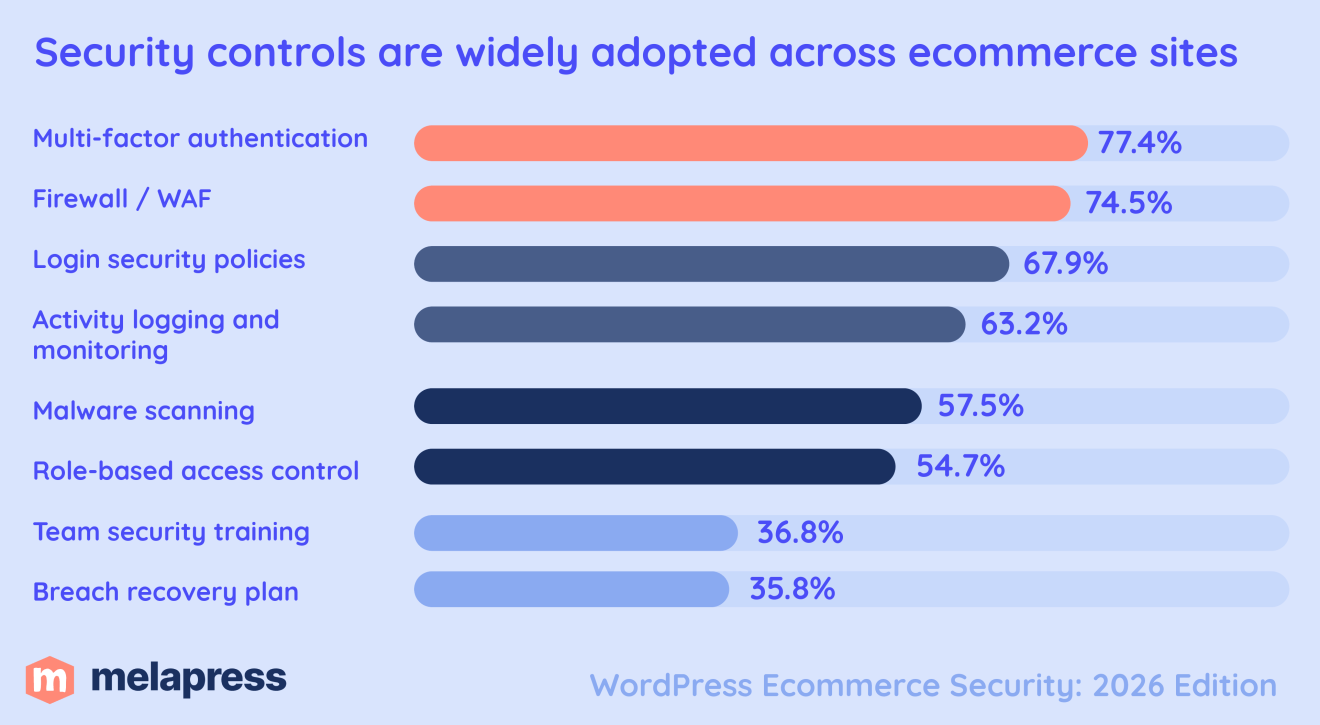
Ecommerce sites report relatively strong security control adoption
Ecommerce respondents reported having an average of 4.68 of the eight security controls measured in the survey.
Of the eight security controls measured, 2FA or MFA was the most common, reported by 77.4% of ecommerce respondents. A firewall or WAF was reported by 74.5%, login security policies by 67.9%, and activity logs or monitoring by 63.2%.
Malware scanning was reported by 57.5% and role-based access control by 54.7%. Team security training and breach recovery plans were the least common measures, reported by 36.8% and 35.8%, respectively.
The relatively low use of recovery plans is interesting in a group where 75.5% had experienced at least one incident. That being said, it’s consistent with the rest of the survey
Ecommerce respondents use more security controls than the rest of the sample
The ecommerce group was more likely to report every single one of the eight measured controls than respondents who did not select ecommerce.
Some of the largest differences were not in the most widely adopted technologies, either.
Role-based access control
54.7% of ecommerce respondents reported using role-based access control, compared with 38.5% of the rest of the survey.
That is a difference of 16.2 percentage points, the largest control gap between the two groups.
This makes sense in environments where different people may need access to orders, products, content, customer support, development, or administration without necessarily requiring unrestricted access to the entire WordPress installation.
Team security training
Training showed an almost identical gap.
36.8% of ecommerce respondents reported team security training, compared with 20.7% of other respondents, a difference of 16.1 percentage points.
Although adoption remains low in absolute terms, ecommerce teams appear substantially more likely to address the human side of security.
Recovery planning
The same pattern shows up when looking at breach preparation.
35.8% of ecommerce respondents had a breach recovery plan, compared with 23.9% among the rest of the sample. That is an 11.9 percentage-point difference.
Again, ecommerce performs better than the wider survey, but the benchmark remains low considering the potential impact of an unavailable or compromised store.
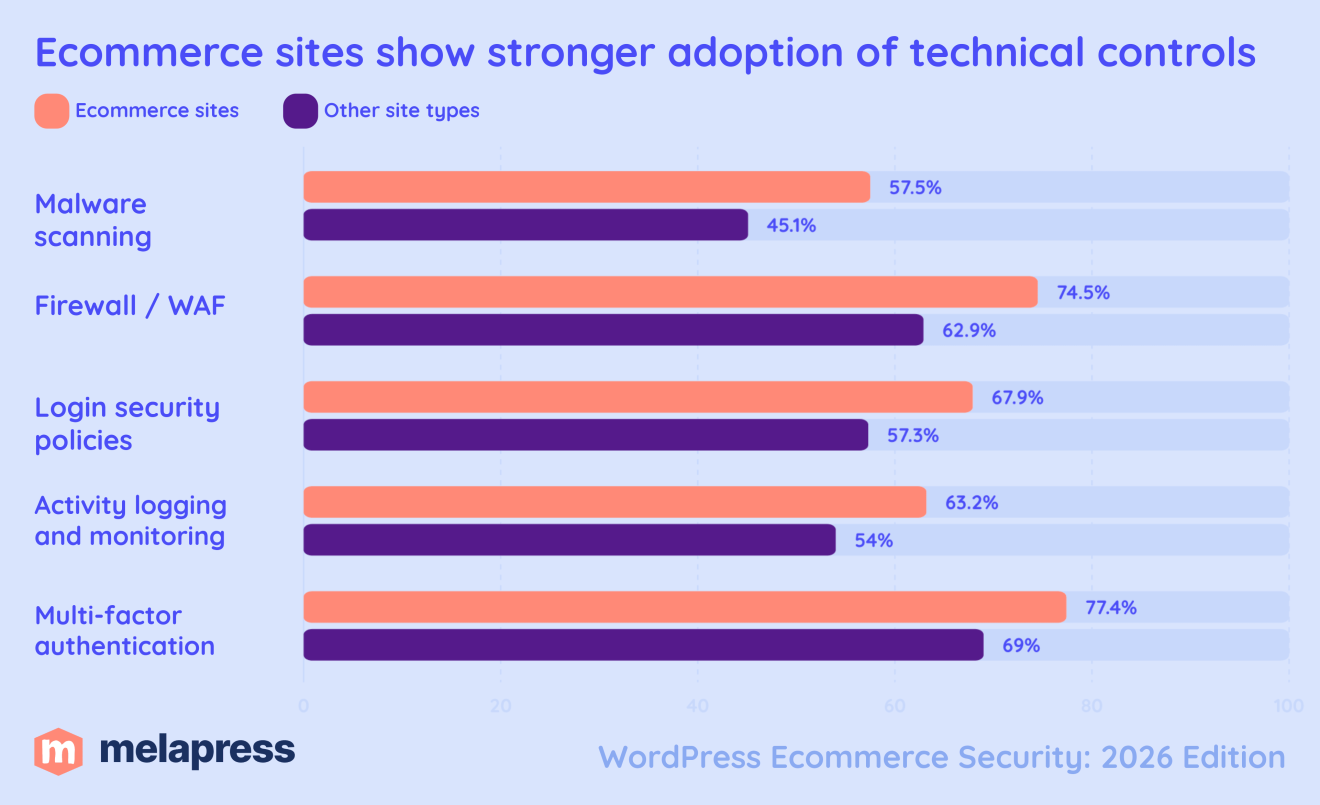
Technical controls are also consistently more common
Ecommerce respondents were also more likely to report other controls.
Malware scanning was reported by 57.5% of ecommerce respondents, compared with 45.1% outside the group. A firewall or WAF was reported by 74.5% versus 62.9%, and login security policies by 67.9% versus 57.3%.
Activity logs or monitoring were reported by 63.2% versus 54.0%, while 2FA or MFA was reported by 77.4% versus 69.0%.
These figures show that each control was more commonly reported by ecommerce respondents, even if they don’t show how well any individual website was protected.
People noticing something wrong is still the most common way incidents are discovered
How an incident is discovered can say a lot about the maturity of a security setup. Among ecommerce respondents with a confirmed incident, strange website behavior reported by someone was the most commonly selected method at 48.1%.
Logs or logging-tool alerts were selected by 45.5%, malware scanners by 37.7%, and hosting or server alerts by 35.1%. Search-engine warnings were selected by only 15.6% of these respondents.
Reports of strange behaviour and logging alerts were selected at similar rates. Because respondents could select several methods, the survey cannot tell us whether someone noticed a symptom before or after a technical alert. Search-engine warnings were the least common of the methods listed.
Whatever signal appears first, someone needs to review it and decide what happens next. That makes responsibility for security an important part of the picture.
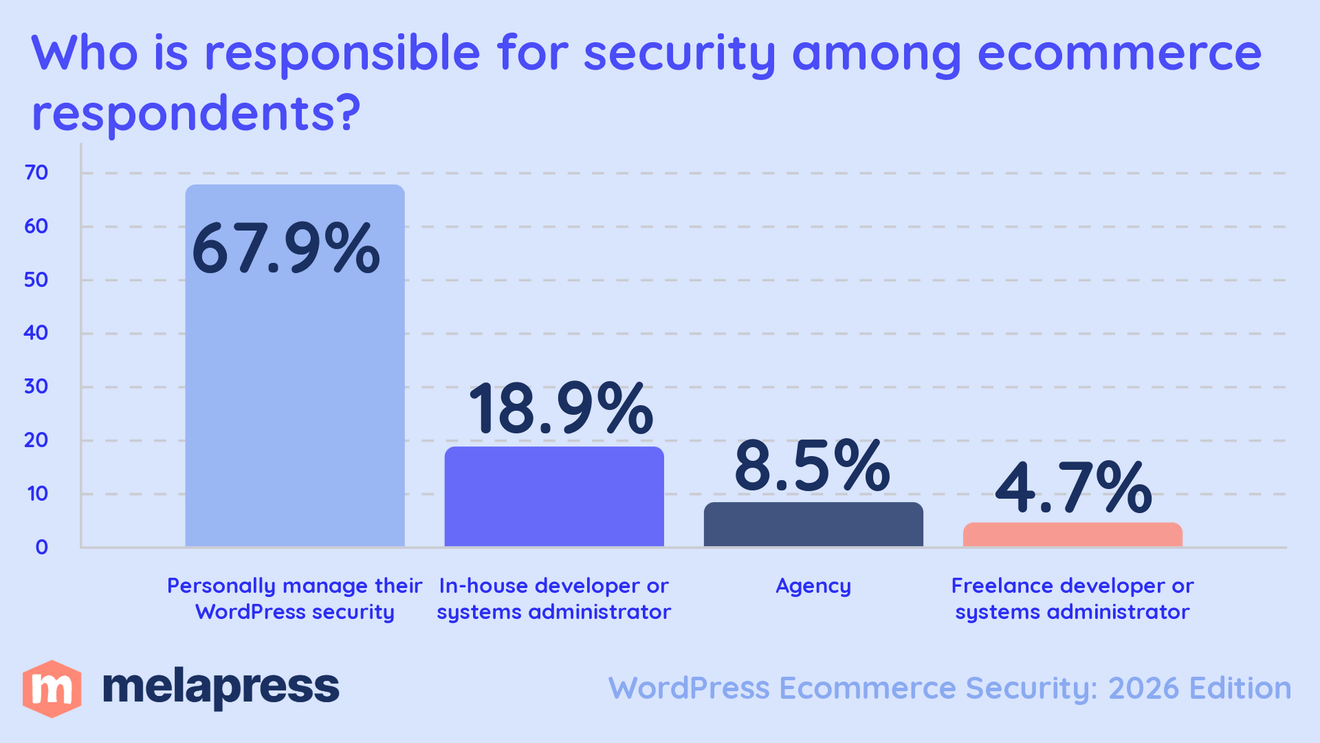
Most ecommerce respondents manage WordPress security themselves
Another interesting finding looks at who is responsible for security. 67.9% of ecommerce respondents said they personally manage their WordPress security.
The remaining groups were split, including 18.9% saying security was managed by an in-house developer or systems administrator, 8.5% saying it was managed by an agency, and 4.7% selecting freelance developer or systems administrator.
This does not necessarily mean two-thirds of ecommerce businesses have no technical or security team. The answer describes who the respondent said was responsible for WordPress security, and respondents themselves may be developers, administrators, business owners, or other technical staff.
Nevertheless, it shows how often responsibility appears to rest directly with an individual.
For these environments, security processes need to work operationally as well as technically. Alerts need an owner, access needs to be reviewed, recovery procedures need to be documented, and someone needs to know what happens when an incident is detected.
What does the 2026 ecommerce benchmark tell us?
The benchmark is most useful as a way to question your own setup rather than as a security score.
Consider whether your ecommerce website has the right security controls in place and is prepared in case something goes wrong.
- Reduce the chance of account compromise. Use 2FA or MFA, appropriate login security policies, and strong access management.
- Limit what compromised accounts can do. Give users only the access they require and regularly review roles and permissions.
- Detect suspicious activity early. Logging, monitoring, malware scanning, and meaningful alerts can help surface incidents before customers or search engines do.
- Plan for potential availability disruptions. Know how the store will be restored, how long restoration is expected to take, and whether backups have actually been tested.
- Prepare the people involved. Everyone involved in the store’s management should know what to do in case of a compromise, as well as what steps they should be taking to keep the store and their accounts secure.
- Assign responsibility before an incident occurs. Someone should know who investigates an alert, who can make emergency changes, who restores the website, and who handles communication if customers are affected.
The 2026 data suggests ecommerce respondents already adopt many security controls at higher rates than other WordPress users.
The next step is making sure those controls form a complete security process.
For ecommerce websites in particular, that means thinking beyond preventing an attack. Detection, containment, and recovery matter just as much when the website itself is part of how the business makes money.
Who we surveyed and methodology
- This report is based on responses from 106 people who said they worked on ecommerce websites, out of the 319 respondents in our 2026 WordPress Security Survey.
- Some respondents worked with more than one type of WordPress website, so the ecommerce group is not limited to those working exclusively on ecommerce websites.
- If an individual question was left unanswered or did not have a valid response, that answer was excluded from the calculation, which means the number of responses may vary slightly between findings.
- Some questions, including those about incident detection and impact, allowed respondents to select multiple answers. As a result, percentages of some questions may add up to more than 100%.
- The survey shows associations, not causation. For example, differences in the use of security controls do not show that those controls caused a higher or lower incident rate. We also do not know whether respondents’ current controls were in place when previous incidents occurred.
Small disclaimer: This report reflects the experiences of 106 respondents who work on ecommerce websites. While the results provide useful insights into WordPress ecommerce security, they should not be taken as representative of all ecommerce websites. Differences between groups, particularly smaller groups of respondents, should be viewed as general patterns rather than definitive conclusions.