
Andreessen Horowitz renamed its blockchain arm a16z crypto to a16z frontier on Thursday, October 22, widening its $2.2 billion fifth fund to AI, robotics and other early-stage technology as crypto startup funding hits a three-year low in deal count. Chris Dixon, who started a16z crypto in 2018, called it “an expansion,” not an exit. The same day, general partner Ali Yahya said he is leaving.
The timing stands out. In May, a spokesperson told Fortune that Fund 5 was “100% dedicated to investing in crypto entrepreneurs.” So what changed, and how much of that money will still reach crypto founders?
— Chris Dixon (@cdixon) October 22, 2026
DISCOVER: Meme coin supercycle: Top performers this week
a16z Crypto Becomes a16z Frontier: What Changes?
The scope, not the team. In Dixon’s announcement on X, a16z frontier will back “companies building new technologies and creating markets that may take years to develop.” He named AI products, autonomous machines that “perceive, reason, and act in the physical world,” biology, and networks that connect people with AI agents.
Dixon will run the fund with Marc Andreessen, Ben Horowitz and general partners Eddy Lazzarin and Guy Wuollet. The operating teams that support portfolio companies stay in place, and the firm will keep lobbying for “sensible crypto regulation.”
In practice, the shift had already started. The Information’s Leo Schwartz, who broke the story hours earlier, noted that a16z crypto had already backed non-blockchain startups such as prediction market Kalshi and AI compute marketplace Ornn.
Why Is a16z Moving Beyond Crypto Now?
Dixon’s answer is that the label stopped meaning much. He wrote:
Wall Street and fintech companies now regularly launch products built on blockchains. Does that make them crypto companies? The label matters less now.
The funding numbers give a second answer. Crypto private financing came to $4.4 billion across 224 rounds in the third quarter, the lowest number of deals since at least 2023, and the ten largest rounds took 58% of the money. Polymarket’s $1 billion raise alone was almost a quarter of the total.
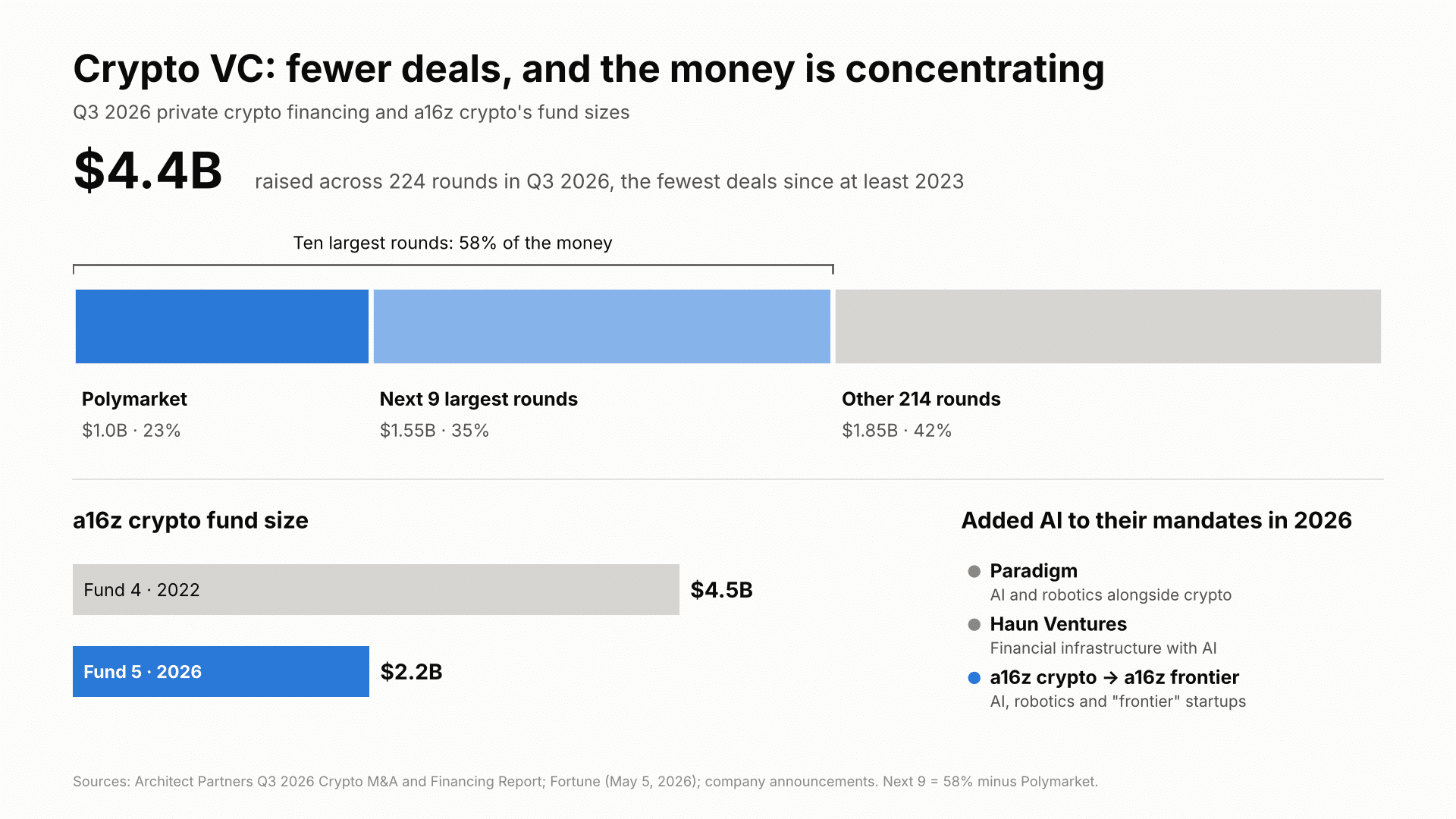
Fund 5 itself was less than half the size of the $4.5 billion a16z crypto raised in 2022. With fewer crypto deals to fund, a wider mandate gives the firm more places to put the money.
a16z frontier also follows Paradigm and Haun Ventures, which both added AI to their mandates this year.
DISCOVER: Best Meme Coins to Buy in 2026
What Comes Next for a16z Frontier? Dixon Outlines the Fund’s New Direction
A supporting one, on Dixon’s account. He sees blockchains as the payment layer for the AI economy: “Crypto has given the internet money rails that are fast, cheap, global, and programmable.” Stablecoins are “quickly becoming a standard tool” for fintechs and banks, and crypto can “enable machine-to-machine transactions” between AI agents.
That points to which crypto startups should keep getting checks: stablecoin payments and tools that let AI agents pay each other. A token project without a business behind it will now compete with robotics and AI labs for the same partners’ attention.
a16z frontier loses one of the people who built a16z crypto. Ali Yahya joined from Google Brain in 2017, when the crypto team “consisted of only” Dixon, and later became a general partner. He said he is moving to San Francisco to start a company.
Big personal news today: I have decided to leave @a16z, move to SF, and start a company.
It’s time to build 🙂
It has been almost 10 years since I joined the firm. I met @cdixon, @bhorowitz, and @pmarca in 2017. At the time, I was an engineer at Google Brain working on…
— Ali Yahya (@alive_) October 22, 2026
He gave no reason beyond wanting to build, and nothing links his departure to the rename. Still, the fund now enters its new phase without the partner who helped write its crypto playbook.
a16z crypto spent eight years and $9.8 billion making the case that crypto deserved its own fund. a16z frontier’s next deals will show whether crypto is still a category for the firm, or just one of the tools its startups use.
Disclaimer: Coinspeaker is committed to providing unbiased and transparent reporting. This article aims to deliver accurate and timely information but should not be taken as financial or investment advice. Since market conditions can change rapidly, we encourage you to verify information on your own and consult with a professional before making any decisions based on this content.

Daniel Frances is a technical writer and Web3 educator specializing in macroeconomics and DeFi mechanics. A crypto native since 2017, Daniel leverages his background in on-chain analytics to author evidence-based reports and deep-dive guides. He holds certifications from The Blockchain Council, and is dedicated to providing “information gain” that cuts through market hype to find real-world blockchain utility.