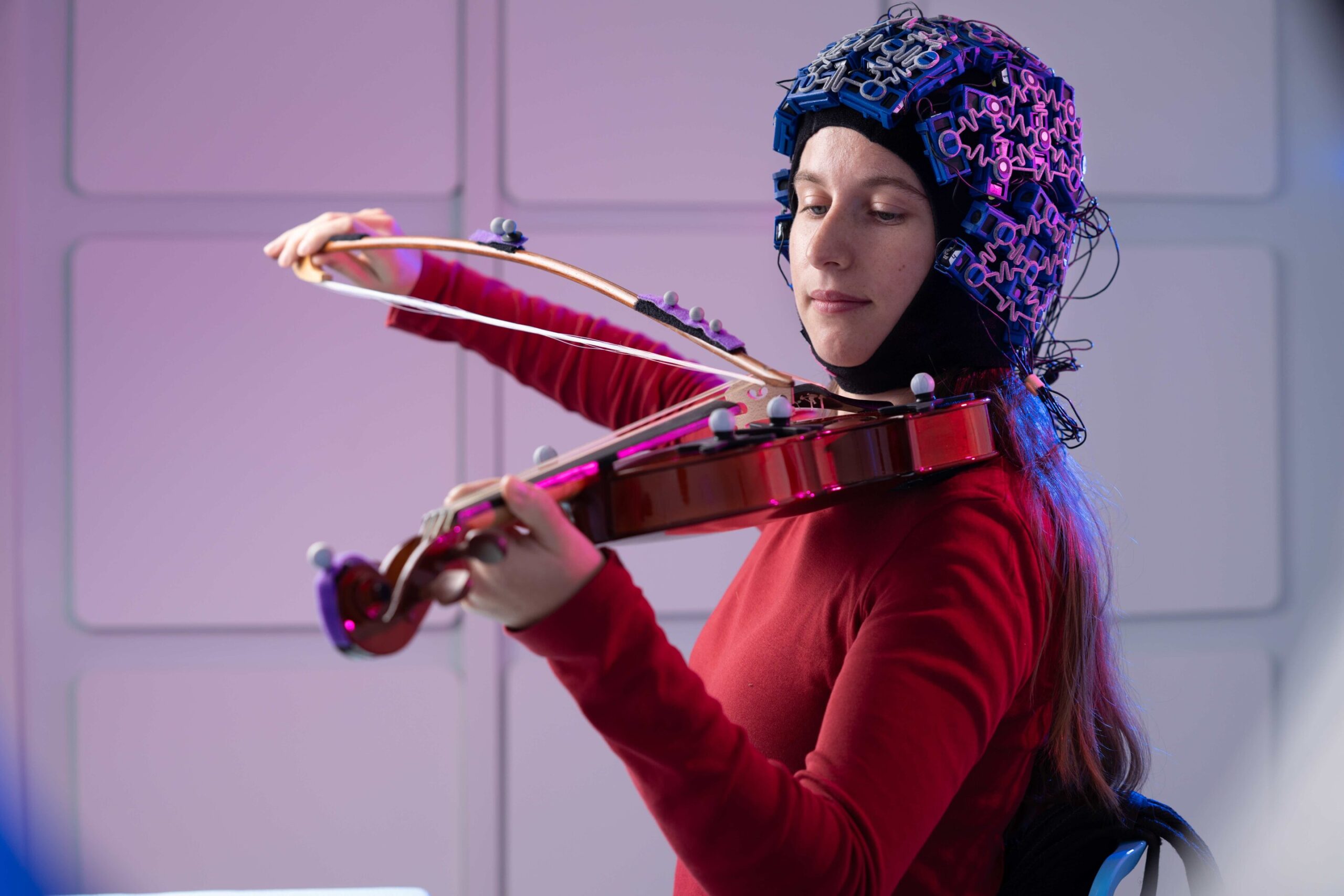
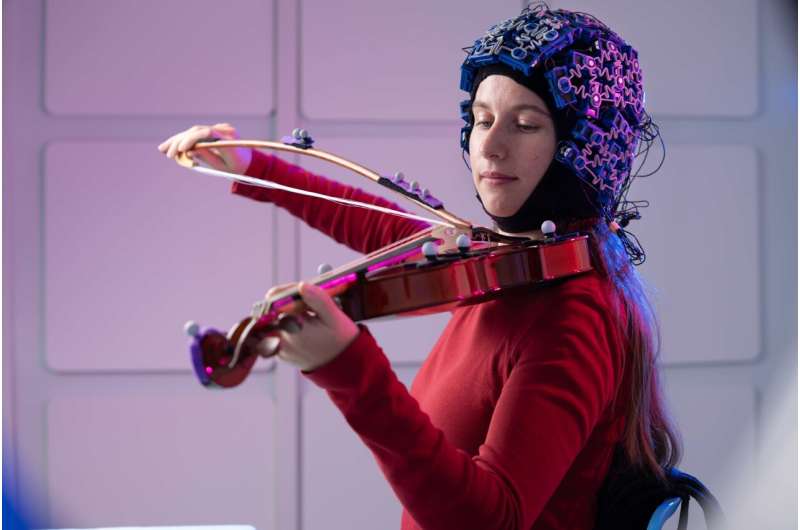
A new study using wearable brain imaging has shown what happens in the human brain when someone learns to play a musical instrument. The results revealed the patterns of brain activity that enable us to play an instrument, in this case a violin, and how having just a single lesson significantly changes those patterns of activity.
The study, led by the University of Nottingham, is published in the journal Imaging Neuroscience.
Brain waves signal whether notes match expectations
To enable this first-of-its-kind study, the team of scientists used OPM-MEG. This new type of scanner, developed in Nottingham, is integrated into a lightweight helmet, with a backpack-mounted control unit. It allows electrical brain signals to be measured and brain function characterized while a person carries out naturalistic tasks.
The researchers measured brain waves (rhythmic changes in electrical activity across groups of neurons) and how they changed throughout the violin-playing task. One of the proposed roles of these oscillations—specifically those in the so-called “beta” frequency range—is to signal information about whether our actions lead to the outcomes we expect.
“Your brain works by making predictions about what will happen as a result of your actions. So, if I am playing a violin, my brain will have an expectation of what sound it will make. If I play the expected note, my brain receives information that the outcome matched its prediction; if I hit an unexpected note, it receives information that it did not. In this experiment, we were able to measure these signals in real time while the instrument was being played,” said Joe Gibson, a Ph.D. researcher in the School of Physics and Astronomy.
The study also found that participants who showed the greatest changes in their beta waves before and after the violin lesson also showed the greatest improvements in their ability to play.
A metal-free violin for brain scanning
To undertake the study, the scientists enlisted the help of a local Nottingham expert violinist and violin maker, Alan Kirby. The instrument used needed to be completely metal-free to enable the scanner, which measures very small magnetic fields generated by electrical activity in the brain, to work.
Kirby sourced a standard violin and modified it, replacing all the metal parts with alternatives that he crafted, producing an all-wooden instrument operating at baroque frequencies.
Kirby said, “Bringing together the ancient art of violin making with the quantum physics underpinning this brain scanner has been amazing. Perhaps even more impressive was to actually see the effects of my lessons on people’s brains. That was quite an experience.”
Tracking changes across a single lesson
Twenty-two novice players took part in a study in which OPM-MEG data were recorded during two scanning sessions, while participants attempted to play a tune on a violin.
The experiment began with participants watching a video in which Kirby was shown playing the tune “Twinkle Twinkle Little Star.” Participants then undertook the first of two scanning sessions, during which they attempted to play the same tune on a violin while brain data were acquired.
After that, participants attended a violin lesson, taught by Kirby. Participants then underwent the second scanning session (identical to the first) in which they again attempted to play the tune while brain activity was measured.
From motor learning to brain disorders
Matthew Brookes, a professor who has led the development of OPM-MEG in Nottingham for over 10 years, said, “This is a study that we have been working on for years, and it’s taken a unique combination of skills: the physics required to measure brain activity; design engineering to create an ergonomic scanner that people can wear; the mathematics required to model the signals; and of course Alan’s knowledge and abilities as a violin player and maker. Without this wonderful diversity of talent, we simply couldn’t have done the work.”
“The results provide a greater understanding of motor learning. It’s also fascinating that some of the effects that we measure here are among those that can be affected by disorders like dementia. Hopefully this type of study will bring about a new understanding of not just healthy brain function, but also disease,” said Brookes, School of Physics and Astronomy.
More information
Joseph Gibson et al., Beta-band dynamics during a naturalistic motor task: An OPM-MEG study, Imaging Neuroscience (2026). DOI: 10.1162/imag.a.1405
Key medical concepts
Clinical categories


Citation:
One violin lesson changes brain wave patterns as beginners learn to play (2026, October 26)
retrieved 26 October 2026
from https://medicalxpress.com/news/2026-10-violin-lesson-brain-patterns-beginners.html
This document is subject to copyright. Apart from any fair dealing for the purpose of private study or research, no
part may be reproduced without the written permission. The content is provided for information purposes only.