When you look at your car, does it stare back? And what expression does it seem to hold? These two questions are surprisingly strange because a car is made of metal, glass, and plastic, and it cannot stare. A car cannot have an expression because a facial expression communicates emotions, and only animals—especially mammals like us humans—have an inner life that can be read on a face.
A face takes on the outward sign of what is going on inside. A face can look happy and expectant. This is the wide-eyed, open, inviting, and smiling “play face” that needs no translation anywhere in the world. We know when a kid is ready to play, wondering what’s next. At the opposite end of the spectrum, a human face can look angry and fearful, and this is one of the most complicated expressions. When the eyebrows pull together and draw downward, observers interpret anger. Add eyebrows turned up at the corner, and we see how the face registers fear. This “blended” expression is also universally and wordlessly understood.
In fact, the human face can explicitly communicate a range of subtle states of mind that others read. With sadness, of course, the brows invert, and the eyelids droop. But more subtly and with more complexity, a sad face can project chagrin or wistfulness, various species of regret, or longing. A face will register shock but can show the effect of more complicated internal turmoil, such as disbelieving shock—this can’t be happening! We know a patient look when we see it, and we know when the patient look turns to exasperation. By looking at a face, we know when a person is confused, bored, at wit’s end, awestruck, disgusted, delighted, on-the-muscle, desirous, or feeling guilty. Here, there, and everywhere on the planet we get faces.
But Back to Cars
But back to car designs. Cars don’t have faces—not the way that people or poodles have faces. But automobile body designers play with design features that look anthropomorphized and expressive. Car designers have specific expressions in mind when they blueprint cars that appear to be looking back at us in specific, emotionally expressive ways. We’re happy to be so regarded, in fact, and will be drawn to those looks in car showrooms.
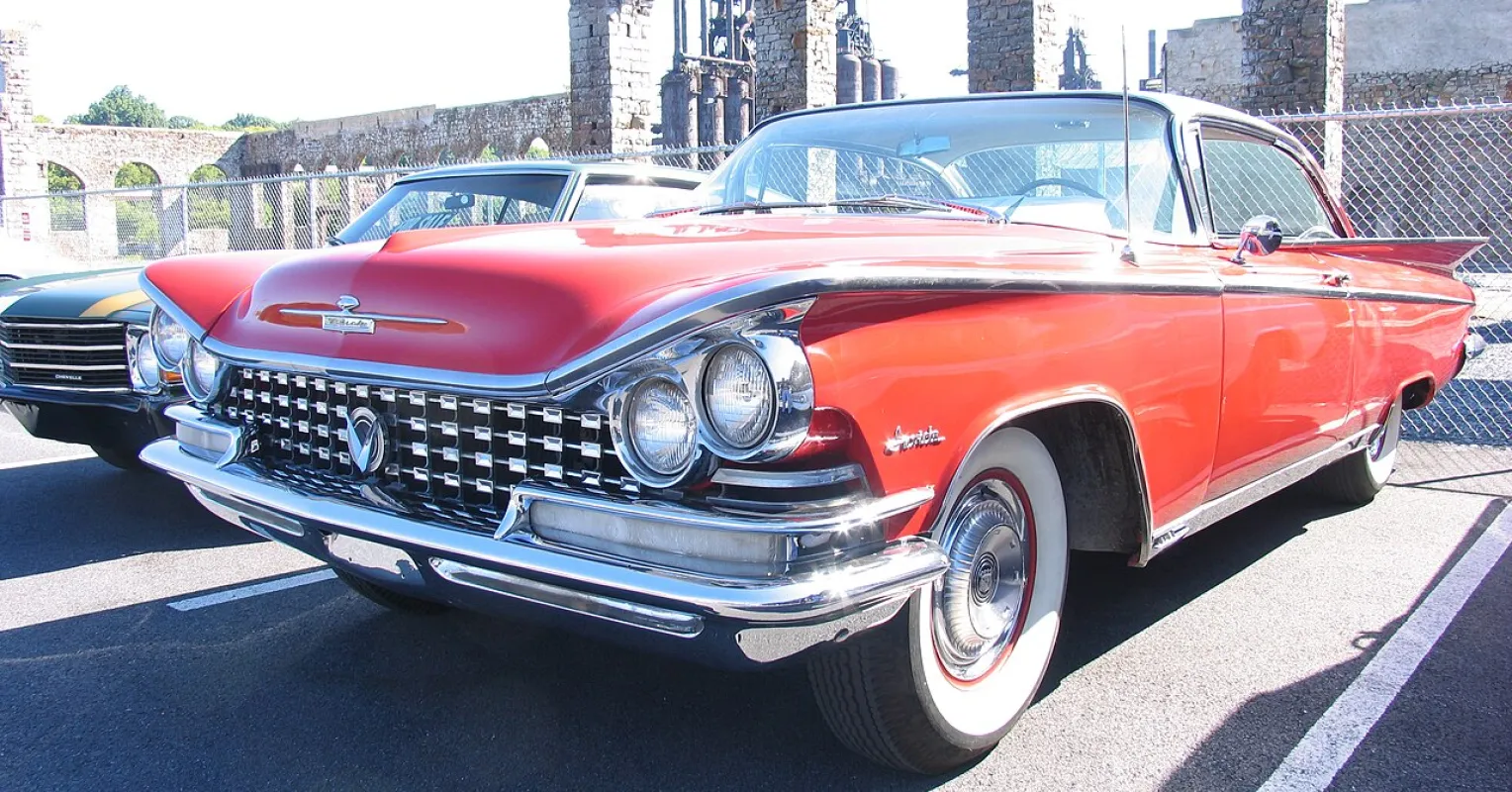
I will get to the how and why below, but for now, here are a few examples. Let me start with a memory of a snazzy family car, a 1959 Buick that sported “delta wing” tail fins, the sheet metal reminiscent of rocket ships or fighter jets. Red taillights looked like flaming rocket exhausts. These identifiable flying objects were on our minds at the peak of the Cold War. Our model was white with a red interior—as I said, snazzy.
But it was what was up front that really counted. First, the dual headlights, shaped like eyes tipped inward— “canted” as the designers described them—to communicate incisiveness. Next, and you will not see this feature on today’s aerodynamically slick autos, the heavy chrome strips above looked like furrowed eyebrows deployed in concentration, or perhaps, wrath. Then below, the grille that ran the car’s full width, was easy to interpret as teeth. The grin looked feral, close to a snarl.
This car looked ready to eat up the road.
Even More Aggressive Faces
This aggressive look sharply contrasted earlier styles. After 15 years of Depression and war, Americans had needed to look at a friendly face. For instance, in 1950, the Buick Roadmaster had seemed out-and-out goofy. Nicknamed “the buck-toothed Buick,” with its massive intake grille (a kind of mouth), and a hood ornament for a nose, this car featured a comical overbite. Droopy eye-headlights amplified the amusing effect.
But after 1959, Cold War-era cars would come to look more aggressive. The hungry looking third-generation Chevrolet Corvette from 1969, for instance, was nicknamed the Mako Shark—its headlights slung low and to the side of gaping jaws, and its hood designed with gliding predatory curves. Engineer-artists have designed today’s eighth generation Corvette models to look even fiercer by including angled, upsweeping anime headlights and a massive manga jawline.
How Cars Are Like the Man in the Moon
Now, for the visual psychology of these designs, we look not to Detroit but to outer space. For several nights each month the night sky treats us to a familiar illusion. Look at a detailed photo of our orbiting moon and you will see only an intricate tracery of rimmed impact craters and smooth “seas.” But stare upward on a moonlit night and your brain/mind will make sense of the random patterns by understanding them as the wryly smiling Man in the Moon. Our visual cortexes have cataloged a category for smiling faces.
Not all Earthlings register this effect as we do in North America. But we all interpret random patterns that culture prepares us to see. In East Asia, a Moon-Rabbit appears. In Australia, where the moon is upside down from our northern and western viewpoint, Australians see St. George slaying his dragon.
The same process allowed Hamlet and Polonius to argue whether clouds looked like camels or weasels, early astronomers to intuit canals on Mars, and the faithful to see angels appear on slices of French toast. Even now we might see mimetolithic trolls on sheer rock façades and wizened Ent-like men in tree bark patterns.
Why Do We See What We don’t See?
We infuse these inanimate objects with personality through a process that psychologists since the mid-nineteenth century have called pareidolia. Because our mind/brains strive to avoid ambiguity and randomness, they play at seeing an object where one does not really exist.
Turn your search engine toward “pareidolia” and you’ll have no trouble detecting cartoon pigs on the coats of palominos, Valkyries in cowlicks, an outraged imp in a sectioned green pepper, a pelvis in a Rorschach blot, or Mother Theresa’s face on a cinnamon bun.
Or, indeed, you will find agreeable connection to a sad, goofy, friendly, or imposing face on a car’s front end.