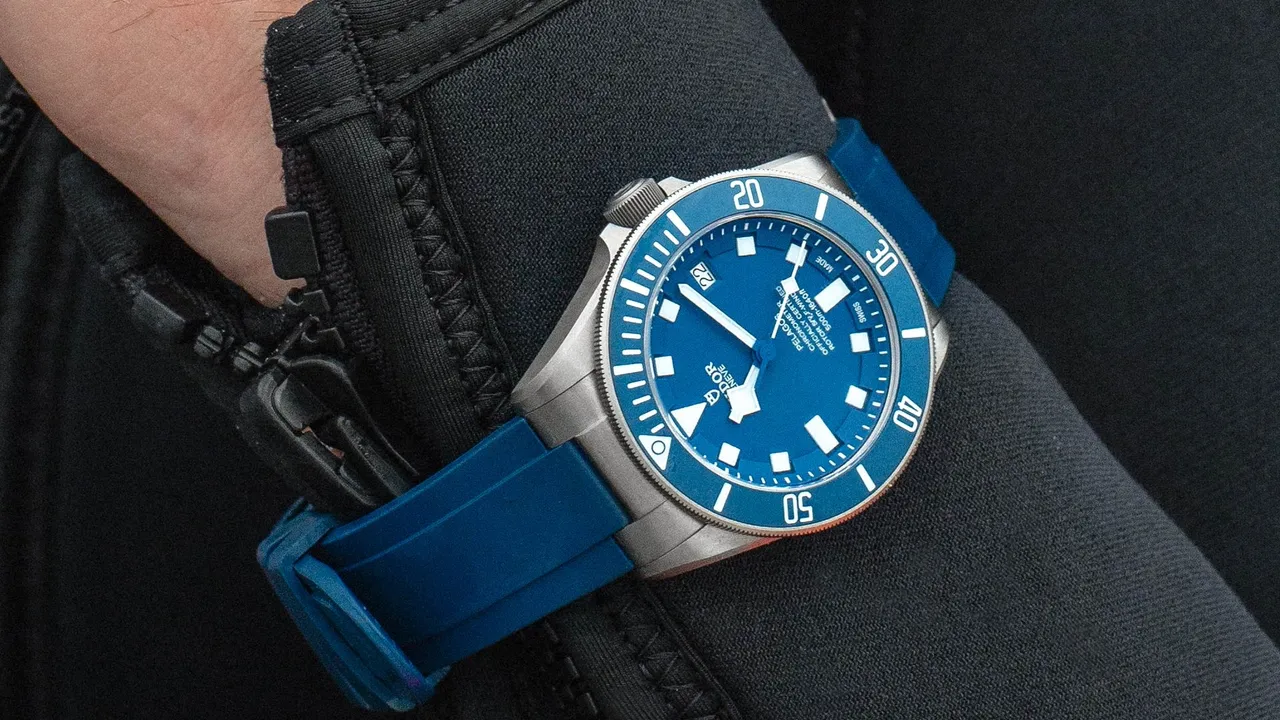
He’s right, of course. But holding one’s breath while floating in a calm pool and out in the open ocean are two completely different worlds. After two days of practice, however, I get the hang of it, descending deeper and deeper each time I try. Finally, on my last attempt—during which I’ve been tasked with removing a card from the bottom of the buoy and taking it back to the surface—I spend two minutes breathing calmly, then descend, Pelagos on my wrist. Though the pressure builds in my left ear, I remain calm, equalize, and feel the bottom of the rope hit my fins. I grab the card, rip it free from its rubber band, and swim quickly for the surface.

While Bourc’his’s competitive career is behind him, he still spends an inordinate amount of time freediving. Unlike with scuba, the beauty of freediving is that it can be done with barely any equipment. A diver like Bourc’his can effectively disappear into the environment. A mechanical watch is one of the few tether points to the topside world of technology and objective measurement for a freediver like him.
Really, Tudor’s role in freediving (and its partnership with Bourc’his in particular) is almost more of a totem—a signifier of the man-made environment to which the diver belongs. Disconnected from urgent reminders of missed meetings, pending RFPs, and an overflowing inbox, you’re consumed by the ocean, free to experience nature as a child might. Then, finally—when you’re ready—a glance down at your wrist reminds you of the surface, and you swim homeward.
“Freediving is a nice school about the knowledge of yourself in this sport—in daily life also,” says Bourc’his. “Slowing down is not just ‘I do nothing.’ You know? It’s a way to organize your life.”