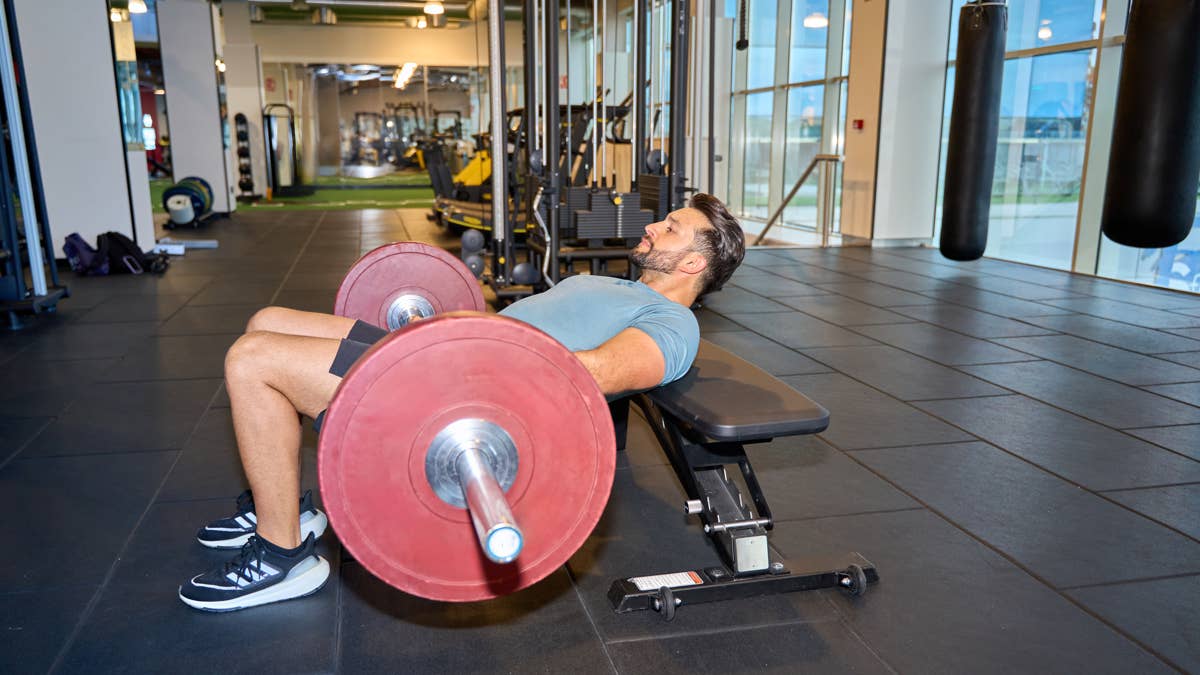
The thought of training your hips might not be as exciting as training your chest or arms, but doing so offers benefits well beyond building stronger glutes. Our hips play an important role in stabilizing the pelvis, transferring force between your upper and lower body, and controlling everyday movements that you probably don’t think twice about. Over time, ignoring your hips can lead to consequences like nagging lower-back pain, stiffness when you get out of bed, or achy knees when you lunge or squat.
As you age, keeping your hips healthy becomes increasingly important for staying mobile, moving confidently, and preserving the ability to do everyday activities without limitations. Below, Carmen Del Mastro, a sports performance coach, shares a three-movement workout that targets those very functions from different angles. Together, these exercises will keep your hips feeling youthful well into your 40s and beyond.
3-Move Workout for Strong Hips
How to Do Loaded Hip Bridge Marches
“The loaded hip bridge march asks me to maintain hip extension and keep the pelvis organized while one leg moves,” Del Mastro says. “Challenging the posterior chain a bit more intently than I’ve been able to lately, and that’s what I’m after.”
- Set up with your upper back supported across one box and both feet planted on a second box, with your knees bent. Secure a weight belt around your hips.
- Drive through your feet to lift your hips until your body forms a straight line from your shoulders to your knees. Brace your core and squeeze your glutes to stabilize your pelvis.
- Keeping your hips elevated, lift one foot off the box and bring your knee toward your chest. Return your foot to the box with control, then alternate legs, keeping your hips level throughout the movement.
How to Do Split Stance Cable Rotations
Split stance cable rotations connect the hips and trunk as the lower body owns the position.
- Kneel sideways into a split stance position next to a cable machine with the handle set around chest height. Hold the handle with both hands, facing the machine.
- Brace your core and rotate your torso forward, keeping your hips mostly square and your arms extended in front of you.
- Return to the starting position, resisting the cable’s pull throughout the movement.
- Complete all reps on one side before switching sides.
How to Do Supported Slider Reverse Lunges
“A supported slider reverse lunge lets me load single-leg strength through more range without balance becoming the entire exercise,” he explains.
- Stand upright with one foot on a gliding disc and hold a sturdy support for balance. Keep your other foot planted firmly on the floor in front of you.
- Slide the moving foot backward as you bend your front knee and lower into a reverse lunge, keeping your chest lifted and your front knee aligned with your toes.
- Press through your planted foot to return to standing, sliding the moving foot forward to the starting position.
- Complete all reps on one side before switching legs.
Related: An NFL Performance Coach Names the 5 Core Exercises He Never Lets His Football Players Skip
Experts
- Carmen Del Mastro, sports performance coach, via Instagram
