Carlos Pardo explains how a confluence of industry developments could mark a turning point in how future in-vehicle networks are designed
Over the past two years, three major vehicle recalls involving three international automakers have affected more than 640,000 vehicles due to rear-view camera failures. Investigations identified software behaviour, electrical noise, shielding integrity, and electromagnetic interference (EMI) as contributing factors. The result is the same: a missing or distorted camera image in a safety-relevant application.
These recalls reflect a broader shift across the automotive industry. As vehicles evolve into software-defined vehicle (SDV) platforms with ADAS and automated driving functions, camera systems are becoming an integral part of the vehicle’s safety architecture, and the requirements placed on their communication links are changing fundamentally.
There is every reason to expect that OEMs have responded to these incidents promptly and appropriately. The purpose of highlighting these cases is therefore not to question those responses, but to help the industry reduce the risk of similar issues arising on future vehicle platforms. Given the potentially serious consequences of a failure in safety-related camera systems, adopting the most robust communication medium available is a prudent approach. In this sense, these recalls should also be seen as early warnings of the increasing demands placed on in-vehicle connectivity as architectures continue to evolve.
Different failures, common vulnerability
The individual cases show how differently problems in copper-based camera links can manifest themselves. In one of the recalls, increased shielding resistance, variations at crimp connections, and resulting electrical noise could corrupt register data and cause the rear-view image to fail sporadically. Another case identified transient signal noise between the control unit and surround-view camera. In a third case, radio-frequency interference from nearby mobile phones could affect the camera module, causing flickering or image distortion.

The vehicles and implementations are different, but there’s a common physical vulnerability: copper carries electrical signals and is therefore susceptible to electrical noise and electromagnetic interference. Reliable operation depends on shielding and the integrity of electrical connections. For safety-related cameras, this can result in an image being unavailable or distorted exactly when the driver or vehicle system depends on it.
From convenience to safety-critical
Cameras are no longer used solely for convenience features such as reversing or parking assistance; they have become essential sensors for ADAS and automated driving functions, providing critical input for perception and decision-making. As camera systems become integral to vehicle safety, so do their communication links.
Reliability, signal integrity and deterministic behaviour have always mattered, but they are fundamental requirements in safety-critical applications. A link that fails or delivers inconsistent performance can compromise information on which drivers and vehicle systems rely.
Reliability begins at the physical layer
As communication links become safety-critical, the physical layer becomes an essential part of overall system reliability. Electrified powertrains, power electronics, and high-speed networks create an increasingly complex electromagnetic environment. Electrical communication technologies require measures such as shielding and grounding to ensure robust operation.
Optical communication follows a different physical principle: because information is transmitted by light, fibre optic links are inherently immune to electromagnetic interference and provide galvanic isolation, while supporting the bandwidth required for high-resolution cameras and multigigabit data transmission.
Ready for deployment
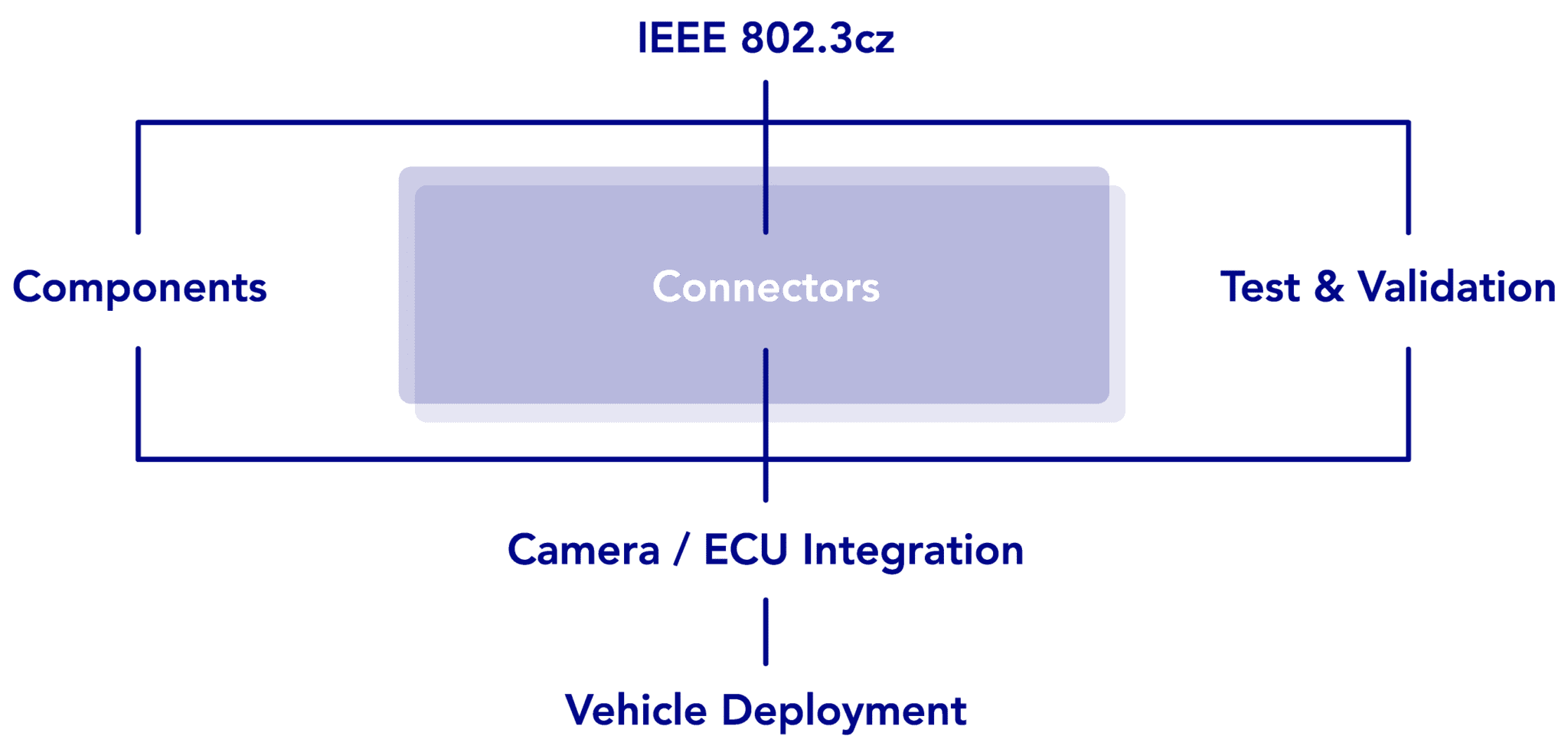
Over the past several years, the foundation for optical Automotive Ethernet has steadily been built. IEEE 802.3cz establishes the standardised framework for automotive multigigabit optical Ethernet, while components, connectors, test solutions and reference implementations are now commercially available. Future vehicle networks are likely to combine electrical and optical links, deploying each technology where it delivers the greatest benefit.
Standards are in place, technologies have matured, and optical Automotive Ethernet has entered the deployment phase. Optical connectivity may become the preferred choice for safety-critical networking applications. This does not mean replacing every copper connection, but rather deploying each technology where it delivers the greatest benefit.
Carlos Pardo is Chief Executive and Co-founder of KD
Source note: The vehicle recall information referenced in this article is based on reports published by Autoblog (January 2026), Repairer Driven News (January 2026), and CarComplaints.com (June 2024)