Support CleanTechnica’s work through a Substack subscription, on Patreon, or on Stripe. Help us produce all of the high-quality, original content we publish week after week despite the challenges of content-scraping AI, antisocial media, inflation, and other hurdles.
Ireland’s electricity regulator has put some useful numbers on the country’s future need for grid flexibility. Its first national assessment identifies about 234 MW and 58 GWh of potential upward flexibility requirements on distribution networks in 2028. Batteries, managed EV charging and industrial demand response could all contribute, but the figures become more interesting at the level of individual substations.
The Commission for Regulation of Utilities’ Flexibility Needs Assessment identifies a potential requirement of 0.6 MW and 3 MWh at the Naas 38 kV/10 kV substation in 2028, concentrated in January. Reinforcement is planned by 2030, when the assessment identifies no corresponding flexibility requirement. This describes a modeled network need, without a commitment to purchase a service or install a battery.
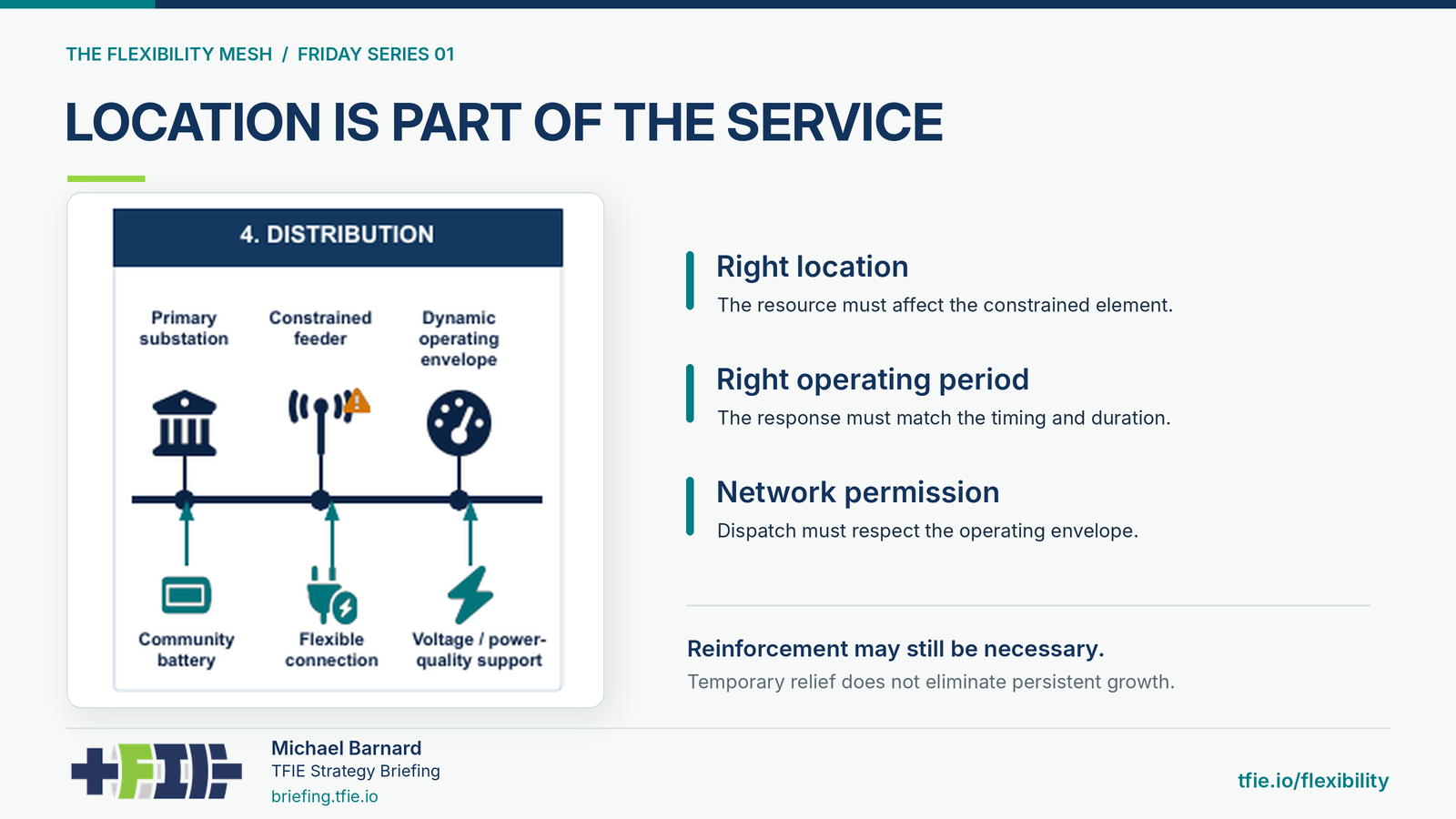
A battery elsewhere in Ireland could provide useful balancing services, help integrate renewable generation and earn revenue in electricity markets while contributing nothing to the particular constraint at Naas. The electrical connection matters. A resource has to change power flows across the affected equipment, in the required direction, during the periods when that equipment is constrained.
Flexibility must affect the constrained electrical equipment at the right time.
The distinction applies equally to demand response. A large fleet of electric vehicles might represent considerable flexible electricity demand nationally, but only vehicles connected in electrically useful locations can relieve a particular transformer. Their charging must also be adjustable without compromising the journeys they need to make. The same questions apply to refrigeration, heating and other industrial or commercial loads.
Timing adds another complication. Naas’s modeled 0.6 MW and 3 MWh figures describe different aspects of the expected requirement. Dividing one by the other does not establish that the network needs a battery discharging continuously for five hours. The duration of individual events, recovery between them and customer operating requirements all affect which resources could help.
There’s an important reality check in Britain. UK Power Networks’ March 2026 network assessment reports that the utility stopped seeking flexibility tenders for certain single-transformer substations whose constraints typically lasted 24 hours. The available flexibility market could not address those requirements effectively on technical and commercial grounds. In those circumstances, reinforcement or another engineering intervention may be more appropriate.
As distribution networks accommodate more electric vehicles, heat pumps, batteries and distributed generation, assessing flexibility at the right electrical location becomes increasingly important. National capacity estimates provide useful context, but investment and procurement decisions need much more specific evidence. The Naas example starts the first article in a series connected to The Flexibility Mesh, an open 99-page strategy report on how physical resources, permissions, operating capabilities and commercial arrangements fit together.
My full TFIE Strategy Briefing analysis examines the Naas case, the alternatives available to utilities and the conditions that turn flexible capacity into a deliverable network service. It also links to the interactive Flexibility Mesh architecture.
Sign up for CleanTechnica’s Weekly Substack for Zach and Scott’s in-depth analyses and high level summaries, sign up for our daily newsletter, and follow us on Google News!
Have a tip for CleanTechnica? Want to advertise? Want to suggest a guest for our CleanTech Talk podcast? Contact us here.
Sign up for our daily newsletter for 10–15 new cleantech stories a day. Or sign up for our weekly one on top stories of the week if daily is too frequent.

CleanTechnica uses affiliate links. See our policy here.
CleanTechnica’s Comment Policy