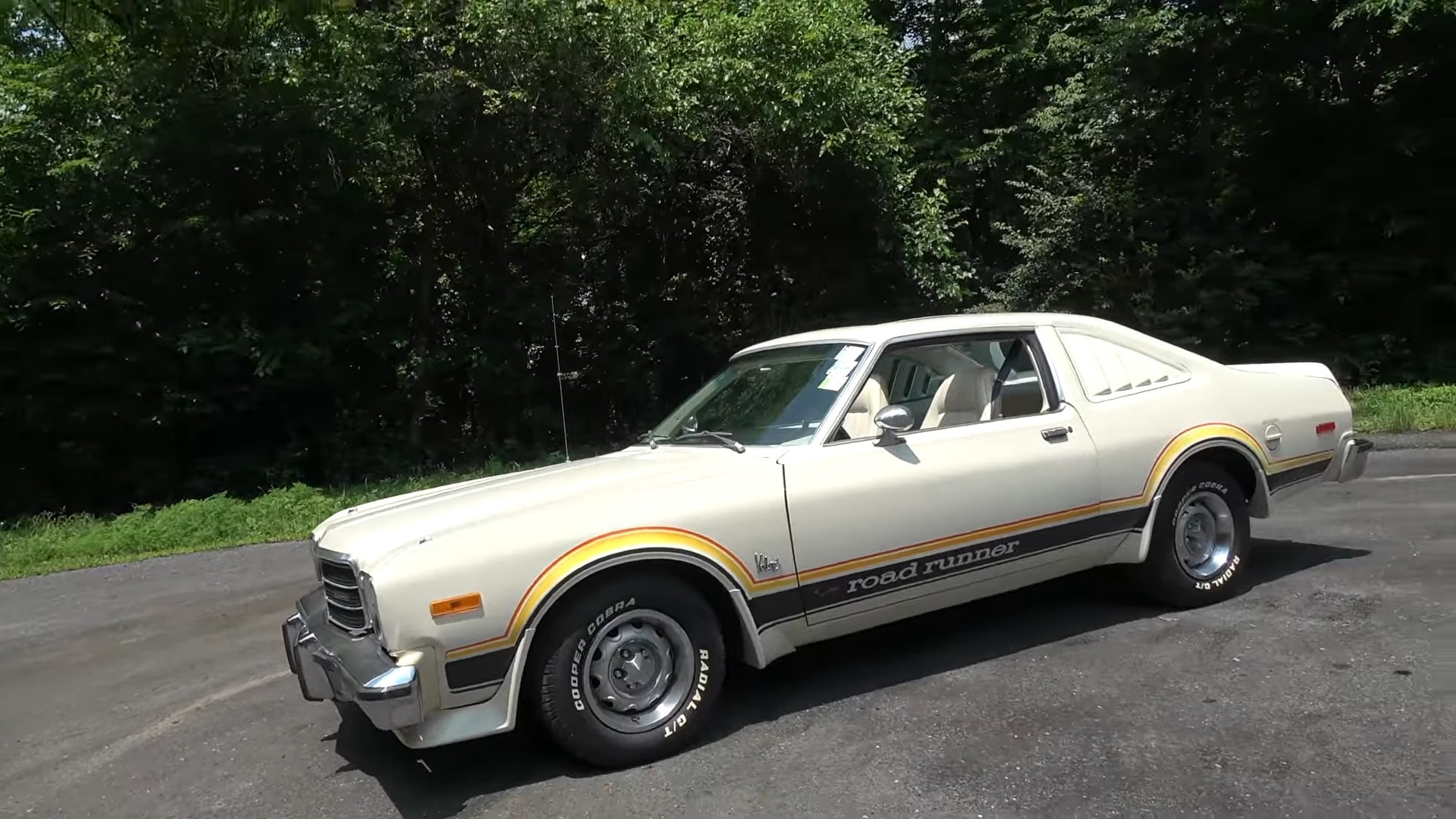
The Plymouth Road Runner is one of those mythical monikers that shot across the sky like a meteor, flashing bright and spectacular as it entered the atmosphere, only to dissolve into nothing and oblivion after a few short moments. What started as a heavy-hitting muscle car in 1968 became a bantamweight cockerel less than a decade later. However, they did – and still do – have a following today, and this Volare Road Runner is ready to testify in favor of that statement.
When Plymouth paid Warner Bros. 50,000 dollars in 1968 for the rights to use the Road Runner name, cartoon likeness, and signature twin-tone horn, nobody imagined what the muscle car landscape would look like just 8 years later.
By 1976, strict federal emissions mandates, catalytic converters, and soaring insurance premiums had banished high-compression big-block monsters to the history books, forcing Detroit engineers to reinvent performance for a fuel-conscious era.
The Road Runner ended on the also-ran list of options on the Volare, a miser way to end a legend, but it was the only Mopar performance (of sorts) available to the public. Gone were the earth-shaking 426-cubic-inch Hemi, the 440-cubic-inch Six Barrel, and even the mid-size 115-inch wheelbase B-body Fury platform that carried the famous bird through the 1975 model year.

Photo: YouTube/Lou Costabile
Funny trivia: while the road runner (the bird) is mostly known for its fast-paced sprints – some believe it to be flightless, although it can flap its wings if it really needs to – ChryCo’s marketing department chose the Volare to carry the moniker. “Volare” means “to fly” in Italian. Something the last-gen Road Runner did not.
For 1976, Chrysler shifted its iconic budget brawler onto the all-new compact 108.5-inch wheelbase F-body architecture, transforming the standalone model into a flashy trim and handling package for the Plymouth Volare, which replaced the long-serving Valiant in dealership showrooms.
Although purists scoffed at calling a compact coupe a muscle car, the 1976 Plymouth Volare captured Motor Trend’s Car of the Year trophy and helped move 255,008 units during its debut season. Across a five-year production run lasting from 1976 to 1980, total Volare output surpassed 1.1 million vehicles, yet only 18,719 buyers ticked the box for the Road Runner package, including 8,769 examples assembled in that inaugural 1976 campaign.

Photo: YouTube/Lou Costabile
Because early F-body Mopars suffered from notorious sheet-metal corrosion that dissolved front fenders in record time, finding an untouched example 50 years later is next to impossible. Fortunately, Chicago-based automotive vlogger Lou Costabile tracked down an extraordinary 1976 Plymouth Volare Road Runner survivor at the Chrysler Nationals in Carlisle, Pennsylvania, featuring owner Mike Vandi and his prized coupe on the “My Car Story” YouTube series.
For Vandi, owning a vintage F-body Plymouth is a deeply personal trip down memory lane rather than a random collector whim. Growing up during the 1970s and 1980s, he earned his driver’s license in 1981 behind the wheel of not one, but two family F-body Mopars, as his father drove a Volare coupe while his mother piloted a Volare station wagon. With that heritage in his veins, he spent years searching for a solid survivor.
His patience paid off 5 years ago when he discovered this white 1976 Road Runner in Virginia. Originally delivered to a buyer in California before migrating eastward, the coupe escaped the harsh road salt that doomed most of its assembly-line siblings. Aside from a few honest dings and minor paint scuffs on the nose that prove its unrestored authenticity, the steel panels remain completely rust-free from bumper to bumper.

Photo: YouTube/Lou Costabile
Dressed in factory white paint, the exterior wears bold orange, yellow, and black graphics sweeping over the wheel arches and along the lower rockers, complete with lowercase “road runner” lettering and cartoon bird decals. As Vandi explains to Costabile, the front chin spoiler, rear decklid wing, wheel-lip ground effects, and slatted rear quarter-window louvers were optional extras that not every 1976 Road Runner received before leaving the factory floor.
Rolling on 14-inch styled Rallye wheels wrapped in Cooper Cobra Radial G/T white-letter tires, the coupe flaunts a vintage “UNLEADED GASOLINE ONLY” decal above its fuel cap. While that’s law today, half a century ago (boy, time sure does fly by, doesn’t it?) Detroit was battling new emission standards (plus the aftermath of an oil embargo that put big-block, hung-ho high-horse muscle cars on the death row).
Beneath the striped rear spoiler, the spotless trunk still houses its original jack, a blue 1976 Plymouth operator’s manual, and crisp factory assembly numbers stamped along the weatherstrip channel.

Photo: YouTube/Lou Costabile
Opening the driver’s door reveals a January 1976 Chrysler build plate, an original catalyst compliance tag, and a remarkably preserved cabin anchored by bright white vinyl high-back bucket seats. Across from the matching rear bench, woodgrain trim frames a 100-mph horizontal speedometer and an optional 3-spoke Tuff steering wheel, while an aftermarket Pioneer stereo represents the classic period upgrade almost every owner performed as a day-two improvement of the compact.
If it couldn’t go fast, then at least it could cool. That’s not to say the Volare was a total foot-in-mouth. Introduced on October 16, 1975, the moniker sold over a quarter-million copies it its junior year. But that was before the cars started manifesting their issues with biodegradability of the fenders and the lean-burn electronic engine management.
Eventually, the ensuing recalls – the largest in history up to that point – became the defining attribute with which the Volare (and its Dodge twin cousin, the equally notorious Aspen) cemented their place in the collective gearhead memory. It became the textbook definition of “rushed development,” that marred Plymouth’s image forever, and it pushed the entire corporation to the brink of bankruptcy by the end of the decade.

Photo: YouTube/Lou Costabile
However, this survivor – quite a miraculous occurrence, given the infamy that mistreated the Volare in the years following the 1976 debut – is none of that. Even more intriguing is the rare combination of a manual crank-operated metal sunroof overhead and a Chrysler Airtemp air conditioning unit mounted beneath the steering column.
Because buyers rarely paired factory air conditioning with a sunroof, this car left the plant without cooling, only for the original California buyer to have the dealership install the system and upper dashboard vents right back in 1976. It was a sound decision, given that driving in the summer with only a small hatch to let the breeze in was probably not the ideal cruising experience in the plastic-upholstered Volare.
Under the hood sits the largest engine offered in the 1976 Volare lineup: an optional 360-cubic-inch (5.9-liter) LA-series small-block V8. While standard Volares used a 100-horsepower 225-cubic-inch (3.7-liter) Slant-Six and base Road Runners carried a 145-horsepower 318-cubic-inch (5.2-liter) V8, the two-barrel 360-cubic-inch motor produced 170 net horsepower at 4,000 rpm and 280 lb-ft of torque at 2,400 rpm, leaving the 220-horsepower four-barrel version strictly for police pursuit packages.

Photo: YouTube/Lou Costabile
It’s not even worth comparing those specs with the numbers that made the Road Runner a legend of Motor City back in 1968, but it was the best money could buy, as far as the Road Runner went.
Out on the winding country roads around Carlisle, the 3,380-pound coupe accelerates briskly under a highway overpass and glides along with remarkable composure. The odometer, showing 392 miles, would have anyone fooled, but its true reading has already passed the “99,999.9” mark. (The interior was probably redone – there is absolutely no way a Volare would look this good after 100k miles).
Even if modern showgoers frequently ask what this rare 1976 bird actually is, Vandi’s time-traveling Plymouth Volare Road Runner proves that mid-1970s Detroit still knew how to build a fun, head-turning cruiser. Fabulously unreliable, but cool nonetheless.