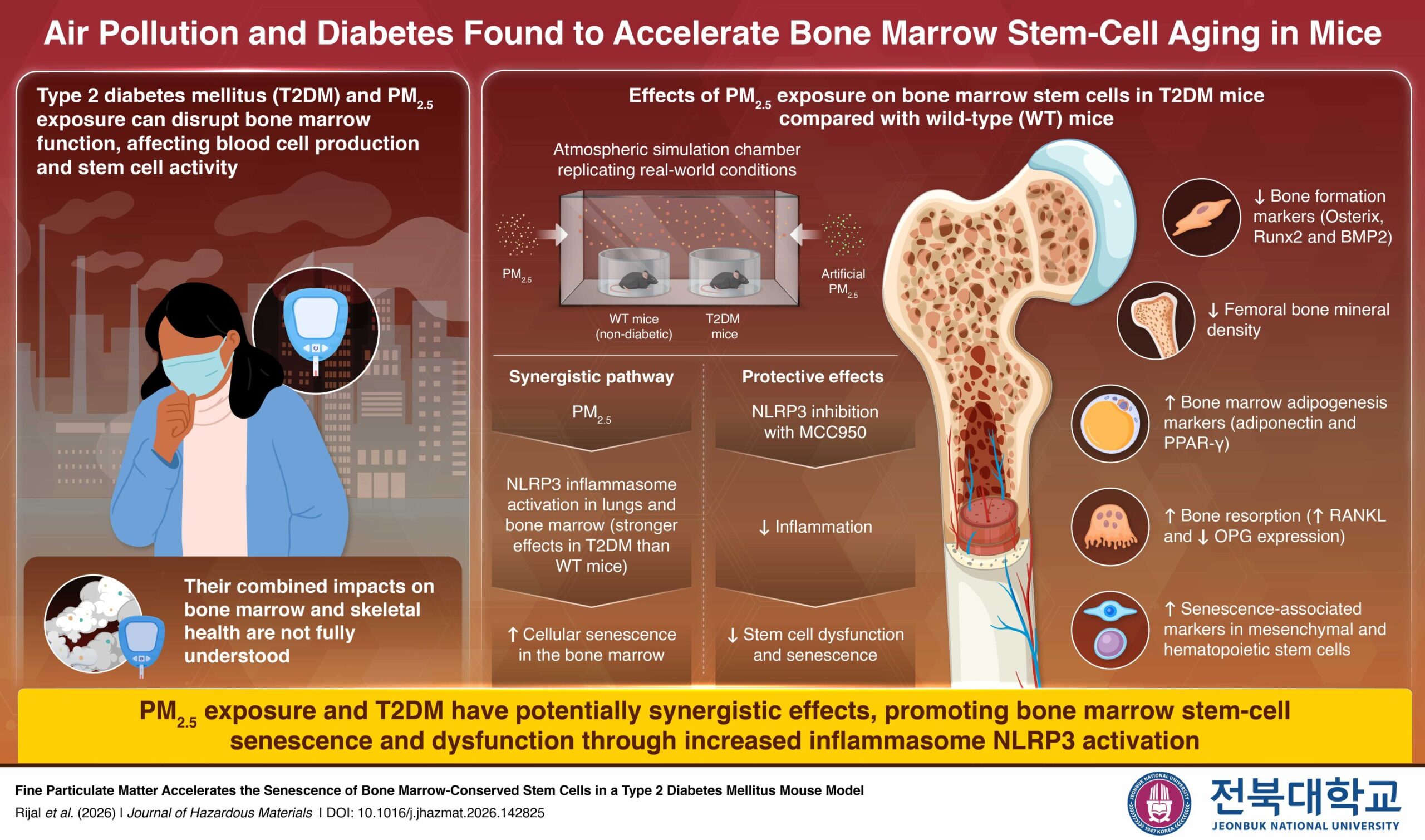
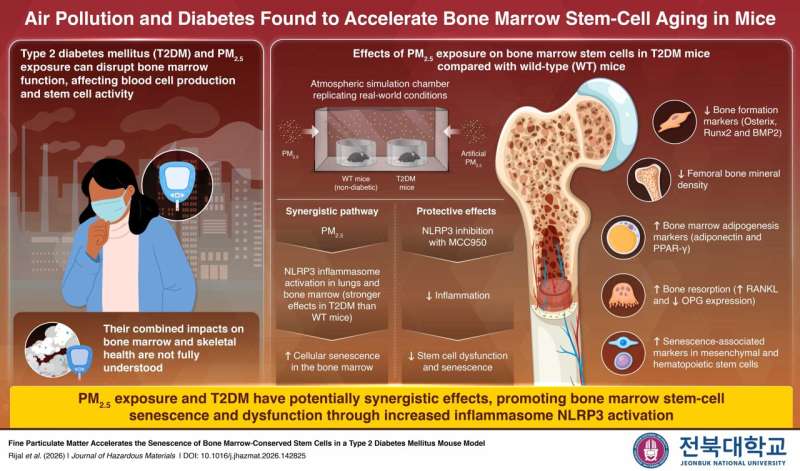
Air pollution affects health beyond the lungs. Fine particulate matter (PM2.5), tiny airborne particles that can enter the respiratory system, can trigger inflammation that affects other parts of the body. People with type 2 diabetes may be particularly vulnerable, as the disease can already impair stem cell function in the bone marrow, which produces blood cells and supports bone health.
Researchers led by Professor Sung-Ho Kook of the Department of Bioactive Material Sciences at Jeonbuk National University, Republic of Korea, found that PM2.5 exposure and diabetes had combined effects in mice, accelerating stem cell aging in the bone marrow and impairing their regenerative function.
The researchers linked these effects to activation of the NLRP3 inflammasome, a cellular system that triggers inflammatory responses. This activation was particularly pronounced in the lungs of diabetic mice. Their findings suggest that air pollution can affect organs beyond the lungs and worsen bone marrow stem cell dysfunction, with potentially greater consequences for people with diabetes.
The paper was published in the Journal of Hazardous Materials.
“Our findings show that the harmful effects of air pollution may extend beyond the respiratory system to affect bone marrow stem cell function, and that people with preexisting metabolic diseases may be particularly vulnerable,” says Kook.
Diabetes amplified pollution’s effects in mice
To investigate these effects, the researchers exposed mice with and without diabetes to artificially generated PM2.5 in an atmospheric simulation chamber. The mice were exposed to a concentration of 50 micrograms per cubic meter for two hours per day over five days.
The researchers found that PM2.5 exposure triggered inflammation in the lungs and bone marrow, with stronger effects in diabetic mice. The exposure also worsened liver injury and fat accumulation and altered pancreatic islet structure, reducing insulin expression and increasing glucagon expression in diabetic mice.
These findings suggest that diabetes makes the body more vulnerable to the effects of air pollution across multiple organs.
Stem cell aging and bone loss
In the bone marrow, PM2.5 exposure accelerated the aging of two types of stem cells, particularly in diabetic mice. Mesenchymal stem cells, which can develop into bone-forming cells or fat cells, showed increased oxidative stress and DNA damage and were more likely to develop into fat cells rather than bone-forming cells.
The bone marrow also accumulated more fat, while bone mineral density decreased. Meanwhile, hematopoietic stem cells, which produce blood cells, showed increased signs of cellular aging and reduced ability to form colonies and replenish blood cells.
Blocking NLRP3 reduced stem cell damage
The inflammatory and stem cell changes were mitigated by treating the mice with MCC950, a drug that inhibits the NLRP3 inflammasome. The treatment reduced inflammation in the lungs and bone marrow, along with oxidative stress, DNA damage and signs of aging in both types of stem cells.
This suggests that NLRP3-related inflammation contributes to the harmful effects of PM2.5 and that blocking this pathway may help preserve bone marrow stem cell function.
The findings suggest that PM2.5 exposure can worsen the effects of diabetes across several organs and accelerate bone marrow stem cell aging. They highlight the importance of protecting people with diabetes from air pollution and identify the NLRP3 inflammasome as a potential target for further research.
“Ultimately, we hope this work will encourage a more integrated approach to disease prevention that considers environmental exposures alongside underlying health conditions,” says Kook.
Publication details
Shankar Rijal et al., Fine particulate matter accelerates the senescence of bone marrow-conserved stem cells in a type 2 diabetes mellitus mouse model, Journal of Hazardous Materials (2026). DOI: 10.1016/j.jhazmat.2026.142825
Journal information:
Journal of Hazardous Materials
Key medical concepts


Citation:
Why people with diabetes are more vulnerable to air pollution’s cellular toll (2026, October 29)
retrieved 29 October 2026
from https://medicalxpress.com/news/2026-10-people-diabetes-vulnerable-air-pollution.html
This document is subject to copyright. Apart from any fair dealing for the purpose of private study or research, no
part may be reproduced without the written permission. The content is provided for information purposes only.