Twenty years ago, the Bugatti Veyron seemed like science fiction. As a sheltered kid with little exposure to popular culture, I still remember reading about this mythical new category of performance car when it exploded onto the scene in 2005—a price tag over one million Euros with 1,000 horsepower out of the eventual quad-turbo W16 engine that replaced the V18, and a top speed higher than 400 kilometers an hour. The Veyron didn’t just move the performance goalposts when it arrived in 2005—it helped create the modern hypercar as we know it. Much of the Veyron’s popularity today probably stems from millennial car kids staring up at bedroom posters daydreaming—myself included.
The craze for 21st-century Bugattis reached an inflection point in 2024, when a 2010 Veyron Grand Sport Sang Bleu sold for $3.085 million at an RM Sotheby’s auction. Then, more recently in fall of 2026, a Veyron Grand Sport Vitesse Wimille reached a stunning new record of $5.44 million. Of course, those low-production variants stand out from the rest, but with only 450 built in total, every Veyron inevitably comes with some kind of a special story.
Those values hitting higher and higher numbers than ever, jumping up by around 29 percent on average to $1.9 million since 2021, only amped up my excitement all the more when I got the chance to take one for a spin this summer ahead of Monterey Car Week.
Does the car that defined my childhood idea of automotive excess still feel special after two decades of progress? I’d spent years imagining what driving a Veyron would feel like—now I had the key.
Michael Teo Van Runkle
How the Bugatti Veyron Created the Modern Hypercar
In the early 1900s, Bugatti contributed to the original years when horseless carriages rapidly evolved into a gold era of motorsport. But by the turn of the millennium, the company depended on the maniacal vision of an Austrian executive named Ferdinand Piech to reboot for the 2000s. Piech cut his teeth at Porsche, then bounced over to Audi and back before taking over the top job at Volkswagen AG. While CEO, he pioneered a series of highly questionable projects, including the Volkswagen Phaeton that competed directly against other group models including the Audi A8—but at a cost-benefit ratio that made little to no sense.
Piech also envisioned a new era for Bugatti, which reportedly began with a feverish sketch on a restaurant napkin that combined three Volkswagen VR6 engines into a single V18 powerplant. Eccentric only scratched the surface of Piech’s wildest schemes, but he also contributed to the consolidation of the entire automotive industry by championing the strategies of shared platforms, modular construction, and absolute engineering perfectionism.
What It’s Like to Drive a Bugatti Veyron Super Sport
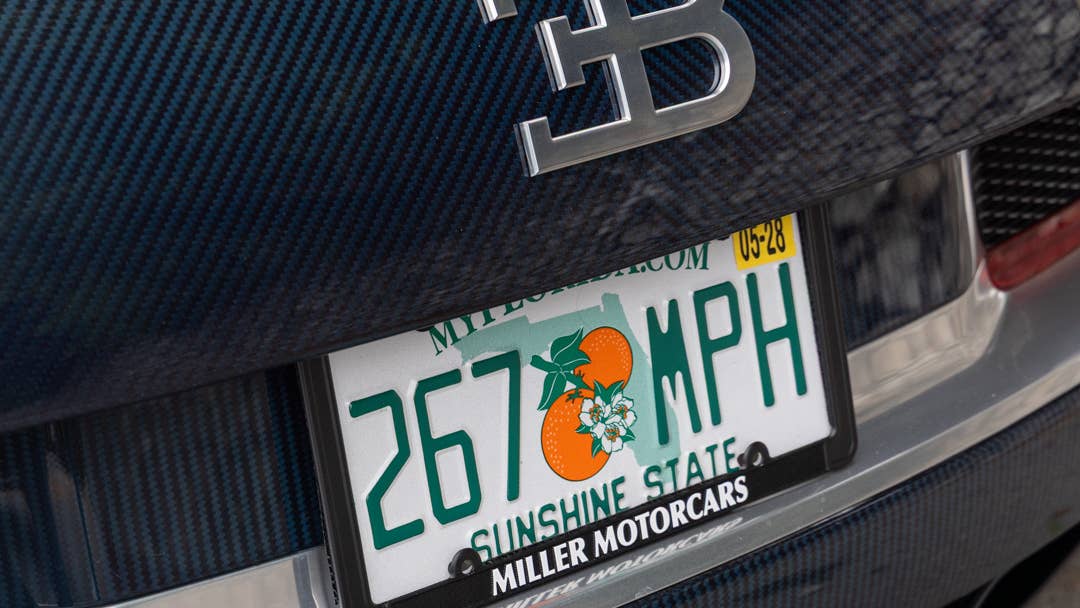
Week had space for a 267-mph run.
Michael Teo Van Runkle
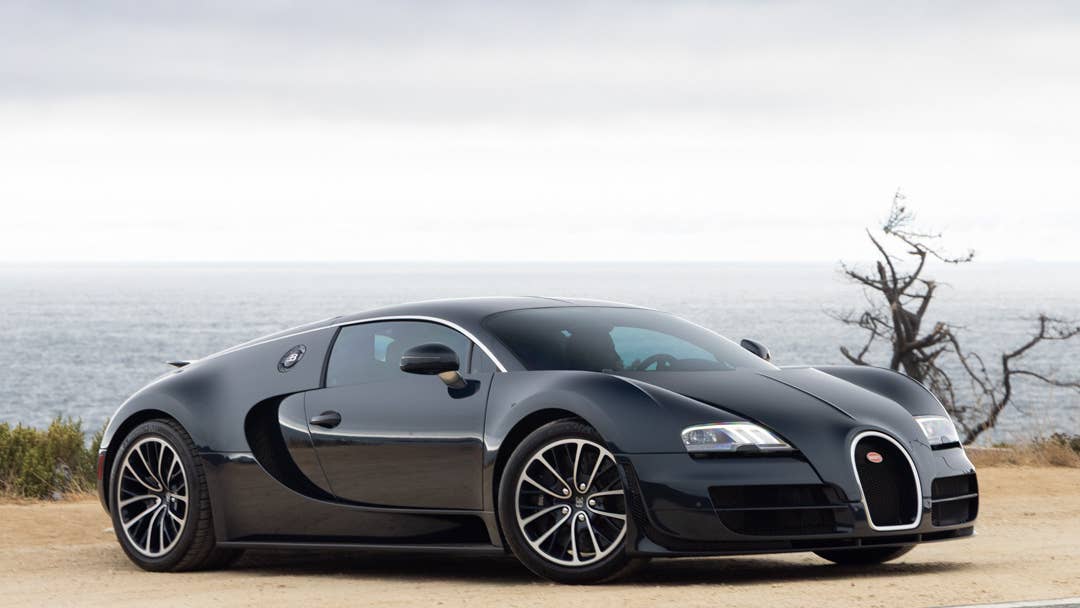
The old adage to never meet your heroes never made much sense to me. Why not, after all? At best, a proven hero provides a role model for living up to. At worst, perceived shortcomings then turn into lessons learnt. All those childhood memories flooded my neurons as I pulled up to a house on the Monterey peninsula and spotted a dark blue Veyron lurking in the mist. This specific car actually made a return to Monterey, of sorts, since it was Bugatti’s original show car at The Quail back in 2010. Technically a model year 2011, this Veyron 16.4 Super Sport cranked up the insanity to 1,200 horsepower and 1,106 lb-ft of torque, with a top speed now over 431 kmh or 267 mph. The price tag? Right up there at $2.4 million to start. Bugatti only built 48 Super Sports, and only six others came to America when new.
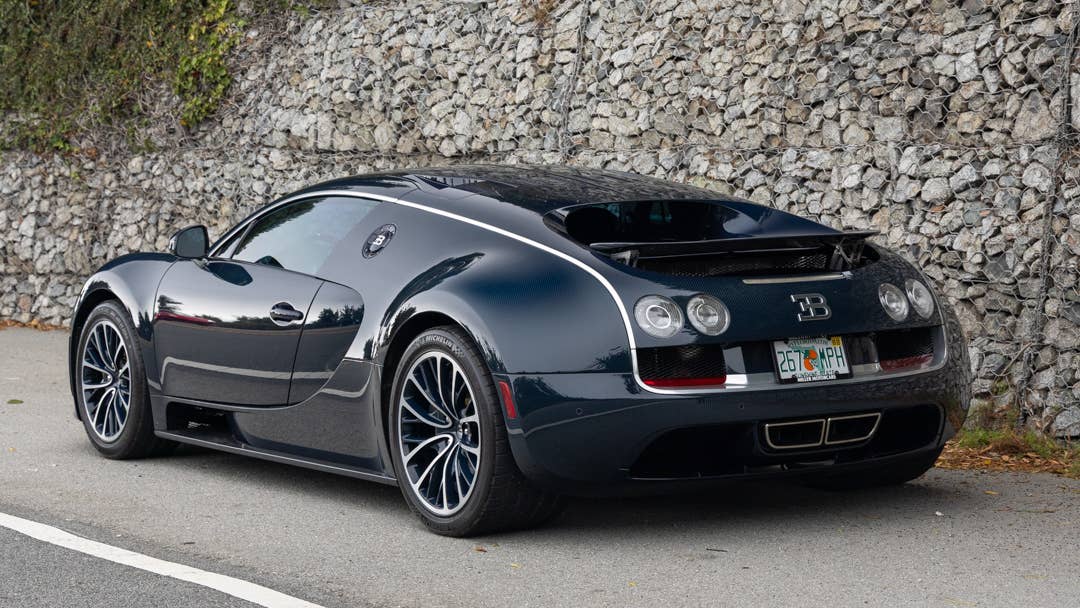
Now privately owned, this original show car is old enough to have its own driver’s license here in California. A first-year Veyron can even buy its own drink. But up close and personal, my Super Sport dance partner for the day looked absolutely pristine, with gorgeous woven blue carbon fiber, a stunning metal window arch line trailing toward the rear exhaust, the mesh grilles, NACA intakes, and crisp wheel cuts—even amid the best pieces of kit at Monterey over the past few years, every detail looked au currant, which I certainly remember as absolutely unrivaled in period whenever I spotted one cruising around Beverly Hills or Hollywood back in the day.
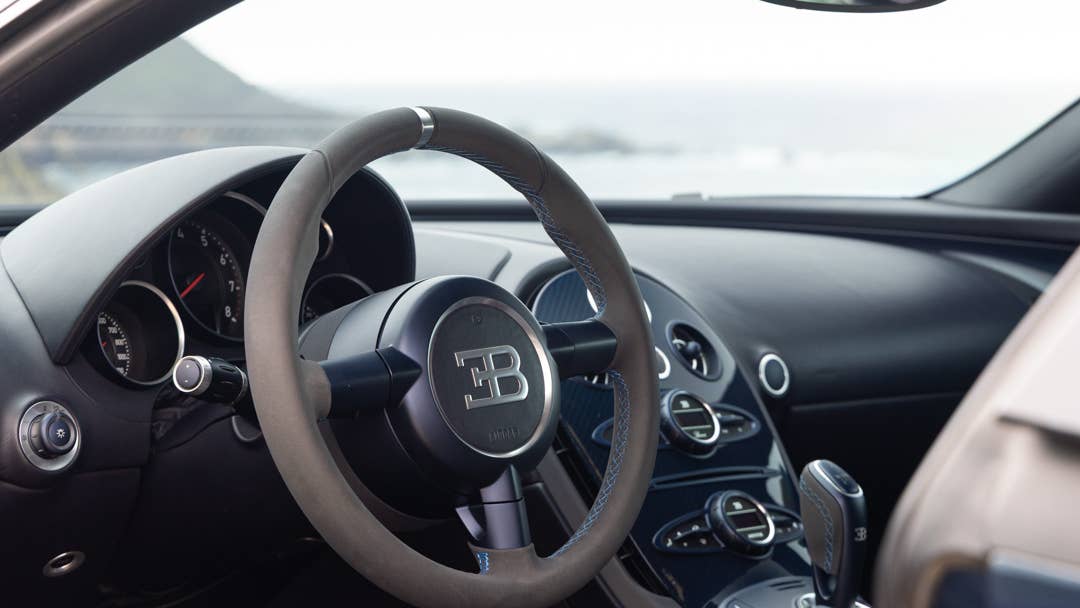
Typically, I can hop into the world’s greatest cars without much of a second thought (such is the insane life of an automotive journalist) but on this day, I took a momentary deep breath as I pretended to scope out the interior. The deep and bolstered buckets looked cushy and welcoming. Even in the dim light, I never felt claustrophobic once I snugged into the cockpit, despite minimal visibility through a slightly iridescent rear window above the enormous engine cover. Though the exterior carbon carried over to the center console, much of the design and switchgear admittedly resembled familiar 2000s Volkswagen Group parts, right down to the key that I swear matched perfectly with my dad’s old MkIV Golf TDI.
Especially compared to a Chiron Super Sport that I drove in France, which blew my mind with a combination of technological prowess and supreme tactility, the Veyron showed some age at the key touchpoints. But would the driving dynamics match the promise hinted decades earlier, or wind up more of its era and best left back then, bloated and bulky, big and boatlike?
The Veyron’s 1,200 HP Still Feels Insane
Despite the allure of the summer’s biggest automotive event, Monterey admittedly lacks the roads, weather conditions, or desperate emptiness to actually push any Bugatti—really, any car at all—anywhere near the limit. I cranked over the W16, pulled the shift lever into D, and gingerly snuck out onto a tight neighborhood avenue. Wider than wide, I needed to focus on avoiding rearview mirrors to my right for a few minutes. But even puttering around before the roads opened up, the heady soundtrack overwhelmed any potential for rational comprehension.
Michael Teo Van Runkle
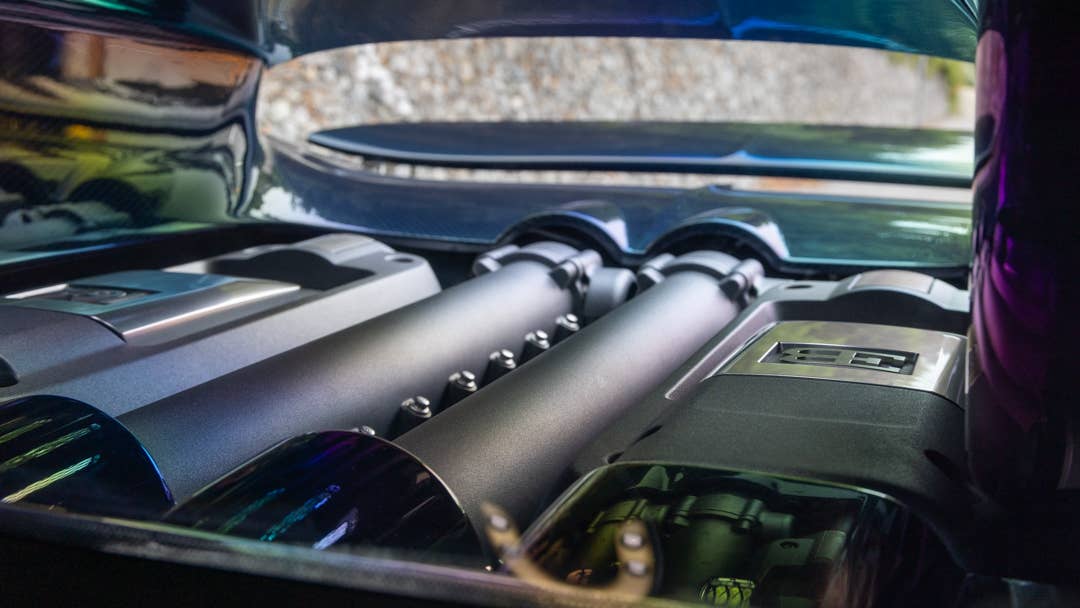
Just a hint of deep rumble from the exhaust served as a bassline beneath more tremulous intake rush, turbos spooling and whooshing and venting pressure as I moved my right foot deeper into throttle. Then I realized I needed to shift manually via the paddle shifters, and popped up into second. The early seven-speed dual-clutch gearbox shuddered a bit at lower speeds, but once up around 2,000 rpm or so, the big powertrain simply chugged along happily. I wound up wheeling through the hilly neighborhood lightly, a bit of chatter on rougher portions of road transmitted through the steering wheel, more communicative than some of the electrically assisted hybrid supercars of today and yet never so weighted as to ruin the impression of an easy life of leisure.
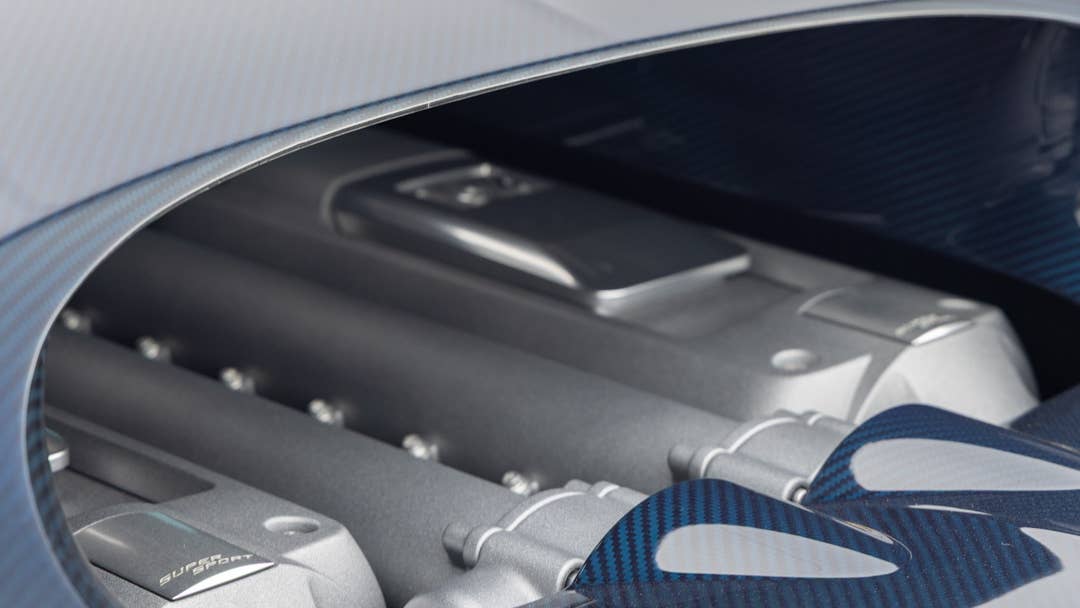
Of course, Bugatti intended the Veyron for top-speed runs equally as much as daily driving, and I only got a few chances to dip in much further than half throttle—plus only one four second or so rip at full cry. Rest assured, the quad turbos and 16 cylinders still punch with the best, not quite at the level of electric car whiplash but more pleasing in every way. The tires hook up immediately with infinite grip at all four corners, massive gulps of air flooding the turbos, boost building and building and building, as that old rollercoaster sensation hit my stomach right around the time the prospect of law enforcement intervention began to interrupt my boyish speed demon reverie.
Michael Teo Van Runkle
I hammered the brakes to bring us back down into double digit speeds, carbon-ceramics (naturally) but despite the age, never squealing. Really, the tires never felt anywhere near breaking loose at these levels of acceleration, either. More cornering next time, please, universe. Tires are a funny part of the Veyron story, too, since I remember rumors of $25,000 tire changes due to the insane demands of essentially road-legal prototype performance, or the fact that Bugatti needed to develop lighter valve stems due to sheer rotational mass at incomprehensibly higher revolutions.
It’s almost entirely incomprehensible that a decade and a half later, this car’s 267-mph top speed still only comes in 25 mph below the highest two-way run ever by an SSC Tuatara. Bugatti managed a 308-mph attempt later, as well, in 2019—but only in one direction. Those numbers comes down more to aerodynamics and tire technology, in fairness, but the Veyron’s surprisingly smooth shape in person reminded me of a polished ocean rock, perhaps picked up on the Carmel shore. The shoreline along which I needed to try to find a place to stop and shoot pics…
Driving a Veyron Means Everyone Is Watching
And here began perhaps the worst part of the experience overall: inevitable, inescapable attention. At all times, everywhere, and bordering on harassment. One car chased us for quite literally the entire drive, start to finish. Never before, in any car, have I witnessed the sheer level of gawking a Veyron brings out in pedestrians, other drivers, random cyclists… Parking for two minutes to steal a few snaps, the world compressed as crowds seemed to materialize out of the chaparral. The only comparable moment I remember happened years back at a MotoGP race in Italy when I accidentally stepped out of a doorway directly next to Valentino Rossi and nearly lost my breath as a black hole of humanity crushed us into the wall.
Michael Teo Van Runkle
Another quick rip, another pit stop cut short by crowds. Back into the cockpit, whipping through traffic hoping to lose the stragglers, back out onto the peninsula where even a few moments of winding roads let me lean over on the tires momentarily, hammering the brakes once or twice, and in the back of my mind, realizing how quickly I’d adjusted to Veyron life. Somewhere along the line I’d begun steering with one hand on the wheel, not a care in the world despite the priceless nature of the car and the brevity of this specious moment in my life.
Somehow, even among Monterey’s stunning assemblages of Koenigseggs, Ferraris, Lamborghinis, McLarens, restomodded Porsches, pre-war award winners, and even other Bugattis, the Veyron still sits on a different level. Blame the years gone by, the effects trickling down through collective imaginations, the growth into mythical status, maybe. Two days later, I spoke with Bugatti’s Director of Design Frank Heyl, who took on that role in 2023 and recently bought none other than a Veyron himself.
Why the Bugatti Veyron Has Aged So Well
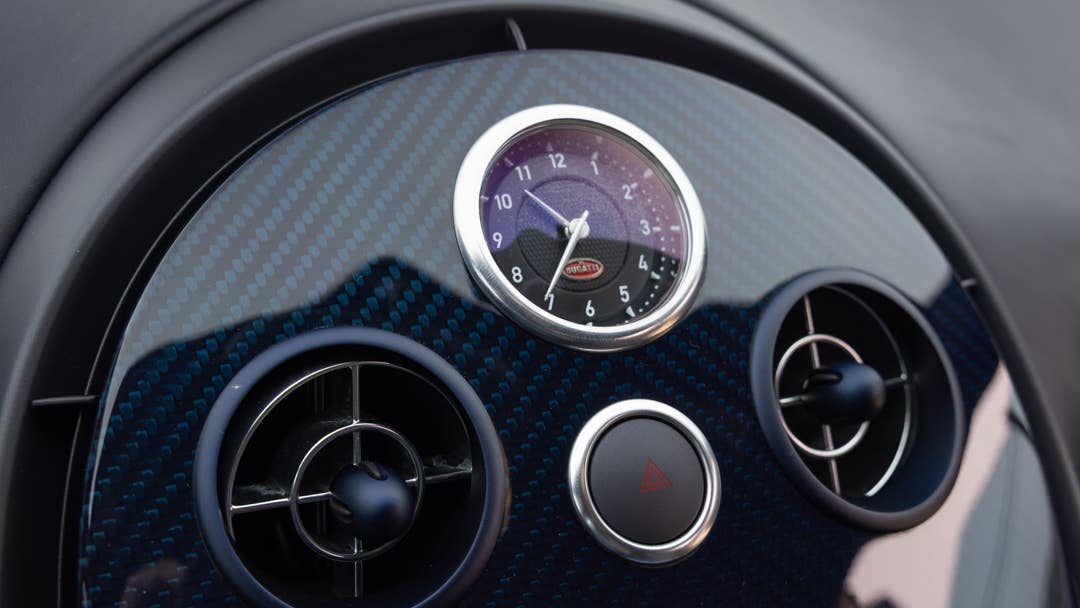
As I recounted my driving experience with Heyl, he chuckled and nodded. But when I pointed out the dated, almost plasticky nature of the interior as something that contrasted with the later Chiron, Bolide, Tourbillon models, he put up a hand to correct me. I might not personally like the design, but turns out every piece of that dash is either carbon fiber, metal, or wrapped in leather.
“The Veyron really is about materials,” Heyl explained, and he should know, having been with the company during those early years as well. “It’s about things being the true material, things being machined from soul. That’s what we love about the Veyron and that’s what stood the test of time of being a 20-year-old car. For example, my car, that car is 20-years-old. If you look at it, it doesn’t look 20 years old. It’s a timeless design.”
Michael Teo Van Runkle
Heyl’s car will now head to a new program offered by Bugatti to maintain and modify original Veyrons all these years later. Dubbed “La Maison Pur Sang” or “The House of Pure Blood” in English, this process launched in 2020 to mechanically refurbish, cosmetically restore, or entirely reconfigure Veyrons to the almost unlimited scope of owner imagination. Fresh paint, new carbon weaves, brushed or machine-turned metals, even different wheel sizes to match the Chiron’s tire specs all fall under La Maison Pur Sang’s purview.
Heyl’s own car will receive machine-turned surfaces inside and out, and to my eye, the center console especially benefits from such craftsmanship—a process Bugatti originally invented in the 1900s, he informed me. I joked with Heyl how few car designers can ever hope to afford a Bugatti. And to his credit, he can rationalize with the best of us gearheads, too.
“I never bought a house, you know, so I never invested in real estate,” Heyl explained. “If you think about it, it is actually much more of a smart investment than any kind of real estate, because you can take it with you, you can move to another country. A house is also, okay, you live in it, maybe, and you try to pay off it, but ultimately it’s also a financial obligation.”
Why Bugatti Veyron Values Keep Climbing
As the old adage goes, you can live in a Bugatti but you can’t drive a house. Jokes aside, roughly 30 Veyrons change hands publicly every year out of that 450 unit production run. And Bugatti brings six or seven per year into La Maison Pur Sang, often to match other cars in a new owners collection. The process costs $600-700,000 and can even include warranty extensions on 20-year-old cars. Take that, Hyundai and Kia!
Michael Teo Van Runkle
Bringing a Veyron back to Bugatti does help bolster values, but the main driver for the big bump in the past few years comes down to demographics, as Hagerty Director of Valuation Analytics John Wiley told me after my drive.
“For people that are looking for a Bugatti Veyron, 40 percent of those folks are under the age of 50,” Wiley revealed. “There is this general recognition that this car is becoming more collectable and further, it’s the early cars. Like 80 percent of the demand that we see is for the early cars.”
I wondered aloud whether millennial tech bros, current Chiron owners not wanting to sell, the Tourbillon’s hybrid powertrain, or simply pure nostalgia might drive the shift toward those earlier cars. Maybe just collectibles in general, physical assets to flaunt in an era of unbridled wealth and the widening divide between haves and have-nots?
“It seems interesting to me that there’s sort of this change,” Wiley admitted. “The thing that is still a question mark is, when does it sort of pop?”
Would I Actually Buy a Bugatti Veyron?
Michael Teo Van Runkle
Somehow, whether gas hits ten bucks a gallon or drops back down to two, I struggle to envision Veyron owners—and aspiring owners—caring all that much. Even a quick drive in my Veyron, all these years later, revealed just how much the car itself lives up to iconic hero status. Which perhaps explains further why Hagerty’s data shows that the average Veyron owner drives 2,200 miles per year. That’s sky high for a collectible, or really any supercar, and especially considering how many likely sit in collections not driving at all, pushing the median higher for those that do see regular exercise. All as the prospect of ever losing money dwindles into nothingness, barring the potential crash that I desperately shoved out of mind for my whole time behind the wheel.
Now 20-plus years since Bugatti changed the automotive landscape for good, will buying a Veyron ever make sense? Absolutely not. If I had the money, would I? Despite a momentary lapse of judgment (or two) in the face of such temptation, still no. But I can better understand those lucky few who do take the plunge, either as an investment or not. Unfortunately, for those of us not lucky enough to call once-in-a-lifetime moments just another day’s work, playing out every last childhood dream truly comes at a cost. And in the case of the Veyron, now somehow both a higher and lower cost than ever before.
