With the US moving to ban Chinese cars, London has become China’s main Western test bed just as the UK weighs EV tariffs. By Stewart Burnett
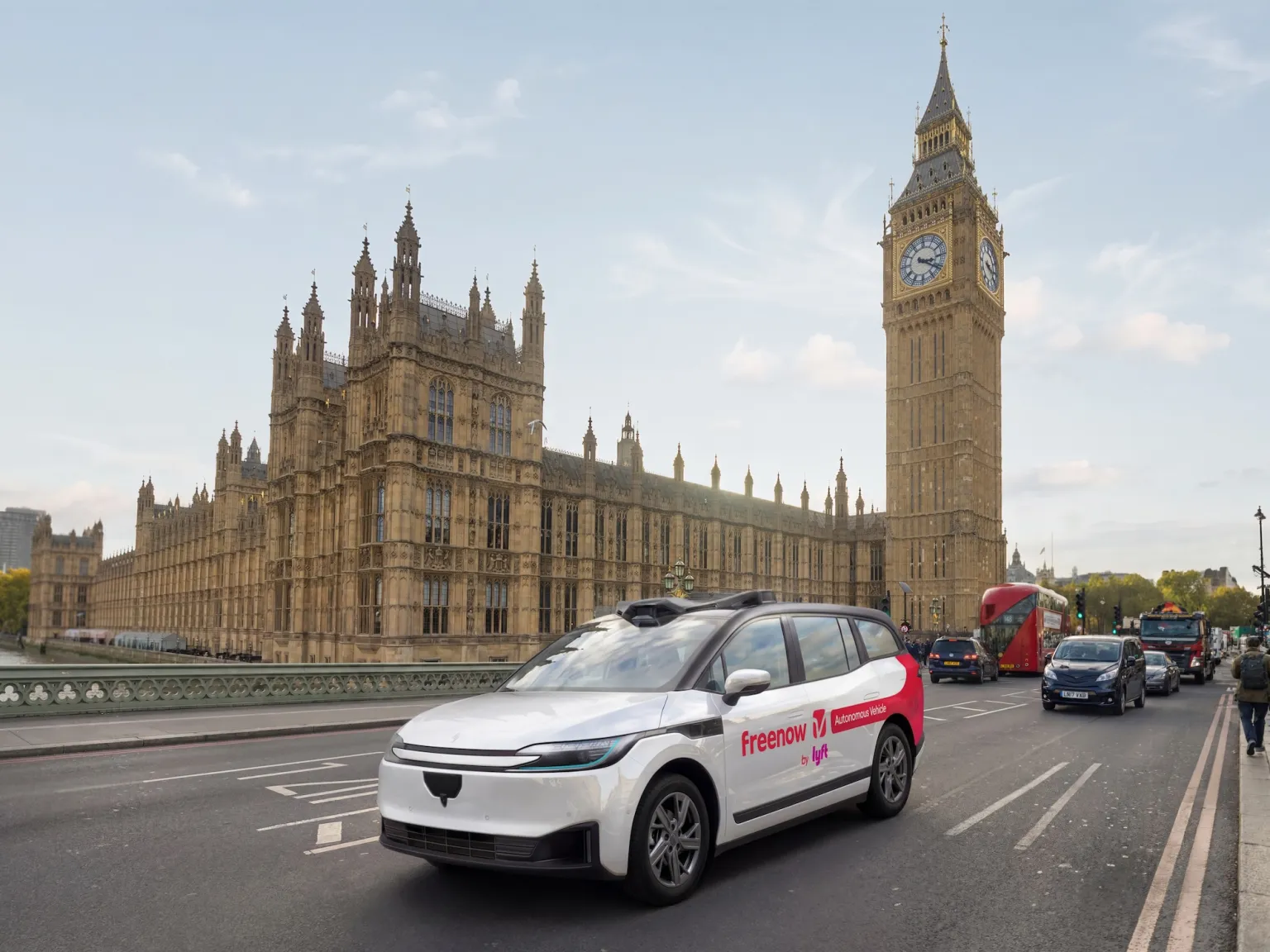
Lyft-owned Freenow and Baidu’s Apollo Go have unveiled the RT6 robotaxi in London, aiming to run fully driverless tests next year ahead of a commercial launch in 2027. With the US Senate moving towards a permanent ban on Chinese cars, London has perhaps become the main Western proving ground for Chinese autonomous driving, just as the UK weighs tariffs on China-built EVs.
The partners have been testing with safety drivers in the borough of Brent since July. According to Danny O’Gorman, Freenow’s UK General Manager, the company expects “tens of vehicles in the next year or two”. He noted that London’s speed bumps, narrow streets and widespread 20 mph limits made it a demanding training ground, describing the car as “learning the rules of the road much like you would do if you’re trying to pass your own driving test”. He also said that the company is working closely with Transport for London (TfL), and expected regulatory guidelines within the coming week.
The RT6 robotaxi is, unlike Waymo’s Jaguar I-Pace fleet, purpose-built for ride-hailing, with a detachable steering wheel and a unit cost of around US$37,000. These economics give Baidu a cost base that few of its Western rivals can hope to match. Freenow, which was acquired by Lyft in 2025 for about US$197m, plans to run the robotaxis alongside human taxi and private-hire drivers rather than replace them. “In terms of the taxi in London, the iconic black cab, this is not a replacement for that service,” O’Gorman said.
Baidu has entered what may be the world’s most crowded field for robotaxi leadership. Wayve and Uber were the first to go live, launching London’s first robotaxi service in September with 15 vehicles and safety drivers, while Waymo aims to launch a fully driverless service through its own app by the end of the year. Fellow Chinese player Pony.ai is also testing robotaxis in the city in partnership with Uber. Baidu, like a majority of robotaxi players, is also tied up with Uber and is partnering with it for other markets.
The contenders are also testing competing technical philosophies. Wayve relies on cameras, radar and a single AI model trained to handle unfamiliar roads without HD maps. Waymo and Baidu take the more cautious approach, using LiDAR and detailed mapping—a split that draws parallels with the debate over Tesla’s camera-only approach. All four players face opposition from the App Drivers and Couriers Union and the Licensed Taxi Drivers’ Association, which are challenging driverless permits over jobs and congestion.
Regulation, rather than technology, is likely to decide the order of the companies’ arrival. TfL has confirmed that no operator has yet registered vehicles with the Vehicle Certification Agency—the first formal step towards unsupervised service—and a Driver and Vehicle Standards Agency permit for fully driverless operation looks unlikely this year. That makes Waymo’s year-end target ambitious and Baidu’s 2027 timeline the more realistic of the two.
Baidu’s biggest risk in London may indeed prove to be political, rather than anything technical. The RT6 is a China-built electric vehicle, and the UK appears to be weighing following the EU into tariffs on such vehicles. This would, therefore, apply to the RT6 unless robotaxis are carved out, eroding the cost advantage that makes Baidu competitive. London will therefore test more than whether Chinese autonomy can handle old, irregular streets: it will show whether the UK treats Chinese robotaxis as imports to restrict, or as a service to license.